My Fiancé Gave My Wedding Ring To His Mistress — He Never Knew I Owned Everything
My Fiancé Gave My Wedding Ring To His Mistress — He Never Knew I Owned Everything
On my wedding day, my fiancé slipped the ring I had chosen onto the finger of his childhood friend and told me, in front of everyone I loved, that if I could not “fall in line,” he would make her his wife instead. I did not scream. I did not cry. I only said, “All right,” and walked away. Harrison thought he had humiliated me into submission. What he did not know was that for three months I had been collecting bank transfers, contracts, deleted messages, hotel receipts, and evidence that his betrayal went far beyond another woman. By the next afternoon, his entire family would learn what my silence had really meant.
Part 1: My fiancé gives my wedding ring to another woman.
The moment the reception hall doors closed, the applause faded beneath the crystal chandeliers.
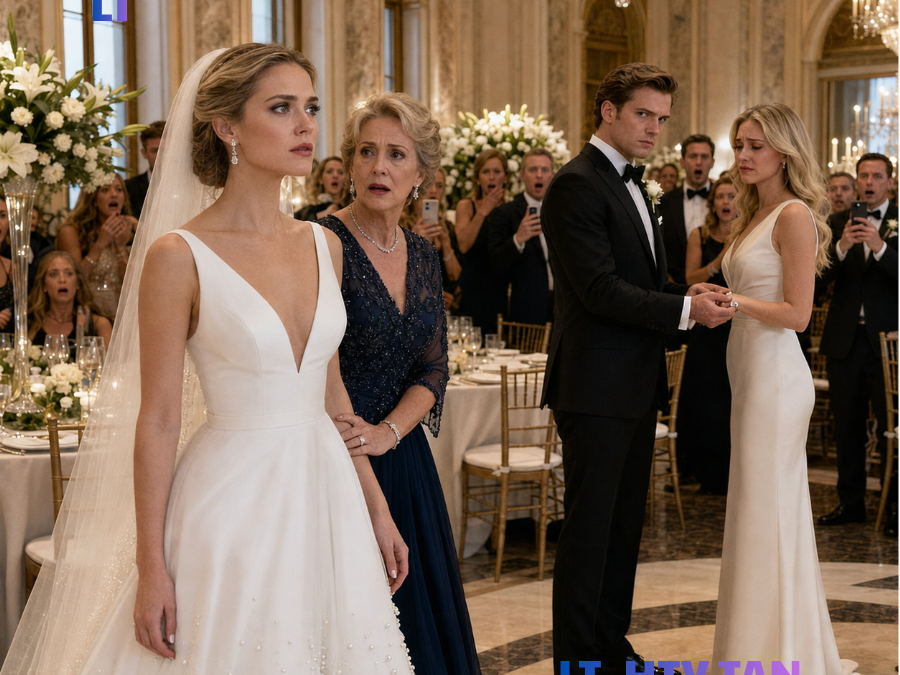
We were inside a historic luxury hotel on Fifth Avenue in Manhattan. One hundred twenty tables filled the ballroom, covered in white lilies and champagne-gold roses.
And in the center of everything stood me.
Eleanor Mercer. Twenty-nine years old. White dress. White veil. A woman who had spent seven years believing she was building a future with Harrison Sterling.
The officiant smiled.
“May we have the rings?”
Harrison accepted the velvet box.
Inside was the ring I had spent three months choosing. I had visited the same jeweler in the Diamond District again and again, adjusting the band, the setting, even the height of the stone.
Inside were our initials.
Tiny. Private. Ours.
Then my phone buzzed inside my clutch.
I almost ignored it.
Almost.
The screen lit up with a photograph taken at 1:17 that morning behind the hotel.
Harrison had his arm around Chloe Ashford’s waist.
His childhood friend.
The woman who had spent years telling me, “You’re so lucky. Harrison has never looked at anyone the way he looks at you.”
I lifted my eyes.
Harrison was still holding the ring box, but he was not walking toward me.
He was looking past me.
Toward Chloe.
She stood among the guests wearing a pale white dress. Her eyes were wet. Her lips trembled.
Then she extended her left hand.
Too naturally.
My stomach went cold.
Harrison stepped toward her.
“Chloe,” he said into the microphone.
The ballroom became perfectly still.
“This ring belonged to you from the beginning.”
My mother grabbed my wrist.
Harrison took Chloe’s hand and slowly slid my wedding ring onto her finger.
It fit perfectly.
That detail hurt more than anything.
He had measured her finger.
This was not spontaneous.
“Eleanor.”
He finally looked at me.
There was no shame in his face. Only annoyance.
“If you refuse to be submissive,” he said, “I’ll make Chloe my wife. She doesn’t question everything I do. She trusts me. She doesn’t turn our life into a ledger.”
A murmur rolled through the ballroom.
Chloe whispered, “Harrison…”
But she did not remove the ring.
The diamond sparkled beneath the chandeliers, my initials hidden against her skin.
I looked at my mother.
Her hand was trembling.
She had helped me alter my dress. For two nights we sat together sewing 128 tiny pearls into the hem because I could not afford to send it back for another fitting.
Every pearl carried a hope.
Every stitch carried a prayer.
Harrison gave a short laugh.
“Well?”
I took one step forward.
“You’re really okay with this?” he asked.
I smiled.
Not because I was numb.
Because something heavy inside me had finally broken loose.
“All right.”
His smile disappeared.
I turned around.
People lifted phones. Someone gasped. Someone whispered my name.
I walked through the ballroom without looking back.
Inside the bridal suite, I locked the door.
The woman in the mirror still looked beautiful.
My eyeliner had not moved.
My lipstick was perfect.
I removed my veil and folded it carefully on the vanity.
Beside it sat the red ring box containing the ring I had intended to give Harrison.
Underneath it was a handwritten card.
Let us keep looking in the same direction, side by side.
I had rewritten that sentence five times.
I stared at it for three seconds.
Then I picked up my phone.
Beatrice Lawson answered on the second ring.
She was my corporate attorney.
“Miss Lawson,” I said. “Don’t cancel anything.”
Silence.
Then she understood.
“You’re certain?”
“Yes.”
I opened my handbag and touched the thick envelope sealed with red wax.
Three months earlier, I had prayed I would never need it.
“Begin Plan B.”
Beatrice exhaled softly.
“Then we begin.”
I ended the call.
Someone knocked.
“Eleanor?”
My mother.
I opened the door.
She stood there in her navy evening gown, wearing the old pearl brooch I had bought with my first paycheck.
She looked at my face.
Then at the envelope in my hand.
“Let’s go,” she said.
I nodded.
That day, I did not run away from my wedding.
I walked away from the last lie I would ever protect.
And Harrison had no idea that before the next twenty-four hours were over, I was going to show his entire family exactly what he had been stealing from me.
Part 2: Three months of evidence reveal betrayal beyond the wedding.
A black Lexus waited beneath the hotel.
Beatrice sat in front. My mother sat beside me in the back, both hands clenched in her lap.
“You knew?” she whispered.
“I suspected.”
“How long?”
“Three months.”
We drove to Brooklyn.
Not to my apartment.
To the seventh floor of the crumbling building where I had started my technology company three years earlier.
The elevator was broken. The windows leaked. Harrison had visited once and laughed.
“You’re building a company in this dump?”
That “dump” now held everything I needed.
When Beatrice opened the office door, she stopped.
The whiteboard covered an entire wall.
Photographs.
Bank transfers.
Hotel receipts.
Corporate registrations.
GPS records.
Deleted-message recovery reports.
And in the center, a copy of the prenuptial supplement Harrison had pressured me to sign.
Beatrice read it again.
“Joint management rights to proprietary technology, client data, risk models and algorithms created within two years of marriage.”
“He called it marriage planning,” I said.
“And the document metadata?”
“Created by Chloe Ashford.”
Beatrice looked at me.
That was the real betrayal.
Chloe had created Ashford Consulting less than a year earlier. Her proposals contained sections copied almost word for word from my company’s materials. Her client list overlapped with mine.
Even some formulas were identical.
Harrison had not merely cheated.
He had helped another woman build a company using mine.
Three months earlier, I had noticed his car beneath Chloe’s Tribeca office after he claimed he was working late.
Then came the hotel charges.
Aspen.
The Hamptons.
Late-night taxis.
Transfers from Harrison’s account into Chloe’s business through one of her relatives.
And deleted messages.
One recording mattered more than all the others.
Chloe’s voice.
“Harrison, what if she notices the client lists overlap?”
Then his.
“She’s too busy with the wedding. Once we’re married, I’ll control the management rights. Eleanor hates making scenes. She’ll fall in line.”
Beatrice slowly lowered the headphones.
“He planned this.”
“Yes.”
My mother stood near the doorway.
For years she had believed the Sterling family had rescued us. They had loaned my company $15,000 when it was struggling. They had helped arrange a doctor during her hospitalization. They had advanced part of the wedding costs.
So she tolerated their insults.
So did I.
Until three months earlier.
That was when I quietly repaid everything.
Loan principal.
Interest.
Medical expenses.
Wedding advances.
Every dollar.
I removed one certified document from the envelope.
Debt paid in full.
Tomorrow, Harrison’s family expected a frightened bride to apologize.
Instead, they were about to meet a creditor who owed them nothing.
I shut the laptop.
“Tomorrow,” I told Beatrice, “we show them the ledger.”
She smiled.
For the first time that day, so did my mother.
But none of us knew Chloe was about to make one mistake that would turn my private case into a public scandal.
Part 3: One recording turns a family dispute into corporate betrayal.
The Sterling family meeting took place the next afternoon in a private Upper East Side dining club.
Harrison’s father, Richard, sat at the head of the table.
His mother, Caroline, sat beside him.
Harrison was there.
So was Chloe.
She was wearing pale blue.
No ring.
Richard began calmly.
“Eleanor, yesterday was unfortunate. But walking out of a Sterling family reception was deeply disrespectful.”
I almost laughed.
Caroline lifted her teacup.
“Chloe is like Harrison’s sister. Excessive jealousy hurts everyone.”
I looked directly at Harrison.
“Was there nothing between you and Chloe?”
His jaw tightened.
“I’m tired of being investigated. Chloe trusts me. You question everything.”
“Answer me.”
He leaned back.
“Yes, what I did with the ring was excessive. But you pushed me.”
That sentence removed the last trace of guilt I still carried.
I placed the debt-clearance document on the table.
Richard read it.
His expression changed.
“The Sterling loan was repaid last month,” I said. “Principal and contractual interest. Every other financial obligation between our families has also been settled.”
Caroline stared at me.
“Without us, your company would never have survived.”
“I’m grateful. But you charged twelve percent interest. That makes it a loan, not charity.”
My mother’s shoulders slowly straightened.
Then I placed the prenuptial supplement beside it.
“This is why I started investigating.”
Richard looked at Harrison.
“What is this?”
“A standard marital agreement.”
“No,” Beatrice said.
Her voice was quiet.
“This document attempts to transfer management rights over Eleanor’s proprietary business assets after marriage.”
I slid another page forward.
“And the original author was Chloe.”
Chloe went white.
“I only helped format it.”
“Formatting does not require listing my company’s algorithms.”
Then came the corporate registry.
Ashford Consulting.
Then bank transfers.
Then overlapping clients.
Finally, I pressed play.
Chloe’s frightened voice filled the room.
“Are you sure we won’t get caught?”
Harrison answered.
“She’ll be my wife. She’ll have no choice.”
Silence.
Richard looked at his son as though seeing him for the first time.
Chloe grabbed Harrison’s sleeve.
“You told me it would be fine. You said the files would become yours after the wedding.”
Harrison pulled away.
That tiny movement told her everything.
Love suddenly became much less romantic when damages were attached to it.
Richard turned toward me.
“State your terms.”
“Public acknowledgment. Immediate liquidation of Ashford Consulting. Permanent cessation of all use of my data. Compensation for damages and lost profit. And Harrison waives any future claim against my company.”
“How much?” Caroline asked.
“Three hundred fifty thousand dollars.”
She nearly shouted.
I stood.
“If you prefer court, Beatrice will handle it.”
As I reached the door, Harrison called after me.
“You’re really taking this this far?”
I looked back.
“I didn’t destroy anything, Harrison. I only dragged what you did into the light.”
Then I left.
At five that evening, legal notices reached Harrison and Chloe.
Two hours later, someone uploaded the wedding video.
By midnight, millions of strangers had watched Harrison put my ring on another woman’s finger.
And by morning, they had started asking the question Harrison feared most:
What else had he done?
Part 4: The stolen ring becomes evidence, and Harrison loses control.
The video spread faster every time the Sterlings tried to remove it.
Then came the photograph of Chloe trying on a ring of the exact same size days before the wedding.
Then public records showing when she formed her company.
Then the trade-secret lawsuit.
Chloe texted me.
Eleanor, please. Harrison told me those files were fine to use. I trusted him.
I forwarded the message to Beatrice.
Her reply came seconds later.
Excellent admission.
Two months later, we entered court.
By then, Harrison and Chloe were blaming each other.
His attorneys argued she had misused information independently.
Her attorney claimed Harrison had supplied everything.
We presented cloud records, transfer histories, document timestamps, corporate registrations and deleted messages.
Then Chloe broke.
“I have a recording.”
Harrison stood halfway from his chair.
“Chloe, don’t.”
She played it anyway.
His voice filled the courtroom.
“Once I marry Eleanor, I’ll manage her assets. Use her model now. We’ll straighten everything out afterward.”
I felt strangely calm.
That was the man whose shirts I had ironed before business trips.
The man whose favorite coffee I ordered every month.
The man I nearly married.
And while I was planning our wedding, he had been planning how to divide my work.
The ruling came weeks later.
Ashford Consulting was found liable for trade-secret infringement and unfair competition.
Harrison was found jointly responsible.
Damages reached $300,000.
The Sterling Group suspended him from executive duties.
Outside the courthouse, a reporter asked me, “Are you still angry about the wedding?”
I thought about it.
“No.”
“Why not?”
“Because if he had behaved better that day, I might have wasted more time.”
Six months later, Harrison found me after my company’s Series B announcement.
He looked thinner.
Older.
He held a red ring box.
Inside was my old wedding ring.
“I got it back.”
I stared at it.
“This belonged to you.”
“Throw it away.”
His face fell.
“I can buy another. Any design.”
“It was never about the ring.”
He swallowed.
“I’m sorry.”
“I accept your apology.”
Hope flashed across his face.
“But I do not forgive you.”
The hope disappeared.
“Can we never go back?”
“No.”
I got into my car.
For the first time in seven years, leaving him required no courage at all.
But my life still had one final surprise waiting for me.
It would arrive not as another act of revenge, but as proof that losing Harrison had never been the ending of my story.
Part 5: I choose myself first, then learn how love should feel.
One year later, my company went public.
On the balcony of the New York Stock Exchange, I rang the opening bell while my mother and Beatrice watched from the gallery.
My mother wore a new pearl brooch.
She no longer sat in back rows.
She no longer lowered her eyes when wealthy people entered a room.
Neither did I.
I kept the lease on that old Brooklyn office.
Sometimes I returned alone and stood before the whiteboard where all the evidence had once been pinned.
Now there was only my first contract, my original business proposal, my mother’s good-luck charm and one sentence printed from a note I had written during those terrible months:
If he doesn’t return, I will walk on my own.
Years later, I met Julian Thorne.
He was an investor famous for being difficult.
The first time he reviewed my proposal, he found forty-seven problems.
I argued thirty-one.
Fixed sixteen.
At our next meeting he said, “You’re tough, Miss Mercer.”
“I thought you hated compliments.”
“I compliment facts.”
That was how it began.
Slowly.
No rescue.
No promises that required me to become smaller.
When I faced a complicated acquisition, Julian did not say, “Let me handle it.”
He dropped the documents on my desk.
“How do you want to play this, Eleanor?”
That question nearly broke my heart.
Not because it was romantic.
Because it contained respect.
Years earlier, Harrison had said, “You don’t understand. Just be submissive.”
Julian asked what I wanted to do.
He eventually proposed in his car after my mother’s birthday dinner.
No crowd.
No hotel ballroom.
Just a navy ring box.
Inside was a simple platinum band.
I turned it over.
Engraved inside were four words.
Eleanor belongs to Eleanor.
My eyes filled.
“This isn’t meant to bind you,” Julian said. “Marriage doesn’t mean surrendering your edge. I want to stand beside you. Not ahead of you. Not behind you.”
I held out my hand.
“One condition.”
He raised an eyebrow.
“I absolutely hate wedding drama.”
“I can work with that.”
“This ring stays on my finger.”
“Top priority.”
I laughed.
Then he slipped it on.
Our wedding was small.
A garden restaurant in the Hudson Valley.
My mother.
Beatrice.
Close friends.
No 120 tables.
No chandeliers.
No dress with 128 pearls.
I had kept that dress packed safely away.
I never hated it.
It had served its purpose.
It was not the dress from the day I was defeated.
It was the armor I wore when I walked out.
At the ceremony, my mother adjusted my veil.
“You look happy,” she whispered.
“I am.”
“Scared?”
“A little.”
She smiled.
“Then keep walking.”
Julian waited beneath the flowers.
When I reached him, he took my hand without gripping it.
Without claiming it.
Without owning it.
And I finally understood something I wish I had learned years earlier.
Love is not being chosen.
Love is being free enough to choose.
After the ceremony, one of my younger employees asked how I had found the courage to trust again.
I told her the truth.
“I stopped asking whether someone would choose me.”
She waited.
“I started choosing myself first.”
Years later, during a university lecture, a student asked how a person could walk away from betrayal with dignity.
I looked across the auditorium.
“Do not confuse dignity with silence,” I said. “You can cry. You can be angry. You can seek justice. Dignity means refusing to pay the price for someone else’s dishonesty.”
The room became quiet.
“If someone says you don’t understand, ask whether you truly don’t understand—or whether they simply don’t want you to know.”
Julian stood at the back.
My mother sat in front.
I touched the ring on my finger.
Once, Harrison Sterling put my wedding ring on another woman and told me that if I would not submit, he would replace me.
I answered, “All right.”
For years, people assumed those two words meant surrender.
They did not.
They meant I would not marry him.
They meant I would protect my company.
They meant I would stop shrinking to preserve someone else’s lies.
They meant I was finally opening the door.
Harrison and Chloe eventually disappeared from my daily life. I heard rumors about failed careers, debts and damaged reputations.
I did not celebrate them.
Their consequences did not create my happiness.
They lived with the results of their choices.
I lived with mine.
And that was enough.
Sometimes I still visit the Brooklyn office and touch the torn edge of that old red-sealed envelope.
I remember the woman whose fingers shook as she opened it.
She was terrified.
But she opened it anyway.
So if I could speak to her now, I would say only this:
Well done.
You were never walking away empty-handed.
You were carrying yourself with you.
And in the end, that was the one thing no one could steal.
THE END.
All the characters and events in this story are fictional and created for the purpose of storytelling and entertainment.
If this story brought you a moment of reflection, comfort, or curiosity, then it has truly fulfilled its purpose.
Thank you sincerely for reading. Your feedback and support are always appreciated and inspire me to keep sharing more stories with you.








