My Neighbor Buried a Sewer Pipe Beside My Private Well—Then Tried to Secretly Dig Up the Evidence
My Neighbor Buried a Sewer Pipe Beside My Private Well—Then Tried to Secretly Dig Up the Evidence
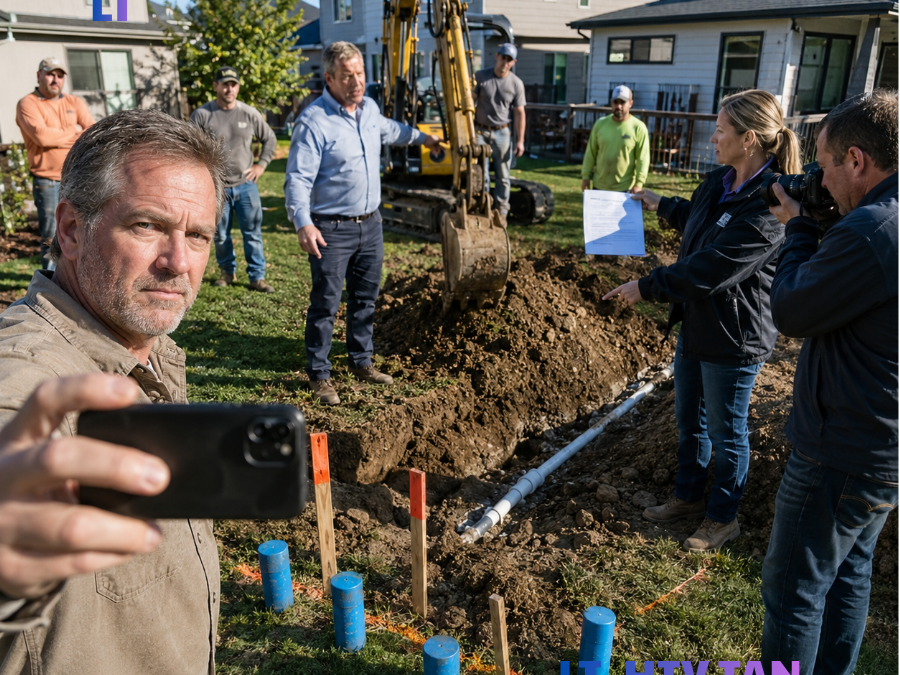
My neighbor said his sewer pipe crossed only “a few harmless feet” of my property. Then the county dug beside my private well and found white PVC buried beneath the markers I had warned him not to touch. He insisted the water was clean, the pipe was dry, and one protective sleeve would solve everything. But a survey, a locating transmitter, and one leaking coupling revealed something much worse: the shortcut ran deep through my well protection area. And just when inspectors gave him a legal way to fix it, he secretly brought in another excavator and tried to erase the evidence before anyone could stop him.
Part 1: My neighbor’s sewer shortcut crosses my well without permission.
The excavator bucket dropped less than ten feet from the nearest blue marker around my well.
“Start there,” Dana Ruiz, the county wastewater inspector, said. “Slow.”
I stood near my porch with my arms folded, watching fresh dirt peel away from the trench my neighbor Greg had ordered buried only hours earlier.
The second pass exposed white PVC.
Nobody spoke.
One of my blue well markers leaned toward the trench. The pipe ran underneath it at an angle, exactly where Greg had insisted there was nothing but empty ground.
Greg folded his arms.
“That’s the only part that crosses over,” he said. “It’s dry. It hasn’t been used.”
Dana crouched at the edge and photographed the pipe.
“Permit number?”
Greg glanced toward his unfinished guest house.
“We can move one joint and be done.”
“Nothing gets moved.”
Then Dana looked at me.
“Do you have something showing the property line?”
“I have a survey inside. There are capped pins along this side.”
Greg gave a small laugh.
“See? Nobody even knows whose side this is.”
I stared at him.
“I know what I told you. You didn’t have permission.”
“The crew followed the practical route.”
The practical route.
That was what he called shutting down the only water supply to my house because a longer sewer route would interfere with his construction schedule.
Dana handed Greg a written notice.
No connection. No cutting. No moving the pipe. No backfill until the county completed its review.
Greg looked toward the excavator operator.
“So we leave everything open?”
“You buried work before inspection,” Dana said. “Yes.”
I went inside and retrieved the survey from the flat file beneath my workbench. I brought back printed copies of the messages Greg and I had exchanged four days earlier.
Dana read mine first.
Do not bring the sewer trench across my property. I am not granting access.
Greg’s reply sat directly underneath it.
We’ll keep the work where it belongs.
Dana read both messages twice.
Greg stepped closer.
“That was before the crew saw the grade problem.”
“You didn’t ask again,” I said.
“There wasn’t time to turn this into a committee meeting.”
I almost laughed.
My drinking water had become something he did not have time to discuss.
A pickup entered my driveway. Calvin Brooks, the contractor who had serviced my private well for years, climbed out carrying sampling bottles.
He checked the well cap. The electrical system. The disturbed soil.
Then he shut off the breaker and attached a tag.
“Until we know where that pipe runs and whether it has been used, leave the well off.”
Greg moved closer.
“It hasn’t been used.”
Calvin looked at him.
“I’m not making that call from somebody’s word.”
He collected samples and explained something Greg did not want to hear.
Even clean water would only mean the water was clean when sampled. It would not approve the sewer route. It would not settle the property line. And it would not guarantee a buried pipe could never leak later.
That evening, I carried cases of bottled water through my front door.
No sink.
No shower.
No normal toilet use without pouring water into the tank.
Greg watched from across the yard.
“You’re choosing to shut it down,” he said.
I set a cooler on my porch.
“No. I’m choosing not to gamble with it.”
He shook his head.
“The sample will come back clean. Then this whole thing will look ridiculous.”
I wanted him to be right about my water.
But even if it was clean, the pipe still wasn’t his to keep.
And the next morning, when the surveyor finally drove two new stakes into the ground, Greg’s entire argument collapsed in less than five minutes.
Part 2: The survey proves Greg deliberately built outside his approved route.
Martin Hail had surveyed my property three years earlier. He arrived after lunch with the signed survey, his field notes, and coordinates tied to two capped iron pins.
Greg met him beside an old wire fence.
“You’re here to settle this?”
Martin shook his head.
“I’m here to restake the line shown on my survey.”
The first pin was easy to find. The second had been partly covered by loose soil from Greg’s sewer excavation.
Martin exposed both caps, checked his measurements, then placed three temporary stakes between them.
I watched Greg’s face change.
The real boundary did not follow the old fence.
It ran several feet inside it.
The trench gravel, the exposed pipe, and the open test pit were all on my property.
Martin photographed everything.
“This is the boundary location I can support from the survey and existing monuments.”
Dana then unfolded Greg’s approved wastewater plan.
The permitted sewer route remained completely on Greg’s parcel. It ran behind the guest house and reached a lower connection near his driveway.
The pipe beneath my grass followed a completely different path.
Greg leaned over the plan.
“That drawing was preliminary.”
Dana tapped the approval stamp.
“This is the route the county reviewed.”
“Field conditions changed.”
“Then the revision should have come back for review before you buried it.”
Greg turned toward the crew foreman.
“Tell her why we changed it.”
The foreman hesitated.
“The approved run wouldn’t hold gravity all the way. We would have needed a lift pump.”
“And the route you installed?” Dana asked.
“Shorter. Better fall.”
“Who approved the change?”
The foreman looked at Greg.
Greg answered.
“I told them to use the practical route.”
There was that phrase again.
Practical.
On paper, it meant Greg avoided buying a lift pump, avoided electrical work, avoided extra trenching, and saved himself money.
Standing beside those survey stakes, I could see where he had placed those savings.
Under my land.
Near my water.
Greg changed tactics.
“The line is underground. Paul can still mow over it. He can walk across it. It doesn’t take anything from him.”
I pointed toward the bottled water on my porch.
“It already did.”
Dana asked whether the entire buried run followed the shortcut.
The foreman shifted.
“Mostly.”
“Mostly where?”
“We followed the grade.”
That answer changed everything.
Greg had spent two days insisting only a few feet crossed my property.
Now even his own crew could not tell us where the pipe actually went.
Dana ordered two test holes opened where Greg claimed the line returned to his parcel.
The first hole contained no pipe.
Neither did the second.
Greg stared into the empty dirt.
“The operator must’ve curved it.”
“You were certain five minutes ago,” I said.
He ignored me.
Then he pulled papers from his truck.
His plumber had prepared a proposal: replace one joint, slide a protective sleeve over the crossing, rebury everything.
All I had to do was sign an agreement.
I read it slowly.
The agreement granted Greg—and every future owner of his property—the right to enter my land to inspect, excavate, replace, and maintain the sewer line.
The pipe had been buried on my property for less than two days.
And Greg was already trying to turn his mistake into a permanent legal right.
I handed the agreement back.
“No.”
His jaw tightened.
“You have clean water. You’re not losing anything.”
Dana looked at the empty test holes.
Then she said the sentence Greg had been hoping never to hear.
“We need to locate the entire line.”
Part 3: A transmitter reveals the sewer runs directly beneath my wellfield.
A plumbing technician named Aaron Pike arrived carrying a camera cable and a locating transmitter.
He explained the process simply.
The transmitter would travel inside Greg’s sewer pipe from the guest house cleanout.
A locator on the surface would follow its signal underground.
Martin’s stakes told us where my property began.
The blue markers showed the protected area around my private well.
Aaron’s device would tell us exactly where Greg’s pipe had gone.
Greg stood beside the cleanout.
“We already know where it goes.”
Dana glanced toward the two empty test holes.
“Then this should confirm what you’ve told us.”
Aaron pushed the cable into the cleanout.
A few feet.
Then more.
He stepped onto the lawn with the locator.
Beep.
Beep.
Beep.
The strongest signal appeared near the guest house.
Greg pointed toward his driveway.
“There. It turns that way.”
Aaron advanced the transmitter.
The signal did not move toward the driveway.
It moved toward the survey stakes.
Dana placed a small orange mark on the grass.
Aaron pushed farther.
Another signal.
This one landed on my side of the boundary.
Then another.
Then another.
Greg stepped closer.
“That can’t be right.”
Aaron checked again.
Same place.
He advanced the transmitter.
The locator screamed directly beneath the first row of blue well markers.
Nobody said anything.
Dana painted another orange mark.
Then another.
We walked slowly across my well area.
The orange dots formed a crooked line through my property.
Not a few feet.
Not a corner.
A connected sewer lateral running directly through the ground surrounding the only well supplying my house.
Dana asked how much cable Aaron had fed into the pipe.
He gave her the distance.
Greg’s face hardened.
“That doesn’t mean the whole distance is on his property.”
“No,” Dana said calmly. “The survey tells us when it’s on his property. The locator tells us where the pipe is.”
Aaron pushed farther until the signal finally crossed back toward Greg’s parcel.
Dana had him repeat the entire trace.
Same route.
Same marks.
Same result.
Greg walked to the folding table where I had placed copies of the survey and approved plan.
“The crew must have curved it more than I realized.”
The foreman said nothing.
Dana photographed the orange route, the blue well markers, and Martin’s boundary stakes in the same frame.
Then she pointed at two locations along the buried line.
“I need joints exposed here and here.”
Greg objected.
“You found the route. That was the point.”
“That answered location. Not condition.”
The first excavation exposed a clean-looking section.
Greg immediately pointed.
“Exactly. The pipe is fine.”
The second excavation was different.
The bucket peeled back soil until a coupling appeared.
One side sat slightly lower than the other. Gravel beneath it had shifted. The soil nearby looked darker.
“Groundwater,” Greg said quickly.
Aaron crouched beside the pit.
“Could be trench moisture. You can’t identify it by looking.”
Dana nodded.
“Then we test the joint.”
Aaron used clean water containing visible tracing dye. No sewage. No unusual pressure.
For several seconds, nothing happened.
Greg looked directly at me.
“This is what you shut your well down over.”
Then a thin blue-green line appeared beneath the coupling.
It collected slowly in the gravel.
Aaron stopped the test.
They dried the area.
He repeated it.
The same colored line appeared again.
A leak.
Greg stared at it for half a second.
Then he changed his argument.
“So one coupling needs to be reset.”
Dana stood.
“We found a problem. That does not approve the route.”
Greg looked toward me.
“We replace it. Sleeve the crossing. Finish the job.”
Dana handed him another written hold.
No cutting.
No moving.
No repair.
No backfill.
The unauthorized line remained disconnected until the county approved a correction.
Greg signed.
That evening, he approached me one last time.
“Let me replace the coupling. Sign the access agreement. This ends.”
“You already have two legal ways to correct it.”
“I’m offering a third.”
“It isn’t yours to offer.”
His expression went cold.
“You’re turning a repair into a war.”
I looked at the orange marks, the survey stakes, and the open test pits.
“No. I’m refusing to make your sewer permanent on my land.”
The next morning, I woke to the sound of another excavator.
And Greg was already standing beside the leaking coupling.
Part 4: Greg secretly alters the evidence despite a signed county hold.
It was not the same operator.
A pickup I didn’t recognize sat near Greg’s driveway. A man wearing a gray work shirt stood beside a mini excavator while Greg pointed toward the exposed coupling.
I stayed away from the pit and started recording.
Then I called Dana.
“There’s equipment running at the site. They’re changing the exposed section.”
“Do not enter the work area,” she said. “Do not touch anything.”
The operator lowered the bucket.
I heard him ask Greg whether the county had cleared the repair.
Greg answered loudly enough for me to hear.
“It’s a limited correction. The hold is about connecting the line.”
That was false.
Dana had read the restrictions aloud.
No cutting.
No moving.
No repair.
No backfill.
The operator cut out the coupling that had failed the dye test.
Then Greg told him to pull the pipe several inches toward the boundary before installing the replacement.
It still remained on my property.
The angle simply changed.
“Cover this one when you’re done,” Greg said.
The operator hesitated.
“They don’t need to inspect the new joint?”
“They already saw the problem.”
The bucket began moving toward the pile of soil.
Then Dana’s county vehicle entered my driveway.
Another inspector sat beside her.
The operator shut down immediately.
Dana walked straight toward the pit.
“Who authorized this work?”
The operator climbed down and handed her his work order.
Repair exposed sewer coupling.
Nothing about county approval.
Nothing about moving the pipe.
Nothing about backfill.
“He told me the county approved a limited repair,” the operator said.
Greg stepped forward.
“I said the repair was allowed.”
Dana held up the inspection notice Greg had signed the previous day.
“No cutting. No moving. No repair. No backfill.”
Greg glanced at the new coupling.
“The defective part is fixed.”
Dana looked into the pit.
The tested joint was gone.
The pipe had moved.
Fresh soil had already been pushed toward the hole.
Then she asked me one question.
“Did you record what happened before we arrived?”
“Yes.”
I gave her the video.
Greg had seen the survey.
He had watched Aaron trace the pipe.
He had signed the hold.
And then, before inspectors returned, he brought in another operator and tried to alter the exact joint they had documented.
Dana did not argue with him anymore.
She placed the approved plan beside Martin’s survey on the hood of her vehicle.
Then she handed Greg a new written direction.
“Expose the unauthorized section.”
Greg stared at her.
“You already inspected it.”
“The entire unauthorized run.”
“That could be half the yard.”
Dana pointed toward the first orange mark.
“Start there.”
The excavator bucket went down.
This time, it did not stop after one test hole.
It followed every orange mark.
White PVC appeared again.
And again.
And again.
The trench stretched across my property until Greg’s “few harmless feet” became a long white line running straight through my well protection area.
When the final section was exposed, Dana stood at the edge of the trench for several seconds.
Then she looked at Greg.
“This cannot remain here.”
Part 5: The county orders every unauthorized pipe removed from my property.
Greg rubbed both hands across his face.
“What exactly are you ordering?”
Dana pointed toward the exposed pipe.
“The portion on Mr. Mercer’s property must be removed. Your replacement system must follow an approved route on your parcel. The guest house wastewater approval remains on hold until the new work passes inspection.”
Greg looked stunned.
“You can’t hold my guest house over a property disagreement.”
“The property line has been restaked. Your installed route does not match your approved plan. The buried work was never inspected. One joint failed a controlled test. Then you altered the line after signing a written hold.”
Her voice stayed level.
“I’m not approving this system.”
The operator changed buckets.
The first length of white PVC lifted from the ground with wet gravel clinging beneath it.
Then came the replacement coupling Greg had installed that morning.
Then the curved section he once claimed did not exist.
Piece by piece, the sewer line was removed and placed on plastic sheeting on Greg’s side.
I did not celebrate.
I stood near my blue well markers and watched until every unauthorized section disappeared from my property.
By late afternoon, nothing remained beneath the well area.
But the ground looked destroyed.
Deep bucket marks.
Mixed soil.
An empty trench where Greg’s shortcut had been.
Removing the pipe solved the main problem.
It did not immediately give me my water back.
Calvin returned the next morning.
He checked the well cap, conduit, and soil around the wellhead, then took another set of samples.
“The source we were worried about is gone,” he said. “Now we verify before putting the well back into service.”
Meanwhile, Greg had no shortcut left.
His corrected sewer route required exactly what he had tried to avoid from the beginning.
A longer trench.
A lift pump.
Electrical work.
Another inspection.
And everything had to stay on his property.
The restoration crew removed loose contaminated-looking construction fill, brought in clean material, compacted the trench in layers, restored the drainage grade, replaced topsoil, and reset my blue markers.
I photographed every stage.
I had already watched one buried pipe disappear beneath fresh dirt.
I wasn’t trusting appearances again.
Then Calvin called.
“The follow-up indicators are clear.”
He returned, removed the tag from the electrical system, and flipped the breaker.
The pump started beneath us.
Inside the utility room, I heard the pressure tank filling.
It was such an ordinary sound.
After days of carrying bottled water into my own house, I stood there listening until the pump shut off.
Then came the money.
I had kept every receipt.
Bottled water.
Well inspections.
Laboratory testing.
Martin’s restake.
Restoration checks.
I sent Greg only the direct costs I could document.
No price for anger.
No charge for lost sleep.
No imaginary number for inconvenience.
His first response was short.
The county already made me remove the pipe. That should settle it.
I sent him my original refusal.
His written promise to stay on his property.
Dana’s correction notice.
And every invoice.
Greg had wanted the evidence buried.
Now the paper trail was about to cost him more than the lift pump ever would.
Part 6: The final settlement exposes what Greg truly tried to gain.
Greg’s liability carrier reviewed everything.
They questioned why I needed two rounds of water testing.
Calvin answered in writing.
They questioned Martin’s survey visit.
Martin documented exactly why the boundary had needed to be restaked.
After that, Greg agreed to a limited settlement covering the supported direct costs.
There was no giant courtroom check.
No dramatic lawsuit.
No public apology.
He paid for the temporary water.
The professional inspections.
The testing.
The removal.
The restoration.
Then he paid separately to install the sewer system he should have built in the first place.
A week later, I watched county inspectors examine the new route.
It stayed entirely on Greg’s property.
The trench ran the longer way.
A lift pump sat beside the guest house.
The electrical service was installed.
Not one foot of pipe crossed Martin’s stakes.
Two weeks later, Greg sent me the final wastewater plan.
I studied it carefully.
Nothing crossed my land.
But the most important page was not the plumbing plan.
It was the settlement language.
Greg had no sewer line through my property.
No maintenance access.
No utility right.
No future easement through the area surrounding my private well.
That was the final truth.
His original “temporary shortcut” had never really been temporary once he asked me to sign that access agreement.
If I had accepted his practical solution—one sleeve, one signature, one buried pipe—future owners of his property could have entered mine whenever that sewer needed inspection, replacement, or repair.
He had tried to transform an unauthorized shortcut into a permanent right.
And he had nearly done it beneath a few inches of dirt.
I signed the settlement only after Martin reviewed the property description.
Greg signed without coming to my house.
He never apologized.
I never asked him to.
I replaced the bent blue markers with taller posts.
Not a fence.
Not warning signs.
Just something visible enough that nobody could ever again pretend the well area looked like empty ground.
The guest house eventually opened.
Cars appeared there on some weekends.
Sometimes I could hear the lift pump cycle beside the building.
A low mechanical hum.
Greg’s system.
Greg’s property.
Greg’s responsibility.
The restored ground took longer to recover.
Rain settled part of the trench. The crew returned, added fill, compacted it again, and corrected the grade.
By the end of the season, grass covered the entire scar.
One evening, I came inside from my shop with sawdust on my sleeves.
I turned on the kitchen faucet.
For a moment, I caught myself listening for the pump.
Then water flowed.
Clear.
Steady.
Ordinary.
I filled a glass and carried it to the window.
Across the yard, the ground was level again.
The survey line was undisturbed.
The blue well posts stood straight in the evening light.
There was no excavator.
No open trench.
No white pipe.
No agreement waiting for my signature.
Greg had called his shortcut practical because it saved him money.
But practical choices do not require somebody else to surrender their property, their drinking water, or their right to say no.
I took a drink.
And for the first time since that excavator crossed my yard, I stopped listening for trouble beneath the ground.
THE END.
All the characters and events in this story are fictional and created for the purpose of storytelling and entertainment.
If this story brought you a moment of reflection, comfort, or curiosity, then it has truly fulfilled its purpose.
Thank you sincerely for reading. Your feedback and support are always appreciated and inspire me to keep sharing more stories with you.








