On My Wedding Night, My Husband Died… A Week Later, The Truth Shocked Me. On My Wedding Night, Our Car Was Hit By A Truck. My Husband Died Instantly. I Survived… Barely. A Week Later, The Truck Driver Was Caught. But When He Finally Spoke, My Blood Ran Cold. He Wasn’t Just A Driver…
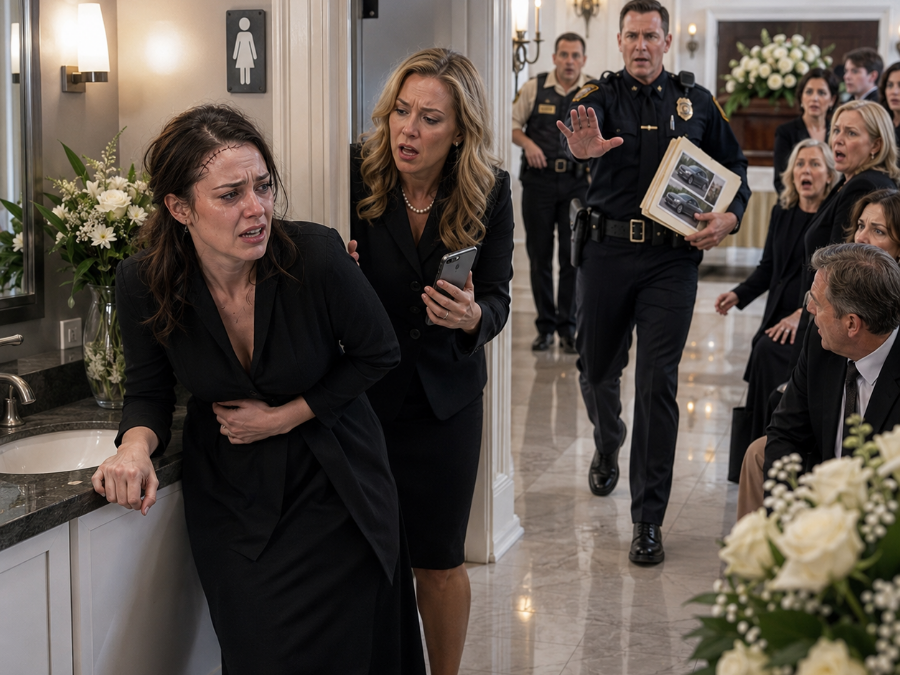
“You need to stop falling apart. People are watching,” my sister Rachel told me while I cried in the bathroom at my husband’s funeral, my scalp still stitched and every breath scraping against fractured ribs. Days earlier, a truck had driven straight into us on our wedding night. Evan died. I survived. Police soon learned the crash had been hired—and the driver had been given our exact route and departure time. Then Rachel texted me, “Stop digging into things you don’t understand,” even though I had never told her I was investigating. When Detective Grant arrived with records linking her to the man behind the crash, Rachel’s perfect mask finally cracked. She thought grief had made me weak. It had actually made me impossible to silence.
Part 1
My name is Claire Dawson, and at 6:30 on my wedding night, I thought the hardest thing I would remember was how badly my heels hurt. The ballroom smelled like roses, champagne, and lemon cake, and my new husband, Evan Cole, kept making me laugh during photographs, whispering that I looked “dangerous in satin.”
My parents were glowing. Evan’s father, Thomas, hugged me like I had already belonged to their family for years, while my older sister, Rachel, wore dark green silk and smiled beautifully for every camera.
“You got the fairy tale,” she told me while the photographer changed lenses.
“It feels like it.”
Her smile stayed in place. “It always does for you.”
I barely noticed the edge in her voice. Ten minutes later my phone buzzed from an unknown number, and when I answered, someone breathed quietly on the other end before hanging up.
“Spam?” Evan asked.
“Probably.”
I wish I had been right.
We left beneath sparklers after midnight, confetti still caught in my hair. Evan opened the passenger door with a ridiculous bow, and I kicked off my heels the second we were alone, my bouquet resting on the back seat while the city slid past in amber reflections.
“Mrs. Cole,” he said, grinning.
“Sounds like I own pearls.”
“We’ll buy pearls.”
I laughed.
Then white headlights filled the windshield.
There was no drifting vehicle, no desperate swerve, no last-second brake lights. A truck came straight at us.
Evan threw his arm across my chest. Metal screamed, glass exploded, my body snapped sideways, and the world disappeared.
I woke beneath fluorescent lights with stitches in my scalp, fractured ribs, and a monitor beeping beside me. My mother stood in the corner crying, and my father looked twenty years older.
“Where’s Evan?”
Nobody answered.
I tried to sit up and pain tore through my chest. “Where is my husband?”
My mother took my hand. “Claire… he didn’t make it.”
I remember screaming, tasting blood where I had bitten my cheek, and clawing at the hospital blanket as if I could tear open reality and find the previous night underneath it. Three days later, police called the crash suspicious because the truck driver had accelerated before impact.
At Evan’s funeral, Rachel found me crying in a bathroom and handed me water. She looked perfect in black, untouched by the chaos that had ruined the rest of us.
“You need to stop falling apart,” she said. “People are watching.”
I thought she was only being cruel in the familiar way sisters can be cruel.
That evening, detectives asked whether Evan or I had received strange calls before the wedding. I mentioned mine, then remembered Evan admitting someone had been calling him too.
That night, while sorting the torn tuxedo returned from the wreck, I found a folded note inside his jacket.
An address.
Tuesday, 8:30.
Evan had died on Saturday.
And suddenly I had a question more frightening than grief: What had my husband planned to do three days after our wedding—and why had he hidden it from me?
Part 2
The address led me to a narrow brick office between two warehouses on the south side of town. My ribs hurt with every breath, and the cold air smelled like diesel and wet concrete.
A man named Caleb Ross opened the door, and the second I said Evan Cole, his expression changed.
“I don’t know him.”
“You reacted.”
He studied my bruises, checked the street behind me, then let me inside. Caleb called himself a private mediator, though the office looked more like a place people used when they did not want meetings recorded.
After several minutes of arguing, he finally admitted Evan had visited twice before the wedding.
“He thought someone was trying to intimidate him,” Caleb said.
My mouth went dry. “Who?”
“He didn’t know. Calls. Someone following him. Same dark truck twice.”
Caleb opened a drawer and handed me an envelope Evan had left behind. Inside was a flash drive and a short note in his handwriting:
If you’re reading this, I was right to be worried. Don’t trust easy answers.
The drive contained contracts, altered invoices, rerouted payments, and audio recordings. In one, Evan argued with another man about money disappearing from a redevelopment project.
Then I heard Evan say, “She got a call at home.”
The other man asked, “Claire?”
“Yes.”
My skin went cold.
Another document had one sentence underlined twice: Someone is feeding them internal timelines.
Before I could understand it, police brought worse news. The driver had confessed the collision was hired, and he had been given our route, our departure time, and instructions to hit our vehicle hard from the left.
When I sat across from him at the station, he looked directly at me.
“You weren’t supposed to live,” he said.
My father lunged out of his chair, but a detective stopped him.
“Who paid you?” I asked.
“A middleman. Calls himself Victor Hale.”
That name appeared in Evan’s files.
The driver said payment had been split in two—half before, half after. To prove the job was complete, he was supposed to recover Evan’s wedding ring.
“But I never got it,” he said.
“Why?”
“Someone reached the wreck first.”
He described a dark sedan stopping behind us before emergency crews fully secured the scene. A hooded figure moved quickly near Evan, took something, then disappeared.
My stomach turned.
That night Rachel texted me: Stop digging into things you don’t understand.
I stared at the message until my cracked screen dimmed.
I had never told her about Caleb. I had never told her about the flash drive, and I had never told her I was digging.
The next morning, I opened a hand-delivered envelope found inside our apartment. A brass bank key fell into my palm beside a card:
Box 417. Ask for Collins.
Someone had been inside my home.
And someone knew exactly what Evan had left behind.
Part 3
The bank manager told me Evan had arranged access to box 417 ten days before our wedding.
“In the event of his death,” he said.
Those words nearly knocked the air out of me.
Inside the box were more financial records, another flash drive, and Evan’s missing wedding ring. I closed my fist around the scratched gold band.
“How did this get here?”
“It was delivered yesterday morning by an unidentified courier.”
So whoever had taken it from the wreck was still moving pieces around.
Evan’s final letter was worse than anything else. He wrote that he had discovered fraudulent payments tied to the redevelopment project, that Victor Hale was involved, but that Hale was only “the bridge.”
Then came the line I read until the words blurred:
If the answer is inside the family, love does not make it less true.
The flash drive contained hotel security footage from three weeks before the wedding. Hale entered first, and thirty seconds later Rachel walked in.
They took the same elevator.
I watched the clip over and over until denial became impossible.
That evening Rachel came to my parents’ house carrying soup like nothing had changed. I waited until she sat down.
“Were you seeing Victor Hale?”
Her hand moved automatically to the side of her neck. She had done that since childhood whenever she lied.
“Who?”
“I have video.”
The room went silent.
Finally she admitted meeting him “for consulting work.” Then her phone lit up on the table.
Unknown number: Need confirmation ASAP.
She flipped it facedown.
I grabbed it before she could stop me, and my father forced her to give up the password. Deleted messages still showed fragments:
Need route confirmation.
Bride leaving later than expected?
Proof required.
Cleanup handled.
My mother started crying.
Rachel backed toward the counter. “It doesn’t mean what you think. I gave him information. That’s all.”
“What information?”
“Schedules. Events. Who knew who. Business connections.”
“Our wedding route?”
She said nothing.
The doorbell rang.
Detective Grant stood outside with Evan’s father, Thomas. Thomas carried a folder from private investigators containing bank records, burner-phone links, and a gas-station image showing Rachel beside Hale’s car three nights before my wedding.
“Why?” I asked her.
Something in her face finally changed.
Not fear.
Resentment.
“You really don’t know?” she said.
Then years of bitterness spilled out. She said I had always been easier to love, easier to forgive, the daughter who got happiness without “earning” it. She hated the way Evan looked at me, hated our wedding, and hated that my future seemed brighter than hers.
“I only meant to scare him,” she insisted. “Hale said the crash would be a warning.”
Detective Grant placed printed messages on the table.
The driver had been told both occupants were acceptable targets.
Rachel went pale.
Then I asked the question that destroyed whatever remained between us.
“Who took Evan’s ring?”
Her eyes closed.
“I did.”
My mother sobbed.
Rachel whispered that she had returned toward the wreck because Hale demanded proof. She thought I was dead, and when she saw blood inside the car, she decided that was enough.
Part 4
The handcuffs closed around Rachel’s wrists with a soft metallic click.
She looked at me as Detective Grant read her rights.
“Claire.”
“No.”
That was all I gave her.
The weeks after her arrest were filled with search warrants, phone records, financial transfers, and facts uglier than rumor. Police recovered a second phone from her apartment, cash she could not explain, and printed directions showing our wedding route highlighted in yellow.
Hale disappeared.
The driver cooperated to reduce his sentence. Rachel’s attorney argued that she had been manipulated, that she never intended murder, that resentment and greed had pulled her into something she could no longer control.
None of it changed what she chose.
At sentencing, she stood in court and called everything “mistakes.” Then she blamed our childhood, our parents, and finally me.
When it was my turn to speak, I walked to the microphone with Evan’s ring hanging on a chain beneath my blouse.
“I used to think betrayal arrived wearing a stranger’s face,” I said. “Now I know it can sit at your family table. It can zip your dress before your wedding. It can smile beside you in photographs while waiting for your life to collapse.”
Rachel finally looked at me.
“You are not misunderstood,” I told her. “You are not the victim of everyone else’s happiness. Evan is dead because you repeatedly chose jealousy, money, secrecy, and self-preservation over human life.”
My voice shook, but I did not look away.
“You do not get my forgiveness. You do not get to call this complicated. I will live with what you helped destroy for the rest of my life. You will live with the consequences.”
The court gave her a sentence that meant freedom would be a distant possibility, not a promise.
I thought that was the end.
Three nights later, I returned to Evan’s apartment and found my front door unlocked. On the kitchen counter sat a card.
Five typed words:
You were never the target.
Detectives reopened parts of the case, while Thomas hired investigators. Eventually the final shape emerged.
Evan had been the primary target because of the corruption he had uncovered. Rachel’s hatred gave Hale access to schedules, routes, and private family details, and Hale used her resentment as cover. If I died too, no one involved cared.
Weeks later, Hale was found dead in a burned vehicle. Soon afterward, federal prosecutors charged several executives tied to the redevelopment fraud.
I visited Rachel once before she was transferred.
“I got a note,” I said. “It said I was never the target.”
She looked down. “I suspected that afterward.”
“You still helped him.”
“Yes.”
No apology. No excuse worth hearing.
“Did you ever love me?”
“In my own way.”
I stood.
“That was always the problem.”
She called my name as I walked away.
I never turned around.
A year later, I moved out of the apartment Evan and I had shared. I kept his ring, his ridiculous cereal note, and one photograph from our wedding—the one taken before anyone knew what the night would become.
I did not forgive Rachel.
I did not need to.
I built a life that did not depend on understanding her, rescuing her, or carrying her bitterness.
She had spent years believing my happiness stole something from her.
In the end, the only thing she truly destroyed was her place in my life.
THE END!
Disclaimer: Our stories are inspired by real-life events but are carefully rewritten for entertainment. Any resemblance to actual people or situations is purely coincidental.








