The Crime Lord Came To Take His Cat Back—But What The Cat Did Next Left Everyone Stunned
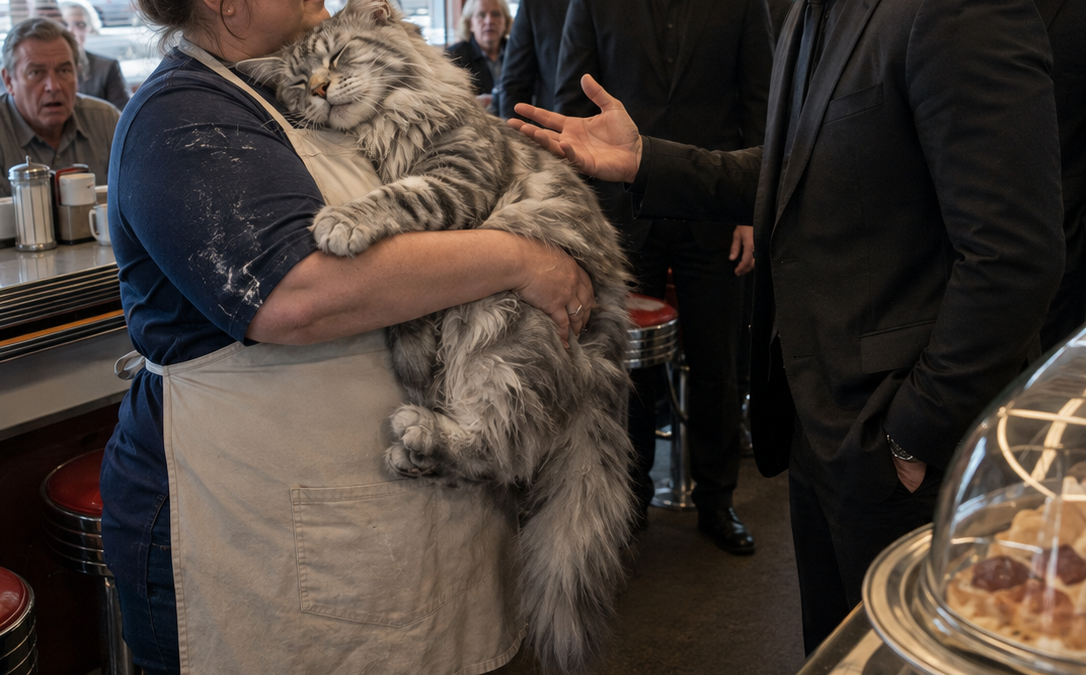
The Crime Lord Came To Take His Cat Back—But What The Cat Did Next Left Everyone Stunned
The four men in black came through my diner door at 2:17 on a Tuesday afternoon.
The one in front looked at the sixteen-pound Maine Coon sleeping in my arms.
Then he looked at me.
“Put the cat down.”
I didn’t.
The diner went quiet.
Not completely.
The refrigerator behind the pie case kept humming. Bacon still snapped on Carl’s grill. Somebody’s spoon tapped once against a coffee mug and then stopped.
But every customer suddenly became very interested in not moving.
The cat opened one yellow eye.
I’d been calling him Vesper for eleven days.
Apparently that wasn’t his name.
“Ma’am,” the man said.
Polite.
That somehow made it worse.
“The cat belongs to Mr. Malone.”
Vesper tucked his face deeper into the crook of my elbow.
“We’re here to bring him home.”
I looked down at him.
Then back at the four men.
“He seems comfortable.”
The man’s jaw tightened.
“He’s property.”
“He’s a cat.”
“He belongs to Mr. Malone.”
“And right now he’s holding onto my apron.”
As if he understood the argument, Vesper extended one enormous paw and hooked two claws delicately into the fabric at my shoulder.
The man stared at it.
I almost smiled.
Almost.
Then the bell above the diner door rang again.
Nobody turned around.
They didn’t have to.
The four men did something much more informative.
They straightened.
All of them.
The man who entered behind them wasn’t what I expected.
That bothered me immediately.
I knew the name Corbin Malone.
Everyone within four blocks of Henley’s Corner Diner knew it.
You heard it late at night when customers thought the kitchen noise covered their conversations.
You saw what happened to people’s faces when someone mentioned a Malone property.
And if you handled the diner’s books, as I had for seven years, you occasionally found invoices that made much more sense if you stopped asking questions before you reached the bottom of the page.
So I had built a picture in my head.
Big.
Loud.
Gold watch.
Maybe three bodyguards and a voice that entered the room before he did.
Corbin Malone was none of those things.
He was around forty.
Dark hair.
Gray eyes.
Black suit.
No jewelry I could see.
He wasn’t especially broad.
He didn’t need to be.
Some people enter a room and demand attention.
Malone entered like he had never once considered the possibility of not receiving it.
His eyes moved once across the diner.
Front door.
Kitchen opening.
Back hallway.
Customers.
Me.
Then the cat.
He stopped.
Vesper opened his other eye.
Malone stared at him.
The cat stared back.
For one second, neither moved.
Then Vesper closed his eyes again.
Something happened to Malone’s jaw.
Small.
Almost invisible.
But I saw it.
“That’s my cat.”
I looked down at the silver fur spilling over both my arms.
“He seems to have a different opinion.”
One of the men behind Malone inhaled sharply.
I regretted the sentence immediately.
Not because it was wrong.
Because Malone’s attention shifted from Vesper to me.
Fully.
I suddenly became aware of flour on my sleeve.
My hair coming loose from the clip behind my head.
The coffee stain near my left shoe.
The fact that I was forty-three years old and shaped more like a woman who carried boxes of syrup than somebody who belonged in a confrontation with a man half the neighborhood was afraid to name.
Malone’s eyes returned to Vesper.
“Orpheus.”
The cat’s right ear rotated.
That was it.
I blinked.
Malone tried again.
“Orpheus.”
Vesper sighed.
Actually sighed.
I felt his entire body deflate against my arms.
One of Malone’s men looked at the floor.
I bit the inside of my cheek.
“That’s not his name,” the man muttered.
“It is now,” I said.
Malone looked at me.
“What did you do to my cat?”
I stared.
“Fed him.”
Silence.
Not normal silence.
The kind that has weight.
Behind me, Carl leaned halfway through the kitchen opening.
He looked at Malone.
Looked at me.
Then disappeared again.
Smart man.
Malone held out one hand.
“Come here.”
Vesper lifted his head.
For the first time since the men entered, he looked genuinely interested.
He stretched one giant paw toward Malone.
Touched his knuckle.
Once.
Then pulled the paw back.
Turned around in my arms.
And buried his face against my chest.
The man standing nearest Malone looked like he wanted to disappear into his jacket.
Malone’s hand remained suspended in the air.
The entire diner watched.
I looked at him.
“He knows you.”
“Obviously.”
“He’s not afraid of you.”
His eyes sharpened.
I continued carefully.
“He’s just not ready.”
Something changed.
Not anger.
That would have been easier.
Instead Malone lowered his hand and studied the cat.
Then he asked:
“Has he eaten?”
I blinked.
“Today?”
“Yes.”
“Half a can of Wellness Core. A little turkey. Some scrambled egg whites.”
Malone looked at me.
“Scrambled eggs.”
“Carl made too many.”
From the kitchen:
“I always make too many.”
Nobody acknowledged him.
Malone looked at Vesper again.
“How long has he been here?”
“Eleven days.”
His face went still.
“He was missing eleven before that.”
I looked at him.
“Twenty-two days total?”
“Yes.”
“You were looking for him?”
His eyes moved back to mine.
“We were looking everywhere.”
No performance.
No threat.
Just a fact.
And for the first time since he walked through the door, Corbin Malone looked less like a man who owned half a neighborhood.
He looked like somebody whose cat had disappeared for three weeks.
I adjusted Vesper’s weight.
“He came in through the fire escape.”
Malone glanced toward the back hallway.
“It was raining. He was soaked.”
Vesper began purring.
“I gave him half my turkey sandwich.”
Malone looked offended.
“He doesn’t eat processed deli meat.”
“He did that night.”
“He has a nutrition plan.”
I stared at him.
“He was living behind my dumpster.”
Malone said nothing.
“That tends to change your standards.”
One corner of his mouth moved.
Barely.
Then vanished.
He looked at Vesper one last time.
“Tomorrow.”
I frowned.
“What?”
“I’ll come back tomorrow.”
He turned.
The four men moved immediately.
I called after him.
“Mr. Malone.”
He stopped.
“If he wants to go with you tomorrow, he goes.”
Malone looked over his shoulder.
“And if he doesn’t?”
I looked down at the cat.
Vesper was asleep again.
“Then I suppose you’re going to have to negotiate with him.”
For three seconds, Corbin Malone just stared at me.
Then he walked out.
The bell rang.
The door closed.
Every table in the diner exhaled at once.
I set Vesper on the counter.
He sat down.
Raised one back leg.
And started cleaning himself.
I pointed at him.
“You could’ve gone.”
He stopped licking.
Looked at me.
Yellow eyes.
Absolute contempt.
Then went back to his paw.
I had the distinct feeling I was the only person in the room who didn’t understand what had just happened.
I would understand soon enough.
Because Corbin Malone came back at 7:42 the next morning.
Alone.
And this time, when Vesper saw him, the cat did something that made me realize I had been wrong about both of them.
Part 1
I was pouring coffee when the bell rang.
Seven forty-two.
I remember because the clock above the register ran four minutes fast, and I had been meaning to fix it since Christmas.
The morning rush hadn’t started yet.
Two construction workers were in the corner booth.
Mrs. Feldman was eating oatmeal near the window.
Carl was in the back singing badly to an old Motown song.
Normal.
Then Corbin Malone walked in without an entourage.
No black suit either.
Dark slacks.
Gray jacket.
Open collar.
He somehow looked more dangerous dressed casually.
Maybe because it suggested he didn’t need the uniform.
He sat at the counter.
I picked up the coffee pot.
“You always come this early when collecting property?”
His eyes moved to me.
“Good morning, June.”
I stopped.
I hadn’t told him my name.
He glanced toward my name tag.
I looked down.
Right.
I poured.
“Coffee?”
“Yes.”
“Sugar?”
“No.”
“Cream?”
“No.”
“Human emotion?”
A pause.
“No.”
I set the mug down.
That corner of his mouth moved again.
There.
Almost.
Vesper had spent the night sleeping on folded tablecloths in the storage room.
The back window never shut properly.
He could have left whenever he wanted.
He hadn’t.
Now he came strolling out of the hallway.
Malone saw him.
Vesper saw Malone.
The cat froze.
Malone didn’t move.
Neither did I.
Then Vesper jumped onto the stool beside him.
Malone’s shoulders changed.
Just slightly.
Vesper sniffed his sleeve.
Circled once.
Then pressed his entire sixteen-pound body against Malone’s arm.
I smiled before I could stop myself.
“There it is.”
Malone looked down.
Vesper’s eyes had closed.
“He loves you.”
“He ran away.”
“That doesn’t mean he doesn’t love you.”
“He was gone twenty-two days.”
“You said eleven before I found him.”
“Yes.”
“And he spent last night three feet from a window he knows how to climb through.”
Malone looked toward the hallway.
“He could’ve gone back.”
“He didn’t.”
His fingers moved carefully over Vesper’s head.
The cat leaned harder into him.
Malone went still, as if even breathing too deeply might break something.
I leaned against the counter.
“Something scared him.”
“He’s not easily frightened.”
“Overwhelmed, then.”
“He has an entire floor.”
I waited.
“Of what?”
“My building.”
“You gave your cat an entire floor?”
“It’s not solely for him.”
“What else is there?”
“Security.”
“People?”
“Yes.”
“What do they do?”
“Work.”
I nodded slowly.
“So he had an entire floor full of people whose job was to be there.”
“Yes.”
“Not people whose job was to be with him.”
Malone’s hand stopped.
I immediately regretted the sentence.
Not because I thought he would hurt me.
Strangely, I didn’t.
Because I had seen something move behind his eyes.
I picked up the coffee pot.
“More?”
He looked at his nearly full mug.
“No.”
“Good.”
I walked away.
Sometimes people need you to stop watching them think.
When I came back six minutes later, Malone was still sitting in the same position.
Vesper had stretched across the counter.
His chin rested on Malone’s forearm.
“I’m not saying your place is bad,” I said.
Malone looked at me.
“I’m saying maybe this isn’t about square footage.”
He was quiet.
Then:
“What is it about?”
I looked at Vesper.
“Company.”
Malone’s expression changed.
Not much.
Enough.
I moved to refill Mrs. Feldman’s coffee.
Malone stayed another forty-three minutes.
Then he stood.
Vesper opened his eyes.
Malone scratched him beneath the chin.
“Come.”
Vesper considered it.
Then jumped from the counter.
Malone’s shoulders relaxed.
They walked toward the door together.
Halfway there, Vesper stopped.
Turned around.
Came back.
Jumped onto the counter.
And sat on my order pad.
Malone stared at him.
I looked at the cat.
“Traitor.”
Vesper began washing his face.
Malone looked at me.
“Tomorrow.”
“You said that yesterday.”
“I know.”
Then he left alone.
He came back the day after that.
And the day after that.
Five times in two weeks.
Always with a reason.
Vesper wasn’t eating.
Vesper was restless.
Vesper needed the veterinarian.
The veterinarian happened to be nearby.
Vesper kept trying to walk toward Henley’s.
By the fifth excuse, even Carl had started keeping a fresh mug behind the counter.
That Tuesday, Malone arrived at noon.
Bad time.
Lunch rush.
Every stool occupied except one.
Of course.
He sat.
Vesper immediately climbed into the front pocket of my apron.
Or tried to.
At sixteen pounds, “into” was generous.
Most of him hung outside.
Two enormous paws dangled over my hip.
Malone stared.
“That position cannot possibly be comfortable.”
“Tell him.”
“He’s too large.”
“Fifteen pounds, twelve ounces.”
“You weighed him?”
“Yesterday.”
“Why?”
“He lost weight.”
Malone’s eyes moved from Vesper to me.
“He’s gaining it back.”
Something passed through his face.
I pretended not to see.
I was beginning to learn that Corbin Malone spent a great deal of energy making sure nobody saw anything he hadn’t intentionally shown them.
That made the moments he forgot more noticeable.
He watched me write an order.
“What’s your full name?”
I looked up.
“Why?”
“I know everyone who works in buildings I own.”
My pen stopped.
There it was.
Buildings.
Plural.
“June Alcott.”
He repeated it.
“June.”
I didn’t like the way it sounded in his voice.
Not because it was threatening.
Because it wasn’t.
“You’ve been here seven years.”
“That wasn’t a question.”
“You handle the books.”
“Sometimes.”
“You’re careful with invoices.”
My fingers tightened around the pen.
Malone noticed.
Of course he did.
“You’ve been reading my bookkeeping?”
“I own the building.”
“That answer is doing a lot of work.”
“You do more than bookkeeping.”
“I refill ketchup bottles too.”
His eyes stayed on mine.
Silence.
He was good at silence.
He used it the way other people used follow-up questions.
I refused to fill it.
Finally he looked at Vesper.
“You’re good with numbers.”
“Yes.”
“And cats.”
“Apparently.”
“And avoiding questions.”
“I’ve had practice.”
That almost-smile again.
The bell rang.
Three customers came in.
I pointed toward the dining room.
“I have people to feed.”
Malone lifted his coffee.
“By all means.”
I walked away.
And found myself annoyed that I was smiling.
By the end of the month, Vesper had established a schedule no human had approved.
Morning at Henley’s.
Evening with Malone.
Occasional overnight stays wherever he felt like sleeping.
He had a blanket beneath the counter.
A water bowl in my office.
And a small collection of toys Malone claimed he had not purchased.
“Someone in the building bought them.”
“Someone.”
“Yes.”
“A six-foot feather wand.”
“Apparently.”
“Pink mouse?”
“Security.”
“Security bought your cat a pink mouse?”
Malone drank his coffee.
“They have downtime.”
I laughed.
He looked at me.
Really looked.
And for the first time, he smiled.
It lasted maybe two seconds.
One corner first.
Then the rest.
I forgot what I was going to say.
That irritated me.
So I reorganized the sugar packets.
Blue.
Pink.
Yellow.
Blue.
Pink.
Yellow.
Malone watched.
“You’ve moved those four times.”
“They were wrong.”
“They’re sugar packets.”
“Symmetry matters.”
“Does it?”
“It does when everything else is a mess.”
His eyes stayed on me.
“What’s a mess?”
I looked up.
“Nothing.”
“You’re anxious.”
“I’m employed in a diner inside a building owned by a man people stop talking around.”
He didn’t react.
“I do the books.”
“I know.”
“I occasionally see numbers I’m fairly certain I wasn’t intended to understand.”
His expression went still.
“There are between six and twelve things I probably know that I would prefer not to know.”
“Measured anxiety seems appropriate.”
He was quiet.
Then:
“You’re not in danger.”
The strange thing was, I believed him.
Immediately.
I stared at him.
“You say that like it should make me feel better.”
“Doesn’t it?”
“Yes.”
“That appears inconvenient.”
“It is.”
Vesper jumped into Malone’s lap.
Malone’s hand came down automatically.
Slow circles behind the ears.
The cat started purring.
I pointed.
“That.”
“What?”
“That’s why.”
“Why what?”
“Why I believe you.”
His eyes dropped to Vesper.
The cat had gone boneless across his thighs.
Malone said nothing.
He didn’t need to.
The trouble started on a Thursday.
Of course it did.
Thursday had always been our strange day.
Busy enough to matter.
Quiet enough for problems to have room.
Derek Cannon came in at 1:18.
I knew him.
Property developer.
Expensive shoes.
Perfect teeth.
A personality built almost entirely out of explaining other people’s businesses to them.
He had been circling our block for months.
Twice he’d asked whether I was “the decision-maker” or “just helping out.”
I’d answered politely because Henley’s needed customers more than I needed satisfaction.
That afternoon Malone was at the counter.
Vesper lay between us.
Cannon didn’t recognize him.
That was mistake number one.
He sat two stools away.
“June.”
“Derek.”
“Still holding down the fort?”
“Still standing.”
He looked at Vesper.
“Running a petting zoo now?”
“One cat.”
“Cute.”
Vesper stared at him.
Cannon turned back to me.
“I’ve been in talks about this block.”
My hand stopped over the register.
“What talks?”
“Redevelopment.”
Malone took a sip of coffee.
Cannon didn’t notice.
“Higher-yield units. More modern tenants.”
“Henley’s is a tenant.”
“Right.”
He smiled.
Not cruelly.
Worse.
Dismissively.
“The ownership wants to make better use of the corner.”
I looked at Malone.
He didn’t look at me.
Interesting.
Cannon continued.
“The girl at the register probably doesn’t need the details, but I didn’t want you blindsided.”
The diner became quiet.
Again.
I had learned something during seven years of customer service.
There are insults that make you angry.
And there are insults that simply complete a calculation you were already doing.
I set down the coffee pot.
“I’m not the girl at the register.”
Cannon blinked.
I continued.
“I’ve managed this diner’s books for seven years.”
Malone turned his head slightly.
“I’ve negotiated our suppliers.”
“Managed payroll.”
“Kept staff paid through shutdowns.”
“Reworked the menu margins when our food costs jumped.”
“Kept this place solvent while half the storefronts on this block changed hands.”
Cannon’s smile had faded.
“The reason this corner has foot traffic worth ‘repurposing’ is because Carl keeps people fed, our staff keeps them coming back, and I make sure the numbers work.”
I held his eyes.
“So thank you for the warning.”
Cannon inhaled.
“June, I didn’t mean—”
“Who authorized the conversation?”
Malone’s voice was quiet.
Cannon turned.
For the first time, he actually looked at the man beside him.
“You’re…?”
Malone picked up his coffee.
“The building ownership.”
Cannon’s face changed.
Not pale yet.
Processing.
“I’ve been speaking to management.”
“No, you haven’t.”
“There have been preliminary discussions.”
“There have not.”
Cannon stared.
Malone put the mug down.
“I would know.”
And there it was.
The exact moment Derek Cannon understood that he had spent the last five minutes describing Corbin Malone’s plans to Corbin Malone.
His face went pale.
I looked away.
Not because I felt sorry for him.
Because if I watched any longer, I was going to smile.
Cannon cleared his throat.
“I may have been given inaccurate information.”
Malone looked at him.
“Yes.”
“I apologize for the confusion.”
“To whom?”
Cannon hesitated.
Malone did not look at me.
Didn’t need to.
Cannon turned.
“June.”
I waited.
“I apologize.”
“For?”
His cheeks darkened.
“The way I spoke to you.”
I nodded once.
“Thank you.”
He left seven minutes later.
Coffee untouched.
The door closed.
I wiped the counter.
Malone watched Vesper.
“You didn’t have to do that.”
“I corrected inaccurate information.”
“He was also wrong about me.”
“You corrected that yourself.”
I stopped wiping.
Malone looked at the cat.
“I corrected the part that still required correction.”
Something moved inside my chest.
I did not like it.
Not because it was unpleasant.
Because it was.
That night, after Carl left, I sat alone in my office with the books open.
Vesper occupied the shelf above my desk.
I stared at a column of vendor costs I’d already checked twice.
The numbers were right.
The problem wasn’t the numbers.
It was Corbin Malone.
The name.
The building.
The men in black.
The way conversations stopped when he entered.
And the other version.
Coffee at 7:42.
No sugar.
No cream.
Vesper asleep on his arm.
The almost-smile.
The fact that he had defended me without speaking for me.
Those two versions belonged to the same man.
I wasn’t stupid enough to pretend otherwise.
I had spent most of my adult life building something small enough to control.
My apartment.
My job.
My routines.
Henley’s.
Nobody decided where I went.
Nobody introduced me as someone’s anything.
Nobody rearranged my life because they could.
Corbin Malone rearranged rooms simply by walking into them.
That didn’t make him bad.
It made him dangerous to the kind of life I’d built.
I looked at Vesper.
“You started this.”
He opened his eyes.
“Don’t.”
He blinked.
“You show up wet on a fire escape, and suddenly I’m having emotional problems with organized property ownership.”
Vesper yawned.
I pointed toward the door.
“You know exactly what you did.”
He closed his eyes.
Which, in cat language, felt very much like an admission.
Two weeks later, I told Corbin Malone not to come back.
And the look on his face told me I had finally found something in this city that frightened him.
Part 2
He came in at 7:42.
Of course.
Vesper had arrived twenty minutes earlier and stolen half a piece of bacon from Carl.
Malone sat.
I poured his coffee.
Then I stayed behind the counter.
He knew.
Immediately.
“You’re reorganizing the sugar.”
“They need it.”
“They’re already alternating.”
I looked down.
They were.
Damn.
Malone waited.
I set the caddy aside.
“Vesper’s settled.”
He looked at the cat.
“Good.”
“He comes here in the mornings.”
“Yes.”
“He goes home to you in the evenings.”
“Yes.”
“That seems to work.”
His eyes returned to mine.
“Yes.”
I folded my hands on the counter.
“So there’s no reason for you to keep coming here.”
Silence.
Not defensive.
Not angry.
Understanding.
Malone glanced at his coffee.
“Professional reason.”
I hated that he had found the word I had deliberately avoided.
“Yes.”
He was quiet a long time.
“You want me to stop coming.”
“I want my life to stay mine.”
His expression changed.
I continued before courage had time to leave.
“People move when you enter rooms.”
“I don’t ask them to.”
“That doesn’t matter.”
He didn’t interrupt.
“People watch what they say around you.”
“People change plans because of you.”
“Men like Derek Cannon apologize because you exist ten feet away.”
“I don’t want to wake up six months from now and realize my entire life has started bending around somebody else’s gravity.”
Malone’s jaw tightened.
Not anger.
Pain, maybe.
Hard to tell with him.
I looked at Vesper.
“This isn’t about the cat anymore.”
“No.”
The answer came instantly.
That hurt worse.
I looked back at him.
“At least we’re clear.”
“We are.”
He drank his coffee.
Slowly.
Finished all of it.
Then scratched Vesper behind the ears.
The tenderness of the gesture nearly broke my resolve.
Nearly.
Malone stood.
He put cash beneath the mug.
Too much.
I pushed half of it back.
He looked at me.
“Coffee costs two seventy-five.”
“I know.”
“Then pay two seventy-five.”
Another pause.
He took the money.
“Goodbye, June.”
“Goodbye, Corbin.”
That was the first time I’d called him that.
His eyes held mine for one second longer.
Then he left.
No argument.
No threat.
No promise that he’d return.
The bell rang.
The door closed.
And suddenly Henley’s Corner Diner felt enormous.
The next morning, his stool was empty.
Vesper arrived at seven-ten.
I fed him.
At 7:42 I looked at the door.
Nothing.
At 7:46, I rearranged the sugar packets.
Carl saw me.
Said nothing.
At 8:03, he put a plate of scrambled eggs in the pass-through.
“For the cat.”
“That’s a lot.”
“He’s hungry.”
Vesper ate three bites.
I ate the rest.
The next day was the same.
Then another.
Malone didn’t come.
What I had wanted was proof.
Proof that I could draw a boundary around my life and he would respect it.
He did.
Perfectly.
It was miserable.
There are missing things that announce themselves.
A wallet.
Keys.
A person who should be standing beside you.
Then there are missing things that only become obvious when the totals stop balancing.
A second coffee mug.
A quiet voice.
Someone noticing you’ve reorganized the sugar packets without making you feel ridiculous for it.
Nobody was taking over my life.
Nobody was managing me.
Nobody was showing up at 7:42.
I had won.
I hated it.
Apparently Malone had his own problem.
I learned that much later.
Vesper was fine.
He ate.
Slept.
Left Malone’s building each morning and returned each evening like he had two addresses and an employment contract.
Nothing was wrong with the cat.
Which meant Malone eventually ran out of excuses.
He could no longer say Vesper needed checking.
Couldn’t pretend there was a building issue.
Couldn’t claim Henley’s required his attention.
I’d removed every legitimate reason.
For a man accustomed to being able to move nearly anything he wanted moved, there was something he apparently could not manufacture.
Permission.
So he stayed away.
Three weeks.
Then the bell above the diner door rang at 7:41.
I looked up so fast I nearly spilled coffee.
Corbin Malone stood in the doorway.
Alone.
No Vesper.
No folder.
No men.
No jacket expensive enough to count as a business meeting.
Just him.
I stared.
“Where’s Vesper?”
“Home.”
“Is he sick?”
“No.”
“Did something happen?”
“No.”
I waited.
He walked to the counter.
Sat.
His stool.
I didn’t say that.
I poured coffee before I could stop myself.
His eyes followed the mug.
“You’ve already made it.”
“Muscle memory.”
“I see.”
He wrapped both hands around it.
Then looked down at them.
That was when I knew this was different.
Corbin Malone never looked at his hands.
He watched doors.
People.
Reflections.
Rooms.
He looked at other people’s hands.
Now he looked at his own.
“I spent three weeks trying to find a reason to come here.”
I said nothing.
“The cat.”
“Building maintenance.”
“Lease issue.”
“Something with the books.”
He glanced around.
“I own the building. There isn’t a lease issue.”
“I assumed.”
“Every explanation I came up with was dishonest.”
I leaned against the counter.
“You’re supposed to be a crime lord.”
His eyes lifted.
“According to people who enjoy dramatic terminology.”
“Dishonesty seems like it would be somewhere in the résumé.”
“I’m good at difficult things.”
He paused.
“Dishonest things and difficult things are not the same.”
I studied him.
“What do you want?”
No softer version.
No escape.
His shoulders straightened.
“I want coffee with you.”
I waited.
“That’s it?”
“No.”
Good.
He continued.
“I want to have coffee with you tomorrow.”
“And the next day if you want me here.”
“I want to hear you complain about invoices.”
“You’re making this sound terrible.”
“I want to know why you hate the blue sugar packets touching each other.”
“They clash.”
“They’re identical except for color.”
“Exactly.”
One corner of his mouth lifted.
Then disappeared.
“I want to know why you make Carl pretend the extra eggs are for the cat.”
My eyes narrowed.
“He told you?”
“No.”
“Then how—”
“Vesper doesn’t eat that much.”
I looked away.
Traitor.
Malone became serious again.
“I want to see where this goes.”
I folded my arms.
“You’re used to getting what you want.”
“Yes.”
“That’s a problem.”
“I know.”
“Do you?”
He nodded.
“I think that’s why you told me to leave.”
“It was.”
“You wanted to know whether I understood the difference between being allowed somewhere and being able to enter anyway.”
That stopped me.
Malone’s eyes held mine.
“I do now.”
Silence.
Then a scratching noise came from the back.
I closed my eyes.
“No.”
Vesper pushed through the half-open storage window.
Walked directly into the diner.
Jumped onto the counter.
Looked at Malone.
Looked at me.
Then sat precisely between us.
I stared at him.
“You planned this.”
Vesper began washing one paw.
Malone looked at the cat.
“He has unusual timing.”
“He’s manipulative.”
“I haven’t noticed.”
“He escaped an entire building and orchestrated your emotional development.”
Malone almost laughed.
Then Vesper did something neither of us expected.
He turned toward Malone.
Placed one paw on Malone’s wrist.
Then reached the other paw toward me.
Touched my hand.
And lay down between us.
Half his body against Malone.
Half against me.
Neither of us moved.
The diner went quiet.
Mrs. Feldman actually lowered her newspaper.
Carl leaned through the kitchen opening.
Malone looked at Vesper.
Then at me.
I looked down at the cat.
“Well.”
Malone waited.
I picked up the coffee pot.
Refilled his mug.
“Tomorrow.”
His shoulders dropped maybe half an inch.
It was the most relaxed I’d ever seen him.
“Tomorrow?”
“Seven forty-two.”
“I’ll be here.”
“Coffee is still two seventy-five.”
“I remember.”
“No bodyguards.”
“Agreed.”
“No business meetings in booth three.”
“Fine.”
“No frightening my suppliers.”
“I have never frightened your suppliers.”
“Ray nearly dropped a crate of tomatoes when you said good morning.”
“He’s easily startled.”
I tried not to smile.
Failed.
Malone saw it.
This time, he smiled too.
Vesper jumped down.
Walked toward the storage room.
Stopped.
Looked back once.
Then disappeared.
His work, apparently, was finished.
It wasn’t.
Not quite.
Because a month later, someone came through the diner door who knew exactly who Corbin Malone was.
And what he asked me to do made Malone rise from his stool so fast that even Vesper stopped purring.
Part 3
His name was Victor Sloane.
I didn’t know him.
Malone did.
That was enough.
It was late morning.
Rainy again.
Something about rain followed that cat.
Malone sat at the counter reading messages on his phone.
Vesper slept across his lap.
I was checking invoices.
The bell rang.
A man in a navy overcoat entered.
Older than Malone.
Maybe fifty-five.
Silver hair.
Two men remained outside under the awning.
Sloane saw Malone first.
Then me.
Something changed behind his smile.
“Corbin.”
Malone’s phone went face down.
“Victor.”
Every muscle in my back tightened.
No one had to tell me.
This wasn’t Derek Cannon.
Derek had wanted property.
Victor Sloane wanted leverage.
He walked toward the counter.
His gaze moved to Vesper.
Then me.
“I’ve heard about the diner.”
Malone said nothing.
Sloane smiled at me.
“You must be June.”
I looked at Malone.
His face had gone completely still.
That told me more than any warning could have.
“Yes.”
“Victor Sloane.”
He offered his hand.
I didn’t take it.
He lowered it slowly.
“Interesting.”
“Coffee?”
He blinked.
“What?”
“You walked into a diner.”
I held up the pot.
“Coffee?”
Malone’s eyes flicked toward me.
Sloane laughed.
“Why not?”
I poured.
He didn’t drink it.
Instead he looked around.
“Nice place.”
“It pays the bills.”
“Does it?”
Malone spoke.
“Victor.”
One word.
Enough.
Sloane smiled.
“I came with a proposal.”
“Then call my office.”
“Your office doesn’t have her.”
My hand stopped.
Malone stood.
Immediately.
Vesper woke.
That was the fastest I had ever seen Corbin move.
Not toward Sloane.
He moved between us.
Subtle.
One step.
But suddenly I couldn’t see Sloane without looking around Malone’s shoulder.
Sloane noticed.
His smile deepened.
“There it is.”
“Leave.”
“I’m trying to help.”
“No.”
Sloane looked toward me.
“Ms. Alcott, do you know what sort of liabilities come with being important to a man like this?”
Malone’s voice dropped.
“Victor.”
I put down the coffee pot.
“I’m standing right here.”
Both men looked at me.
“I gathered,” Sloane said.
“Then stop discussing me like a parcel.”
Malone glanced back.
I held his eyes.
Let me.
His jaw tightened.
But he stepped half a foot aside.
Not away.
Enough.
Sloane smiled.
“Fair.”
I folded my arms.
“What do you want?”
“To purchase the diner.”
“No.”
“You haven’t heard the number.”
“Don’t need it.”
“Everyone has a number.”
“Then you can spend the afternoon discovering mine isn’t yours.”
Sloane’s smile disappeared.
Malone said nothing.
That mattered.
He could have ended the conversation with one sentence.
He didn’t.
He let me.
Sloane looked around.
“This block is changing.”
“People keep telling me that.”
“You may eventually find yourself without options.”
Malone’s hand rested flat on the counter.
Not threatening.
Still.
I had learned by then that his stillness was the thing people should worry about.
I looked at Sloane.
“Is that a business prediction?”
His eyes moved to mine.
“Of course.”
“Good.”
“Because anything else would be something I should document.”
Malone’s head turned slightly.
Sloane stared at me.
I continued.
“I keep excellent records.”
For the first time, Corbin Malone looked genuinely amused in front of another dangerous man.
Sloane noticed.
His face tightened.
Then Vesper stood.
He had been sitting on the counter between us.
His tail moved once.
Slowly.
Sloane reached toward him.
“Handsome animal.”
“Don’t,” Malone said.
Sloane ignored him.
His fingers got within six inches.
Vesper hissed.
Not loudly.
He had never hissed at me.
Never at Carl.
Never at Malone’s security.
Not even at Derek Cannon.
Now every hair along his back lifted.
Sloane stopped.
The diner went silent.
Vesper moved backward.
Then climbed directly into my arms.
Sixteen pounds of silver fur.
Exactly like the first day.
I held him.
He stared at Sloane over my forearm.
Yellow eyes.
No uncertainty.
Malone looked at the cat.
Then Sloane.
The temperature in the room seemed to drop.
Sloane lowered his hand.
“Animals are strange.”
“No,” I said.
He looked at me.
“They’re usually pretty clear.”
Sloane’s eyes hardened.
Malone spoke.
“Conversation’s over.”
This time Sloane listened.
He buttoned his coat.
Looked at me once.
Then Malone.
“We’ll talk.”
“No.”
Sloane stopped.
Malone’s voice remained calm.
“You’ll talk to my attorney.”
“That necessary?”
“Yes.”
Another pause.
Then Sloane walked out.
The door shut.
Malone waited until the two men outside followed him down the sidewalk.
Then he turned.
“Are you all right?”
I looked down at Vesper.
He was already relaxing.
“Yes.”
“We need to discuss security.”
“No.”
“June.”
“Absolutely not.”
“Someone came here specifically because—”
“I know why.”
“Then—”
“No men sitting in booths pretending they aren’t watching me.”
“I wasn’t going to suggest—”
“You were.”
He stopped.
I pointed at him.
“This is the part.”
“What part?”
“The part where you learn the difference between protecting me and managing me.”
His expression went blank.
Then thoughtful.
I continued.
“If there’s a real risk, tell me.”
“I’ll decide what precautions I take.”
“You don’t quietly rearrange my life because you’re frightened.”
His eyes sharpened.
“I am not frightened.”
Vesper looked at him.
I looked at him.
Malone looked at the cat.
“Don’t both do that.”
Despite myself, I laughed.
Then became serious.
“Are you?”
He was quiet.
Long enough that the answer came before the words.
“Yes.”
My chest tightened.
“Of what?”
Malone looked at me.
“That eventually being close to me costs you something you didn’t agree to pay.”
No performance.
No gray-eyed intimidation.
Just a man standing at my counter telling the truth.
I set Vesper down.
He immediately climbed onto Malone’s stool.
I walked around the counter.
Stopped in front of Corbin.
“You don’t get to make that decision for me either.”
He looked at me.
“I know.”
“Do you?”
“I’m learning.”
I nodded.
“Good.”
Then, because some things do not need speeches, I took his hand.
He looked down at our fingers.
Then back at me.
He didn’t tighten his grip.
Didn’t pull me closer.
Didn’t use the moment to claim more than I had offered.
He simply held my hand.
That was when I knew.
Not when he defended the building.
Not when people went quiet around him.
Not when he told me I wasn’t in danger.
This.
A man accustomed to controlling everything within reach had learned how not to close his hand around something simply because it had been placed inside it.
Vesper purred.
I looked at him.
“You’re smug.”
He blinked.
Months passed.
Some things changed.
Others didn’t.
Henley’s remained mine in every way that mattered.
I still did the books.
Carl still cooked too many eggs.
Mrs. Feldman still stole Sweet’N Low packets despite denying it every time.
Corbin still arrived at 7:42.
Sometimes 7:43.
Never later without texting.
He didn’t have to.
He had learned I worried.
I had learned he worried too.
We were both adjusting.
Vesper divided his time however he pleased.
Malone had a heated cat bed that cost more than my first month’s rent.
Vesper preferred a cardboard produce box beside my office.
That continued to offend him.
“You understand he has orthopedic support at home.”
“He likes the tomato box.”
“It has a hole in it.”
“He likes ventilation.”
“I bought him Egyptian cotton.”
“He sleeps on invoices here.”
Malone looked at the cat.
Vesper stretched.
“Uncultured animal.”
I smiled.
One morning, Carl came out of the kitchen carrying scrambled eggs.
He stopped.
I was reading something on my phone.
Corbin was drinking coffee.
Vesper lay upside down across his lap, four paws in the air.
Nobody was talking.
Nobody needed to.
Carl looked at us.
Then at the cat.
He nodded to himself.
Went back into the kitchen.
A minute later, another plate of eggs appeared.
“Too many?” I called.
“Always.”
Corbin looked at me.
I looked at him.
Vesper opened one eye.
And I remembered the first afternoon.
Four men in black.
A command.
Put the cat down.
I’d thought the important choice had been mine.
It hadn’t.
Vesper had already made his choice before any of us understood there was one to make.
He hadn’t run away because he hated Corbin.
He’d run because he needed something Corbin didn’t know how to give.
Ordinary noise.
People who weren’t paid to stay.
A cook who made too many eggs.
A woman who gave him half a turkey sandwich without expecting anything back.
And somehow, in finding those things for himself, he’d brought them back to Corbin too.
That was Vesper’s real trick.
He hadn’t chosen between us.
He had refused to.
He kept walking from one door to the other until two stubborn people finally understood that caring about someone didn’t always mean taking them home.
Sometimes it meant building a place they wanted to return to.
Corbin reached down and scratched behind Vesper’s ears.
The cat purred louder.
“You know,” I said, “he still likes me better.”
Corbin didn’t look up.
“He lives with me.”
“He visits you.”
“He owns an entire floor.”
“He sleeps in a tomato box.”
“That reflects poorly on you, not me.”
I smiled.
Vesper opened both eyes.
Looked at Corbin.
Then at me.
Then stretched one paw across the small gap between our arms until it rested on both of us.
Corbin looked down.
I did too.
Neither of us said anything.
Some things find their level on their own.
Vesper had understood that from the beginning.
The humans had simply needed time to catch up.
You Might Also Enjoy

Dad Told Me To Leave Forever After My Sister’s Kid Threw My Son’s Lunch — By 6AM He Was Begging At M

My Nephew Shut Down My Daughter’s Birthday Party For A BMX Bike — The Venue Owner’s Photo Made My Si

At 11:30 P.M., My Brother Took The Marina Keys. By Sunrise, The $92,000 Speedboat Was Smashed Agains

My Niece Took My Son’s $1,800 Scooter And Dad Called Him A Nobody — By 6AM A Locksmith Blocked My…




