Millionaire Cowboy Heard Them Laugh at a Widow’s Daughter’s Old Dress—His Next Move Silenced Everyone
Millionaire Cowboy Heard Them Laugh at a Widow’s Daughter’s Old Dress—His Next Move Silenced Everyone
The laughter reached me before I saw the girl.
It was sharp.
Polite enough to hide behind.
Cruel enough that every person in Higgins Mercantile knew exactly what it meant.
I stopped beside the iron stove with one glove still in my hand.
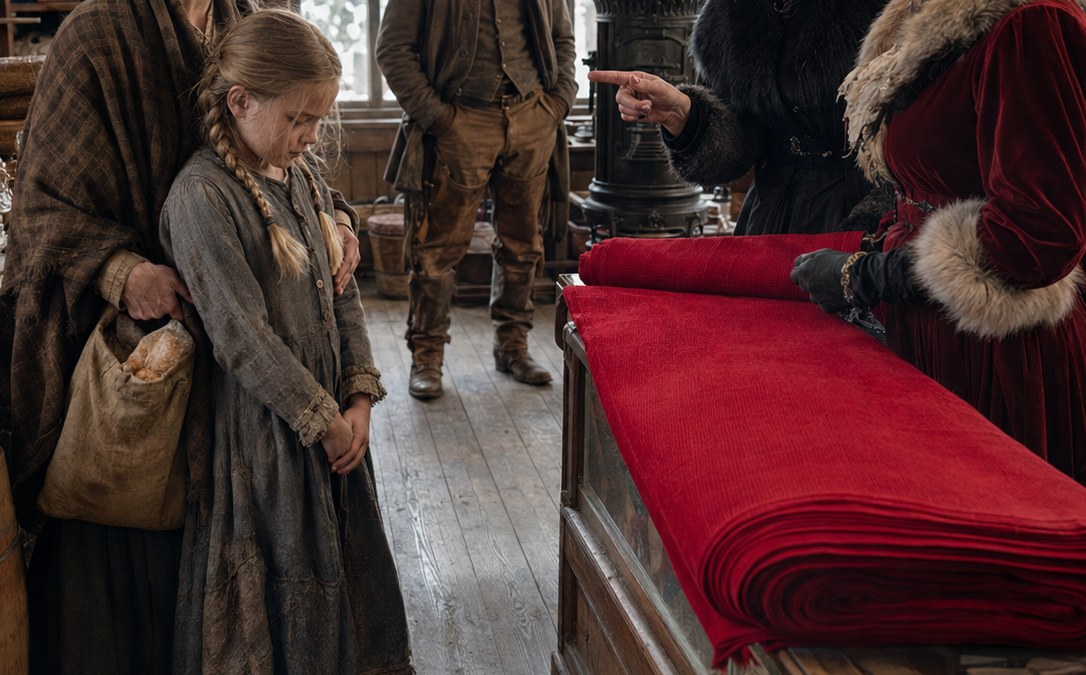
Across the store, a little blonde girl stood beside a bolt of red flannel.
She could not have been more than ten.
Her gray wool dress hung too loosely from her shoulders. The elbows had been patched twice. One button at the collar was brown iron while the others were black. A faded line near the hem showed where somebody had let the dress down after its first owner outgrew it.
The girl kept both hands behind her back.
She was not touching the fabric.
She was only looking at it.
Mrs. Harriet Gable noticed.
“Beautiful, isn’t it?” she asked.
The girl looked up.
“Yes, ma’am.”
Harriet stroked the red wool with two gloved fingers.
“Imported.”
Beside her, Eunice Croft smiled.
“Four dollars a yard.”
The girl’s eyes widened for half a second.
Then she lowered them.
Harriet looked her up and down.
“It is certainly no fabric for a farm girl.”
Eunice covered her mouth.
I saw the smile before I heard the laugh.
Then Harriet added, “Though looking at you, child, I suppose any fabric at all would be an improvement.”
The women laughed.
The girl did not.
Neither did I.
Her mother stood at the counter ten feet away.
Cora Thornton.
I knew the name before I knew her face.
Everyone in Clearwater did.
Her late grandfather, Colonel Silas Thornton, had commanded men during the war. There was still a weathered plaque outside the bank with his name carved into it.
A hero’s name.
A widow’s life.
Those were two very different currencies.
Cora had six coins spread across the counter.
“Half a sack of oats,” she told Mr. Higgins.
“And the small tin of lard.”
That was all.
No coffee.
No sugar.
No meat.
She heard the laughter behind her.
Her shoulders stiffened.
But she did not turn immediately.
I watched her close her hand around the remaining coins.
Slowly.
Like she was squeezing something far more dangerous than money.
Eunice lowered her voice just enough to pretend she wasn’t trying to be heard.
“It looks like a potato sack somebody forgot in the rain.”
More laughter.
The little girl stared at her boots.
Cora finally turned.
“Nellie.”
The child came to her at once.
“Come here, sweetheart.”
“Yes, Mama.”
Cora took her hand.
Harriet still wasn’t finished.
“You would think the granddaughter of Colonel Thornton would have a little more dignity.”
Cora stopped.
For one moment, I thought she might answer.
I almost hoped she would.
Instead she looked down at her daughter.
“Ready?”
Nellie nodded.
Cora picked up her oats.
Then they walked toward the door.
When they passed me, I saw Nellie’s face.
She was not crying.
That made it worse.
Children who cry still expect somebody to comfort them.
That little girl looked like she had already learned not to give cruel people the satisfaction.
I knew that look.
My own daughter, Eliza, was nine.
Her mother had been gone four years.
If anyone had ever looked at my child the way Harriet Gable had looked at Nellie Thornton, I knew exactly what I would have wanted to do.
But anger is expensive.
Used badly, it costs the wrong people.
So I waited until Cora and Nellie stepped outside.
The mercantile door shut.
The wind rattled the glass.
Harriet turned back toward the red flannel.
“So,” she said to Higgins, “I believe five yards should be enough for my niece.”
I walked toward the counter.
My boots struck the floorboards hard enough that Eunice glanced over first.
Her smile disappeared.
Then Harriet turned.
“Mr. Langdon.”
She straightened immediately.
Everyone in Clearwater knew me.
Josiah Langdon.
Owner of Broken Ridge Ranch.
Forty-two hired hands in winter.
Nearly twice that during the summer drives.
Cattle contracts running east as far as Chicago.
Land stretching farther than a good horse could cross before sundown.
People called me a millionaire.
I still repaired my own fence posts.
Money never impressed me much.
What people did when they thought nobody important was watching did.
Harriet smiled again.
“A terrible cold snap we’re having.”
I ignored her.
“Mr. Higgins.”
The storekeeper came over.
“Yes, sir?”
I pointed at the red flannel.
“How much is left on that bolt?”
He blinked.
“Maybe forty yards.”
“I’ll take it.”
Silence.
Higgins looked at me.
“All of it?”
“All of it.”
Harriet laughed uncertainly.
“Mr. Langdon, surely you don’t need forty yards of red flannel.”
“No.”
Her smile returned a little.
“Then perhaps you didn’t hear. I was about to purchase five yards.”
I looked at her.
“You were.”
She waited.
I let the silence stretch.
Then I said:
“But you were too busy laughing at a child to open your purse.”
Nobody moved.
Harriet’s face changed color.
Eunice stared at the floor.
I pulled money from inside my coat.
“Wrap it.”
Higgins hurried to obey.
Harriet stepped closer.
“Now, Josiah, there is no reason to make something ugly out of a harmless joke.”
I looked toward the door Nellie had just walked through.
“You already did.”
Harriet’s mouth closed.
That was the first silence of the morning.
It would not be the last.
I left the mercantile with forty yards of red flannel loaded into my wagon.
But I did not follow Cora Thornton.
Not yet.
I went to the bank.
Arthur Gable was sitting behind his polished desk when I walked in.
Harriet’s husband.
He had a way of looking at every man who entered his bank as if he had already calculated what that man was worth.
When he saw me, he stood so fast his chair rolled backward.
“Mr. Langdon.”
He smiled.
“I have the Northern Line documents ready for your signature.”
“Later.”
His smile flickered.
“Of course.”
I remained standing.
“I want to see the Thornton note.”
The smile vanished.
“The Thornton note?”
“Farm mortgage.”
Arthur adjusted his spectacles.
“I cannot discuss another customer’s account.”
“I’m not asking you to discuss it.”
I pulled off my gloves and placed them on his desk.
“I am asking you to show it to me.”
He stared at me.
“Bank policy—”
“How much money does Broken Ridge keep in your vault, Arthur?”
His jaw tightened.
“That is hardly relevant.”
“Humor me.”
He knew the number.
So did I.
Between payroll, cattle sales, land purchases and railroad financing, enough money passed through his bank under my name that losing it would make the board in St. Louis ask uncomfortable questions.
Arthur sat down slowly.
Then he opened a drawer.
He removed a thick ledger.
“Purely because you have expressed interest in assisting the debtor.”
“Of course.”
He turned the book toward me.
I found Thornton.
Original principal: $200.
Remaining balance: $447.
I read it twice.
“That can’t be right.”
Arthur folded his hands.
“Unfortunately, Mrs. Thornton has been inconsistent.”
I ran one finger down the charges.
Interest.
Processing fee.
Late payment.
Property inspection.
Administrative penalty.
Second late payment.
Another penalty.
“She missed one payment by three dollars.”
Arthur cleared his throat.
“The full amount was not received.”
“You charged her twenty dollars.”
“Contractual penalty.”
“She missed another by five.”
“Again, contractual.”
I looked up.
“You’re turning three-dollar shortages into twenty-dollar penalties.”
“The bank cannot be sentimental.”
Something in his tone told me more than the numbers did.
I kept reading.
Then I found a notation beside the property description.
A survey reference.
I knew that survey number.
I had seen it the previous week in a railroad packet.
“Why is the county water survey attached to the Thornton mortgage?”
Arthur’s face froze.
Only for a second.
But I saw it.
“I wouldn’t know.”
I closed the ledger.
“Arthur.”
He said nothing.
“The Northern Line crosses the Thornton valley.”
His fingers tightened.
I leaned forward.
“The original route went north of it.”
“Plans change.”
“Yes.”
“They do.”
I stared at him.
Three months earlier, the engineers had discovered the valley route could save nearly eight miles of track.
More importantly, Thornton Creek offered the best year-round water source for locomotives anywhere within twenty miles.
Land along that creek was about to become worth more than most people in Clearwater could imagine.
Cora Thornton clearly did not know it.
Arthur Gable did.
Suddenly his fees made sense.
He did not want her payments.
He wanted her to fail.
“How long until foreclosure?”
Arthur’s voice hardened.
“Thirty-one days.”
“And then?”
“The bank takes possession.”
“And then you buy the property from the bank.”
His eyes lifted sharply.
I smiled without humor.
“Through Gable Holdings?”
The color drained from his face.
I had my answer.
He stood.
“I resent the implication.”
“I didn’t imply anything.”
I took out my wallet.
“I just told you what you’re doing.”
“You cannot prove—”
“How much?”
“What?”
“The balance.”
“You saw it.”
“Say it.”
“Four hundred forty-seven dollars.”
I counted out four hundred fifty.
Dropped it onto the ledger.
“The debt is paid.”
Arthur stared at the bills.
“You cannot simply pay another person’s mortgage.”
“I just did.”
“She has not authorized—”
“Then record it as third-party satisfaction of debt and give me a receipt.”
His face reddened.
“This is highly irregular.”
I leaned across the desk.
“Adding twenty-dollar penalties to a widow’s three-dollar shortage looked irregular too.”
His mouth tightened.
I lowered my voice.
“If I find one fraudulent charge on another farm note, Broken Ridge leaves this bank.”
Arthur said nothing.
“Every account.”
Still nothing.
“And I will explain why to every rancher who does business with me.”
That did it.
He reached for his pen.
The scratching sounded loud in the room.
When he handed me the receipt, his fingers were trembling.
I folded it into my coat.
Then I stopped at the door.
“One more thing.”
Arthur looked up.
“If anyone from your bank steps onto Thornton land without Mrs. Thornton’s permission, I want to hear about it.”
His face went very still.
I left.
By the time I drove out toward the Thornton farm, the sky had turned the hard gray-blue color that meant snow before evening.
The red flannel lay behind me.
Forty yards of it.
Too much for one dress.
Which was exactly why I had bought all of it.
Two miles outside town, the Thornton farmhouse appeared beside a line of dark pines.
The house leaned a little.
The barn leaned more.
But the woodpile was straight.
Fence rails had been repaired with whatever timber could be found.
The porch had been swept.
Poverty makes some places look abandoned.
The Thornton place looked defended.
A dog barked when my wagon entered the yard.
The front door opened.
Cora stepped outside.
Her shawl was too thin for the weather.
She saw me.
Then the wagon.
Then the fabric.
Her expression closed.
“Mr. Langdon.”
I climbed down.
“Mrs. Thornton.”
“If this is about what happened at Higgins’ store—”
“It is.”
Her chin lifted.
“If you’ve come to offer charity, you can turn around.”
Nellie appeared behind her.
The girl saw the red fabric.
Her eyes widened.
Cora noticed.
She stepped slightly sideways, blocking her daughter’s view.
“We manage our own affairs.”
“I know.”
“Then you understand.”
“I do.”
I walked to the wagon and lifted the bolt.
“I don’t give charity.”
Cora frowned.
“I hire people.”
She said nothing.
“I have forty men who need winter overshirts.”
Her eyes moved to the red cloth.
“I heard you are the best seamstress west of Mason Ridge.”
“Who told you that?”
“Three people who had no reason to flatter you.”
Her suspicion remained.
Good.
Proud people should be suspicious when wealthy men arrive carrying gifts.
“I’ll pay market rate,” I continued. “Half up front.”
“For forty shirts?”
“Forty.”
“That fabric is too expensive for ranch shirts.”
“I already own it.”
“You bought it because of what happened in the store.”
“Yes.”
“So this is charity.”
“No.”
I adjusted the heavy bolt against my shoulder.
“This is spite.”
For the first time, the corner of Cora’s mouth moved.
Barely.
I continued.
“I bought the cloth because Harriet Gable wanted it.”
Nellie covered a smile.
“And now that I have it, I need a use for it.”
Cora looked at me for several seconds.
“What would you pay?”
I gave her the number.
Her eyebrows rose.
“That is too much.”
“It is the going rate for skilled work.”
“No.”
“It is what I pay my saddle maker.”
“That’s leather.”
“His stitches are uglier.”
Nellie laughed.
A tiny sound.
But I heard it.
So did Cora.
Something softened in her face.
I set the bolt on the porch.
“There is one condition.”
Her guard returned.
“What?”
I looked at Nellie.
“The first dress comes out of that cloth.”
Cora’s eyes sharpened.
“For my daughter?”
“Call it a sample.”
She stared at me.
I stared back.
Then Nellie whispered:
“Mama, I can help with buttons.”
Cora closed her eyes for half a second.
When she opened them again, they were wet.
But her voice stayed steady.
“Fine.”
“Fine?”
“I’ll take the work.”
“Good.”
I reached into my coat.
“And you’ll need this.”
I handed her the bank receipt.
She unfolded it.
I watched her read the first line.
Then the second.
Her face emptied.
She read it again.
“What is this?”
“Your mortgage.”
Her eyes snapped up.
“You paid it?”
“Yes.”
She shoved the paper toward me.
“No.”
“Mrs. Thornton—”
“No.”
Her voice shook now.
“I agreed to shirts. Not four hundred dollars.”
“Four hundred forty-seven.”
“That does not improve matters.”
Nellie looked between us.
I lowered my voice.
“I wasn’t planning to pay your mortgage when I entered the bank.”
“Then why did you?”
“Because Arthur Gable was cheating you.”
Cora stopped.
“What?”
I told her about the penalties.
Then the survey notation.
Then the railroad.
By the time I finished, all color had left her face.
“The creek?”
“Yes.”
“My husband always said the water rights were part of the original deed.”
“They are.”
“So why would the railroad—”
“Because the railroad needs them.”
She shook her head.
“I don’t understand.”
I looked toward the western ridge.
“Has anyone been surveying your land?”
Cora followed my gaze.
“Two men last week.”
My jaw tightened.
“Where?”
“Near the old stone marker by the creek.”
“What did they say?”
“Nothing. They left when I walked toward them.”
“Did you recognize them?”
“No.”
I folded my arms.
Cora noticed the change in my face.
“What?”
“Arthur’s running out of time.”
“For what?”
“The final railroad survey.”
I looked back toward town.
“If he can’t get your farm through the bank, he may try to create another problem.”
Cora’s eyes narrowed.
“What kind of problem?”
“The kind solved by moving a boundary marker before an official surveyor arrives.”
Her hand tightened around the receipt.
Nellie stepped closer to her mother.
“Are they going to take our house?”
Cora opened her mouth.
I answered first.
“No.”
Both of them looked at me.
I crouched until I was closer to Nellie’s height.
“No one is taking your house.”
“How do you know?”
“Because now we know what they’re trying to do.”
She considered that.
Children know the difference between comfort and certainty.
I gave her certainty.
Then I stood.
“Mrs. Thornton, do you own a telephone?”
She almost smiled.
“You’ve seen the house.”
“Fair point.”
“The sheriff’s station closes at eight.”
“Then I’ll speak to him before it does.”
“You believe someone will come tonight?”
“I believe Arthur Gable spent months manufacturing a foreclosure and lost it before lunch.”
I put on my gloves.
“Men who think they’re clever become dangerous when somebody proves they aren’t.”
That evening, I went to Sheriff Cole Mercer.
I did not tell him what I suspected.
I showed him.
The altered penalties.
The survey number.
The mortgage notation.
He read everything twice.
Then he looked at me.
“You think Gable is going to move the Thornton marker.”
“I think he’ll have somebody do it for him.”
“You expect trouble?”
“I expect cowards.”
Cole reached for his coat.
“Those often travel together.”
At eleven that night, four of us waited in the pines above Thornton Creek.
Me.
Sheriff Mercer.
My foreman, Amos.
And Deputy Reed.
No lanterns.
No talking.
Snow had started falling in dry grains that hissed through the trees.
For almost two hours, nothing happened.
Then Amos touched my arm.
A light moved below us.
Then another.
Two men came through the trees.
One carried a lantern.
The other carried a sledgehammer.
Sheriff Mercer whispered:
“Well.”
The men stopped beside the stone marker.
One set down a wooden survey stake.
The other lifted the hammer.
Cole stepped out first.
“I wouldn’t.”
Both men spun around.
The hammer dropped.
One man ran.
Amos caught him before he made twenty yards.
The second reached inside his coat.
I moved forward.
“Don’t.”
He froze.
Sheriff Mercer drew his sidearm but kept it pointed toward the ground.
“Hands where I can see them.”
The man slowly raised both hands.
Cora’s porch lantern came on in the distance.
Then the front door opened.
She stood there with Nellie behind her.
The sheriff marched both men toward the house.
By the time we reached the yard, the one Amos had caught was already talking.
“We didn’t know it was illegal.”
Cole snorted.
“You came after midnight with a sledgehammer.”
“Mr. Gable said it was bank property.”
Cora went completely still.
“Arthur Gable?”
The man realized too late what he had said.
Cole looked at me.
I looked at Cora.
There it was.
Not suspicion anymore.
Proof.
By sunrise, we had signed statements from both men.
Arthur Gable had paid them twenty dollars each to move the creek marker eighty yards east.
Not enough to take the farmhouse.
Only enough to move the legal boundary of the water.
He had planned to create a dispute.
Then use the confusion to control the spring before the railroad contract was finalized.
Arthur thought the railroad was coming.
He knew the water would become valuable.
What he did not know was who actually controlled the railroad.
That was the part I saved for morning.
At eight, I drove back into Clearwater.
Cora sat beside me.
Nellie sat between us.
Behind us rode Amos, Sheriff Mercer and two deputies.
People came out of shops as we passed.
Not because of me.
Because of Nellie.
The gray dress was gone.
Cora had stayed up late the night before.
Somehow, despite everything that happened at the creek, she had finished the dress.
Red wool.
High collar.
Black velvet at the cuffs.
A narrow row of dark buttons.
It fit Nellie perfectly.
She looked warm.
But that was not what changed her.
Yesterday, she had walked through town staring at the ground.
That morning, she looked straight ahead.
Mrs. Harriet Gable came out of the mercantile as our wagon stopped.
She saw the dress.
Then she recognized the fabric.
Her mouth opened.
Nothing came out.
Nellie looked at her.
I wondered what the child would do.
Laugh?
Smile?
Look away?
Instead, Nellie gave Harriet one polite nod.
Then took her mother’s hand.
That was all.
I had never seen ten years of age carry so much dignity.
We entered the bank.
Arthur stood when he saw us.
Then he saw Sheriff Mercer.
His face changed.
“What’s the meaning of this?”
Cole placed two signed statements on his desk.
“You can read.”
Arthur did.
His lips moved slightly.
Then he looked up.
“These men are liars.”
“They’re also in my jail,” Cole said. “Which tends to improve memory.”
“This is ridiculous.”
Cora stepped forward.
“You tried to take my water.”
Arthur pointed toward her.
“You are behind on your obligations.”
“No.”
She placed the mortgage receipt on his desk.
“I am not.”
His eyes moved to me.
I saw the hatred then.
Good.
Hatred is clearer than false courtesy.
“You think paying one widow’s debt makes you a hero, Langdon?”
“No.”
I removed my coat.
“I think it makes her debt paid.”
People had started gathering in the bank lobby.
Mr. Higgins.
The blacksmith.
Two ranchers.
Eunice Croft near the door.
Harriet behind her.
Arthur noticed them.
His voice became louder.
“You all seem to misunderstand what is happening. The railroad is coming whether Mrs. Thornton approves or not.”
Nobody answered.
“The county needs development.”
Still nothing.
“That creek will be necessary.”
He pointed toward Cora.
“If she refuses a reasonable purchase, the Northern Line will use eminent authority. That’s progress.”
I let him finish.
Then I asked:
“Who told you the railroad wanted to buy her land?”
Arthur blinked.
“What?”
“You said the Northern Line needs the property.”
“Everyone knows the survey changed.”
“Yes.”
“The railroad will need the creek.”
“Yes.”
“And companies don’t allow one stubborn widow to stand in the way of millions of dollars.”
The room went colder.
Cora’s hand tightened around Nellie’s.
I stepped toward the desk.
“Arthur.”
He looked at me.
“Who do you think is paying for the railroad?”
Silence.
He frowned.
“The Northern Continental Investment Company.”
“And who owns the controlling interest in Northern Continental?”
His face slowly changed.
He knew.
Or rather, he finally remembered something he should have checked months earlier.
I took a folded document from my coat.
Placed it on the desk.
My name appeared beneath the corporate seal.
Josiah Langdon.
Fifty-eight percent ownership.
Arthur sat down.
Not gracefully.
His knees simply stopped holding him.
Someone behind me whispered:
“Good Lord.”
I looked at Arthur.
“You spent six months trying to steal a widow’s land so you could sell it to me.”
Nobody moved.
“You added false penalties.”
His face was gray.
“You tried to force foreclosure.”
I tapped the statements.
“And when that failed, you paid men to move a boundary marker so you could sell me water I never asked you to acquire.”
Arthur swallowed.
“The railroad still requires water.”
“Yes.”
“Then you’ll need the creek.”
“I do.”
A flicker of hope crossed his face.
That was almost sad.
I turned away from him.
“Mrs. Thornton.”
Cora looked at me.
I handed her another document.
She stared at it.
“What is this?”
“A lease proposal.”
Her eyes moved across the page.
Then stopped.
She looked up.
“Six hundred dollars?”
“Per year.”
The room exploded into whispers.
Cora stared at me.
“For water?”
“For the right to run one pipe from Thornton Creek to the Clearwater station.”
“For ten years?”
“With renewal rights belonging to you.”
Arthur shot to his feet.
“This is absurd.”
I didn’t look at him.
“The railroad will repair any land it disturbs.”
Cora kept reading.
“We will also build a new access road to your farm and maintain the bridge crossing.”
Her hands began to shake.
“You wrote this already?”
“My attorney did.”
“When?”
“Last night.”
“You were waiting at my creek last night.”
“I gave him a very long evening.”
A few people laughed.
Cora did not.
She was still staring at the number.
Six hundred dollars a year.
To most men in the room, it was life-changing money.
To Cora Thornton, it was the difference between losing the farm and giving it to her daughter someday.
“Why?” she whispered.
I knew what she was asking.
Not why the railroad needed the water.
Why I was offering a fair price when I could have used my money to force a cheaper one.
I looked at Nellie.
Then at her mother.
“Because needing something from a person doesn’t give you the right to steal it.”
Cora’s eyes filled.
She looked down at the document again.
I handed her my pen.
“If the terms are fair, sign it.”
“What if I want an attorney to read it first?”
I smiled.
“Then you’re smarter than most of the men I negotiate with.”
That got a laugh.
Even Cora smiled.
“I’ll have someone read it.”
“Good.”
Arthur slapped one hand against his desk.
“This meeting is over.”
That was when Sheriff Mercer stepped forward.
“No.”
Arthur stared at him.
Cole picked up the statements.
“Yours is just starting.”
The bank went silent again.
Arthur’s eyes moved toward his wife.
Harriet stood near the door.
Yesterday she had laughed at Nellie’s dress.
That morning she looked as if she wanted the floorboards to open beneath her.
I could have humiliated her.
It would have been easy.
That is the problem with revenge.
The easy version usually makes you resemble the people you despise.
So I didn’t say a word to Harriet.
I didn’t need to.
Nellie walked past her.
Red dress.
Straight back.
Warm coat over one arm.
Harriet stared at the fabric she had wanted for her niece.
Nellie stopped.
For one moment, the whole room seemed to hold its breath.
Then Nellie said:
“Good morning, Mrs. Gable.”
Harriet swallowed.
“Good morning.”
Nellie walked outside.
That silenced the town more completely than anything I could have said.
Arthur Gable was removed from the bank before the week ended.
The investigation uncovered more than the Thornton account.
Five farmers had been charged suspicious penalties.
Two had lost land.
Three others had been threatened with foreclosure.
When the bank’s owners learned I was prepared to remove every Broken Ridge account, they suddenly became very interested in Arthur’s bookkeeping.
Funny how quickly morality arrives when escorted by financial consequences.
Harriet left Clearwater with her husband before Christmas.
Eunice Croft became a remarkably quiet woman.
Mr. Higgins began keeping a small wooden box near the counter.
People who could afford it sometimes placed an extra coin inside.
People who could not afford winter cloth could take what they needed without their names being recorded.
Higgins called it a fabric account.
I pretended not to know who funded most of it.
Cora never accepted another gift from me.
She did accept work.
Forty ranch shirts became sixty.
Then blankets.
Then riding coats.
By spring, she hired another widow to help.
By summer, three women worked from the back room of the Thornton house.
The porch was repaired.
Then the roof.
Then the barn.
But Cora kept the old gray dress.
I discovered that years later.
Eliza and Nellie became inseparable.
My daughter spent so many afternoons at Thornton Farm that I eventually stopped pretending I was visiting to pick her up.
Sometimes I stayed for coffee.
Sometimes supper.
Sometimes Cora and I sat on the porch after the girls ran inside, listening to the creek that Arthur Gable had nearly stolen.
She never thanked me for saving her.
I was glad.
I hadn’t.
I bought cloth.
Paid a debt.
Read a ledger carefully.
Cora did the saving.
She raised a daughter after burying a husband.
Kept a farm alive through winter.
Turned forty yards of expensive red wool into a business.
And when two men came onto her land in the middle of the night, she stood on her porch and told them to leave before the sheriff ever stepped from the trees.
That wasn’t charity.
That was a woman who needed one unfair hand removed from her throat so she could breathe again.
Years passed.
The Northern Line brought money into Clearwater.
New shops appeared.
The main road widened.
A proper schoolhouse replaced the old one-room building.
Nellie Thornton eventually left for college.
The morning she departed, Eliza and I drove to the station.
Cora stood beside her daughter on the platform.
Nellie was eighteen then.
Tall.
Confident.
Wearing a navy traveling coat.
No patches.
No mismatched buttons.
Her trunk had already been loaded.
Before boarding, she came to me.
“Mr. Langdon?”
“Yes?”
She handed me something small.
Gray wool.
A square no bigger than my palm.
I recognized it.
Her old dress.
“You kept it?”
“Most of it.”
“Why?”
She looked toward her mother.
Then back at me.
“So I remember.”
“Remember what?”
She smiled.
“That poor isn’t the same thing as small.”
I said nothing.
She continued.
“And that people who laugh the loudest aren’t always the strongest people in the room.”
The train whistle blew.
Nellie hugged Eliza.
Then Cora.
Before climbing aboard, she looked at me once more.
“You know what I remember most about that morning?”
“The dress?”
She shook her head.
“The silence afterward.”
I frowned.
“When Mrs. Gable laughed?”
“No.”
Nellie smiled.
“After you bought the fabric.”
Then she boarded the train.
I stood on that platform thinking about a November morning years earlier.
A little girl staring at her boots.
Two wealthy women laughing.
A widow swallowing words she could not afford to say.
And forty yards of red flannel that started as nothing more than one angry cowboy’s refusal to let cruelty have the last word.
People later told the story differently.
Some said I rescued the Thorntons.
Some said I ruined Arthur Gable.
Others said I saved the railroad from a crooked banker.
They were all wrong.
The most important thing that happened that winter was much smaller.
A little girl walked into a mercantile believing a worn dress gave other people permission to make her feel ashamed.
A few weeks later, she walked down the same street with her shoulders straight.
Not because the new dress made her valuable.
Because somewhere between the laughter and the silence afterward, she learned she had been valuable all along.
The red wool only made the town finally notice.
You Might Also Enjoy

Dad Told Me To Leave Forever After My Sister’s Kid Threw My Son’s Lunch — By 6AM He Was Begging At M

My Nephew Shut Down My Daughter’s Birthday Party For A BMX Bike — The Venue Owner’s Photo Made My Si

At 11:30 P.M., My Brother Took The Marina Keys. By Sunrise, The $92,000 Speedboat Was Smashed Agains

My Niece Took My Son’s $1,800 Scooter And Dad Called Him A Nobody — By 6AM A Locksmith Blocked My…




