My husband’s family mocked me at dinner for refusing to surrender my house to his mother—then his public outburst exposed a betrayal none of them expected me to confront
My husband’s family mocked me at dinner for refusing to surrender my house to his mother—then his public outburst exposed a betrayal none of them expected me to confront
Part 1: The Dinner Where Everyone Expected Me to Surrender
By the time my mother-in-law announced that she would be moving into my house, dessert had not even been served, yet every person around the table behaved as though the decision had already been made weeks ago. There were eighteen members of the Prescott family gathered inside the glass-walled dining room of their sprawling country home outside Hawthorne Ridge, North Carolina, and not one of them seemed surprised when Marilyn Prescott smiled over her wineglass and told me exactly when she planned to collect the keys.
“The movers can handle everything the first Saturday in October,” she said pleasantly. “I’ve already chosen which furniture I’m taking, so you won’t need to worry about preparing the rooms.”
I stared at her.
“My rooms?”
Marilyn gave a small laugh.
“The Willow Street house, Claire.”
Across the table, my husband, Grant Prescott, kept cutting his roast chicken without looking at me.
I was thirty-six years old and had spent fourteen years working as a structural engineer, which meant I had learned to remain calm while people argued over budgets, deadlines, damaged foundations, and mistakes that could cost millions of dollars. But nothing in my professional life had prepared me for discovering that my husband’s family had apparently planned the occupation of property I owned before my marriage without bothering to include me in the conversation.
The Willow Street house was a two-story brick duplex near downtown Hawthorne Ridge, purchased with my own savings six years before I met Grant. I lived upstairs during the first years, rented the lower unit, renovated both apartments myself, and eventually turned one floor into a small engineering studio where I met private clients.
It was not a vacation home.
It was not empty.
It certainly did not belong to the Prescotts.
I placed my fork beside my plate.
“Marilyn, you’re not moving into Willow Street.”
Silence spread around the table with almost comic speed.
Grant’s older sister, Paige, lowered her wineglass.
His uncle stopped chewing.
Even Marilyn’s smile vanished.
“I beg your pardon?”
“I said you’re not moving into my house.”
Grant finally looked at me.
His expression told me everything.
He had known.
I felt something cold move through my chest.
Marilyn folded her napkin carefully.
“My knees have gotten worse, Claire, and the family property has too many stairs. Willow Street is close to my doctors and much more manageable.”
“I’m sorry your knees are bothering you, but that doesn’t make my building available.”
Grant’s father, Warren, leaned back in his chair.
“No one is asking you to give it away.”
“That’s exactly what you’re asking.”
He smiled as though explaining something to an employee.
“You would maintain ownership temporarily. Marilyn would occupy the upper floor, and we would use the lower portion for family business meetings until we determine a more permanent structure.”
I almost laughed.
“A more permanent structure?”
Grant’s jaw tightened.
“Claire.”
“No, I’d like to hear this.”
Warren rubbed one finger along the stem of his glass.
“The family investment company is reviewing several real-estate opportunities in that neighborhood.”
There it was.
Not Marilyn’s knees.
Not family.
Money.
My property sat on a block where older houses were being bought by developers, renovated, and combined into larger commercial projects. I had rejected two unsolicited purchase offers that year.
Suddenly the entire conversation made sense.
“You want access to the property because you think the block is going to be redeveloped.”
Paige sighed.
“Why does everything have to become a confrontation with you?”
I turned toward her.
“Because your family is discussing my property like I died.”
Grant pushed his chair back.
“You’re embarrassing everyone.”
I stared at him.
“Did you know about this?”
He looked away.
That was my answer.
“How long?”
“Claire, not here.”
“How long?”
Marilyn interrupted.
“Grant was simply trying to solve a family problem.”
I looked back at my husband.
“You promised them my house.”
His face reddened.
“I said we could discuss it.”
“That isn’t what she just described.”
Several relatives exchanged glances.
Grant leaned toward me.
“You have two properties and my mother needs somewhere practical.”
“I have one investment property and one rental apartment inside it.”
“You barely use the upstairs anymore.”
“I work there every week.”
His voice rose.
“You can work anywhere.”
“And your mother can live somewhere she owns.”
A few people inhaled sharply.
Marilyn looked wounded.
Grant’s face changed completely.
I had seen that expression twice before during our marriage, always during arguments he later called misunderstandings.
This time there were witnesses.
“Apologize to my mother.”
“No.”
“Claire.”
“No.”
The word came out calmly.
Grant stood so abruptly that his chair hit the wall behind him.
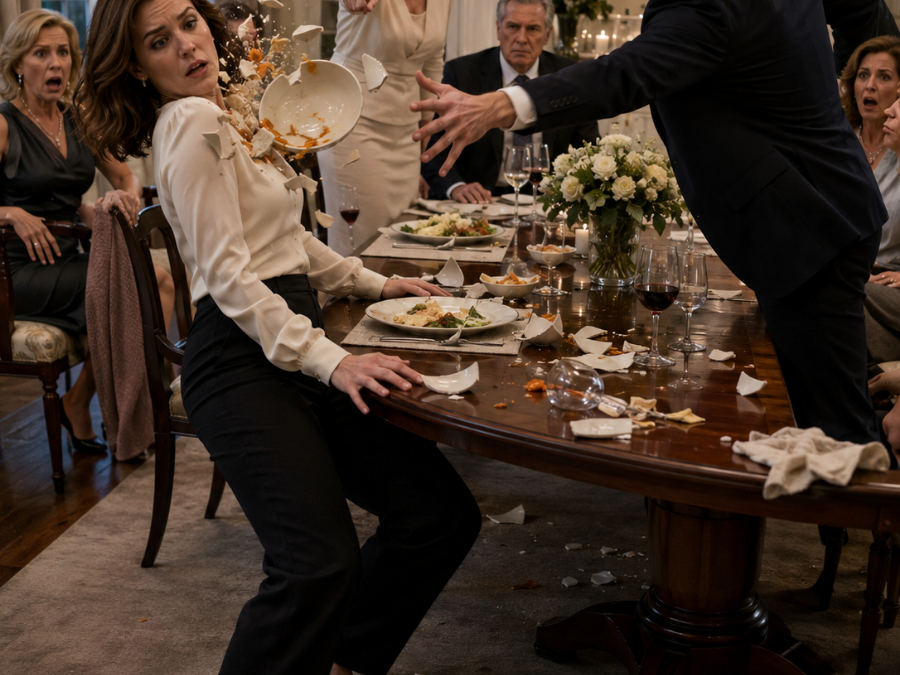
He grabbed the ceramic serving bowl in front of him and swept it off the table toward me.
It struck my shoulder and the side of my head before breaking against the floor.
For several seconds, I heard nothing except a high ringing sound.
Then warmth spread near my hairline.
I steadied myself against the table.
Around me, eighteen people froze.
No one rushed toward me.
No one grabbed Grant.
No one asked whether I was all right.
Marilyn’s first words were:
“Look what you made him do.”
Something inside me became perfectly still.
Grant stared at me, breathing hard.
“You pushed me too far.”
I reached into my handbag.
Warren stood.
“Claire, don’t turn this into something ridiculous.”
I unlocked my phone.
Grant’s eyes narrowed.
“What are you doing?”
I tapped three numbers.
Then placed the phone on speaker.
A dispatcher answered.
I looked around the table at every relative who had watched my husband throw a heavy object at me and then waited for me to accept responsibility.
“My name is Claire Bennett Prescott,” I said clearly. “My husband just assaulted me in front of eighteen witnesses, and I need police and medical assistance at this address.”
Marilyn stood.
“Hang up.”
I ignored her.
Grant stepped toward me.
I raised one hand.
“Do not come closer.”
For the first time since I entered that family, he stopped when I told him to.
Sirens became audible several minutes later.
And suddenly everyone who had been silent discovered they had plenty to say.
Part 2: The Family Story Changed When Police Entered the House
By the time officers arrived, the Prescotts had already begun rewriting what happened.
Grant said the bowl slipped.
Marilyn said I had been hysterical.
Warren insisted we had both been drinking, despite the untouched glass beside my plate.
Paige claimed she had been looking away.
Three other relatives said they did not remember exactly what they saw.
Only Grant’s cousin’s wife, Hannah Cole, spoke immediately.
“He threw it.”
Every face turned toward her.
Hannah went pale, but she repeated herself.
“He picked it up and threw it at Claire.”
Grant stared at her.
“You should stay out of this.”
One of the officers stepped between them.
“That’s enough.”
A paramedic examined the cut near my temple while another officer photographed the broken ceramic, the overturned chair, and the food scattered across the floor.
Grant kept talking.
He said I had humiliated him.
He said I had insulted his mother.
He said stress had made him lose control.
Every sentence made things worse.
When they placed him in handcuffs, Marilyn started crying.
Not because her son had attacked his wife.
Because neighbors could see the police vehicles.
“This family has a reputation,” she whispered to me.
I looked at her.
“So do I.”
I spent several hours at the hospital and left with stitches, medication, and instructions to rest.
Hannah was waiting in the parking lot.
She looked terrified.
“Can I talk to you?”
I hesitated.
Then nodded.
We sat inside her car.
For a long moment she said nothing.
Finally she whispered, “The house isn’t the only thing.”
“What do you mean?”
She gripped the steering wheel.
“Grant has been moving money.”
My stomach dropped.
“What money?”
“Yours.”
I stared at her.
She explained that her husband, Grant’s cousin Eric, occasionally handled bookkeeping for Prescott Holdings, the family’s private investment company. Months earlier, Hannah overheard an argument in which Eric accused Grant of using marital funds to cover losses in one of Warren’s failing development projects.
“How much?”
“I don’t know.”
“Why didn’t you tell me?”
Her eyes filled.
“Because everyone in that family learns to stay quiet.”
I looked through the windshield.
“I’m finished staying quiet.”
The next morning I called Dana Whitmore, an attorney I had known since college.
She arrived at Willow Street carrying coffee, a laptop, and a face that told me she had already decided she disliked Grant.
Within forty-eight hours, we found the first transfer.
Then the second.
Then fourteen more.
For nearly two years, Grant had been moving money from our joint savings account into a company called North Crest Advisory.
I had never heard of it.
Dana traced the company.
It was controlled by Warren.
The total was $186,000.
I stared at the screen.
“That was supposed to be retirement money.”
Dana nodded.
“It wasn’t invested for you.”
She opened another document.
“It was used to cover loan payments connected to a commercial property owned by the Prescott family.”
My stomach turned.
Grant had not merely lied about my house.
He had already been using my money to protect his family.
Then Dana found something worse.
Three weeks before the dinner, Grant had requested copies of the Willow Street deed.
Two days later, a draft transfer agreement had been prepared.
My signature line was blank.
Marilyn’s family trust was listed as beneficiary.
“They were planning to pressure you into signing,” Dana said.
I stared at the document.
“The dinner.”
Dana nodded.
“They wanted a room full of relatives making you feel unreasonable.”
Public humiliation had not been an accident.
It had been strategy.
I thought about the way Warren explained that Marilyn would “temporarily” occupy the building.
The way Paige accused me of creating conflict.
The way Grant demanded an apology.
They expected me to be outnumbered.
They expected embarrassment to do what legal authority could not.
Then Hannah called.
“Claire, there’s something you should know.”
I put her on speaker.
“Warren records family meetings.”
Dana stopped typing.
“What?”
“He has cameras in the main dining room and study. He says they’re for security, but Eric told me Warren keeps recordings whenever money is discussed.”
I looked at Dana.
She was already reaching for her legal pad.
“If that dinner was recorded,” she said slowly, “Grant’s entire story just collapsed.”
Part 3: The Evidence They Never Thought I Would Find
We did not sneak into anyone’s property.
Dana was too smart for that.
Instead, she requested preservation of all security footage through the criminal investigation and immediately notified the family’s attorneys that destroying recordings could create separate legal consequences.
For three days, Warren claimed no useful footage existed.
On the fourth, investigators obtained it.
I watched the video in Dana’s office.
The camera angle looked down from a corner of the dining room.
There I was.
Eighteen people surrounding me.
Marilyn announcing her move.
Warren discussing the property.
Grant refusing to meet my eyes.
Then my refusal.
His chair moving.
His hand grabbing the bowl.
The throw.
I looked away before impact.
Dana paused the video.
“You don’t have to keep watching.”
“Yes, I do.”
She looked at me.
“Why?”
“Because I spent three years wondering if I was exaggerating every time he scared me.”
I pressed play.
The recording continued after police were called.
That was when the real betrayal appeared.
Warren leaned toward Grant.
“You were supposed to get the signature first.”
I stopped breathing.
Marilyn whispered, “If she files charges, the transfer is dead.”
Grant paced.
“She’ll calm down.”
Paige asked, “What about the development offer?”
Warren answered:
“Without Claire’s parcel, the whole block becomes harder to assemble.”
Dana paused the recording again.
Neither of us spoke.
The house had never been about Marilyn needing fewer stairs.
They wanted to place her there, establish family control over the property, pressure me into the trust, and eventually include the building in a larger sale.
My marriage had become part of a business plan.
The next discovery was even more personal.
Dana subpoenaed financial records connected to North Crest Advisory and found that Grant had used $28,000 of my money to pay the down payment on a luxury vehicle for Marilyn.
He had told me Warren bought it.
Another $42,000 covered legal fees for one of Paige’s failed investments.
Several smaller transfers funded family vacations I had been told were “gifts.”
I sat in Dana’s office staring at the statements.
“I paid for people to treat me like I didn’t belong.”
Dana leaned back.
“You paid because your husband lied.”
“That doesn’t make it feel better.”
“No.”
She closed the folder.
“But it tells you where responsibility belongs.”
Grant began calling from his attorney’s office.
I blocked him.
Then letters arrived.
He was sorry.
He had panicked.
His family pressured him.
He loved me.
He wanted counseling.
The first five pages blamed Warren.
The final paragraph blamed me.
“You always made me feel like I had to prove myself,” he wrote.
I stopped reading.
Two weeks later, we met for a court-ordered property conference.
Grant entered wearing a gray suit and the exhausted expression of a man who expected sympathy.
Marilyn and Warren accompanied him.
Dana sat beside me.
My attorney placed the transaction records on the table.
Grant’s face tightened.
Warren spoke first.
“These transfers were family investments.”
“They were unauthorized,” Dana said.
Grant looked at me.
“Claire, we were married. Everything was shared.”
I leaned forward.
“Then why didn’t you tell me?”
He opened his mouth.
I continued.
“Why create a company I didn’t know existed?”
Silence.
“Why prepare a deed transfer before discussing my house?”
Marilyn interrupted.
“Because you are impossible to reason with.”
I turned toward her.
“You planned to take control of property I owned before meeting your son.”
“You married into a family.”
“I married Grant.”
My eyes moved toward him.
“Apparently he married me into a balance sheet.”
Grant’s jaw clenched.
“You always thought you were better than us.”
There it was.
Not remorse.
Resentment.
I finally understood that Grant had never hated my independence because it excluded him.
He hated it because he could not control it.
Dana slid a final document across the table.
It contained my proposed divorce settlement.
Return the transferred funds.
Waive any claim to Willow Street.
Separate all liabilities connected to Prescott Holdings.
No harassment.
No contact except through attorneys until the criminal case concluded.
Grant laughed.
“You think I’m agreeing to this?”
I looked at him.
“No.”
Then I placed a printed transcript from the dining-room recording beside the settlement.
“I think your attorney is going to explain why you should.”
His smile disappeared.
Part 4: The Moment Their Family Loyalty Finally Broke
The Prescotts did not collapse dramatically.
They fractured.
That was worse.
Hannah gave a full statement to investigators.
Her husband, Eric, initially accused her of betraying the family, then hired his own attorney after learning Warren had placed several debts under his name without explaining the exposure.
Paige discovered the family trust was worth far less than Warren had implied.
Marilyn blamed everyone except Grant.
Then Grant blamed Warren.
Warren blamed the economy.
Every person who had spent years defending “family unity” began hiring separate lawyers.
Meanwhile, I went back to work.
The first morning I returned to my studio at Willow Street, I stood alone in the upstairs room and looked at the drafting table near the windows.
For weeks, I had thought of the building only as something they tried to take.
That morning I remembered what it actually was.
Mine.
I had bought it before Grant.
Repaired damaged floorboards with my own hands.
Spent weekends painting walls.
Met my first major client there.
Cried there after my father died.
Celebrated there when I opened my firm.
The Prescotts saw square footage.
I saw a life.
Six months after the dinner, Grant pleaded guilty to a reduced assault charge as part of a broader agreement requiring restitution and mandatory intervention programming. The financial cases connected to Prescott Holdings continued separately, and Warren’s company entered restructuring after lenders began examining several transactions.
I did not celebrate.
I expected to.
Instead I felt tired.
Dana noticed.
“You thought winning would feel louder.”
“Yes.”
“It usually doesn’t.”
“What does it feel like?”
She smiled.
“Mostly paperwork.”
I laughed.
That helped.
The divorce hearing took place on a rainy Tuesday.
Grant sat across the courtroom.
He looked thinner.
For the first time in years, his family was not sitting behind him.
Warren was dealing with his own legal problems.
Marilyn stayed home.
Paige refused to speak to him.
When the judge finalized the dissolution, Grant looked toward me.
“Claire.”
I stopped.
Dana stayed nearby.
Grant swallowed.
“I really did love you.”
I studied his face.
“I believe you thought you did.”
His eyes filled.
“That’s cruel.”
“No.”
I shook my head.
“Cruel was believing love gave you permission to punish me when I said no.”
He looked away.
“I lost everything.”
I thought about that.
Then answered carefully.
“You lost access to things you never had the right to control.”
His face tightened.
“The house?”
“The house.”
“The money?”
“The money.”
“You.”
I met his eyes.
“Especially me.”
For once, he had nothing to say.
Outside the courthouse, Hannah waited beneath an umbrella.
Her husband was not with her.
“I filed,” she said.
“For divorce?”
She nodded.
“I kept telling myself Eric wasn’t like Grant because he never threw anything.”
Rain ran along the edge of the umbrella.
“But silence can be its own kind of participation.”
I hugged her.
Not because our stories were identical.
They weren’t.
Because I understood how difficult it was to discover that the people you called family had been teaching you to distrust your own boundaries.
Hannah pulled back.
“Do you ever regret calling the police?”
“No.”
The answer surprised both of us with how quickly it came.
Not anymore.
The phone call had not destroyed my marriage.
It had simply stopped me from protecting a marriage that was already destroying me.
Part 5: The House They Wanted Became the Place I Chose
One year after the dinner at the Prescott estate, I hosted twelve people at Willow Street.
Not eighteen.
Not twenty.
Twelve.
That number felt right.
Dana came.
Hannah came with her sister.
Several colleagues from my engineering firm brought food.
My downstairs tenant joined us with his teenage daughter, who spent most of the evening arguing cheerfully with Dana about whether pineapple belonged on pizza.
We ate around a long oak table I had bought secondhand.
The plates did not match.
Nobody cared.
There was no seating chart.
No one discussed property.
Halfway through dinner, Hannah lifted her glass.
“To Claire.”
I groaned.
“No speeches.”
“This isn’t a speech.”
“It’s beginning like one.”
Everyone laughed.
Hannah smiled.
“To the woman who taught me that ‘no’ is a complete sentence.”
I lifted my glass.
“To the woman who actually used it.”
We drank.
Later that evening, after everyone left, I carried dishes into the kitchen.
For a second, a plate slipped in my hands and struck the edge of the sink.
The sound was sharp.
My body froze.
One year disappeared.
I saw the dining room again.
Grant standing.
Ceramic breaking.
Eighteen faces doing nothing.
My breathing changed.
Then the moment passed.
I looked down.
The plate had not broken.
I set it gently on the counter.
Recovery was strange that way.
Freedom did not erase memory.
It simply gave memory less authority.
The next morning, I walked upstairs to my studio and opened the windows.
Construction drawings covered the walls.
My firm had recently won a contract to design a neighborhood center containing affordable apartments, child-care space, and small offices for local businesses.
It was not glamorous.
There would be no magazine profile.
I loved it.
For years, the Prescotts measured people by what they owned.
Homes.
Land.
Cars.
Companies.
Trusts.
I had almost absorbed the same thinking in reverse, believing independence meant protecting every possession at any cost.
But Willow Street mattered for a different reason.
It was the place where I learned ownership was not only about deeds.
It was about deciding who entered.
Who stayed.
Who received a key.
Who had the right to ask.
And who had to leave.
Marilyn sent one letter.
I nearly threw it away unopened.
Then curiosity won.
She did not apologize.
She wrote that family matters should never have become public and that Grant’s consequences had been excessive.
At the end she wrote:
“I hope someday you understand what loyalty means.”
I laughed so loudly my downstairs tenant texted to ask whether everything was okay.
I wrote Marilyn one response.
Loyalty without respect is obedience.
Then I deleted it.
Some people do not need your final argument.
Silence can become a boundary instead of a prison when you choose it yourself.
Grant completed the required program and eventually moved to another state.
I heard through attorneys that he found work with a smaller construction company.
I did not ask for details.
Warren sold much of the Prescott estate as part of his financial restructuring.
Marilyn moved into a comfortable one-story rental.
Not mine.
Life continued.
That was perhaps the strangest part.
For months, I had believed the confrontation would define everything afterward.
It didn’t.
Eventually I had deadlines again.
Bad coffee.
Client arguments.
Laundry.
Birthdays.
Sunday grocery shopping.
There were days when I did not think about Grant at all.
Those days became weeks.
Then months.
Two years after the dinner, I replaced the front door at Willow Street.
The original was dark wood with decorative glass that had always rattled during storms.
The new door was simple.
Solid.
Blue-gray.
I installed the final hardware myself.
Dana arrived halfway through and watched me tightening screws.
“You know people can do that professionally.”
“I know.”
“You literally employ contractors.”
“I know.”
She smiled.
“So why are you doing it?”
I stepped back.
The door closed smoothly.
Because I wanted to.
That answer had become increasingly important.
I wanted the house.
I wanted my work.
I wanted friendships where favors were offered instead of demanded.
I wanted family relationships that did not require surrender as proof of love.
Most of all, I wanted the right to say no without preparing for punishment.
The old Claire believed being reasonable meant explaining herself until everyone agreed.
I no longer needed agreement.
Some boundaries are understood only when enforced.
On the second anniversary of the dinner, Hannah came over carrying a ceramic serving bowl.
I stared at it.
She immediately started laughing.
“I realized after I bought it that this might be the worst gift in human history.”
I laughed too.
The bowl was bright blue with tiny painted leaves.
“What am I supposed to do with it?”
“Serve pasta?”
“That seems dangerously normal.”
“Exactly.”
That evening we filled it with salad.
Nothing happened.
Nobody yelled.
Nobody demanded property.
Nobody shattered anything.
It was simply a bowl.
I realized then how many ordinary objects become frightening because of what someone once did with them, and how healing sometimes means allowing those objects to become ordinary again.
The Prescott dinner had once seemed like the night my life collapsed.
It wasn’t.
It was the night I finally saw the structure clearly.
My marriage had not failed because I refused to hand over a building.
It failed because the people around me believed my boundaries were negotiable and my independence was something they could punish until it disappeared.
Calling for help did not make me disloyal.
Leaving did not make me selfish.
Protecting what I built did not make me greedy.
And saying no did not create the violence that followed.
Those choices belonged to someone else.
Mine came afterward.
I chose the police call.
I chose the attorney.
I chose the truth.
I chose the divorce.
I chose the blue-gray door.
And eventually, without realizing exactly when it happened, I chose a life where I no longer measured peace by how successfully I prevented other people from becoming angry.
That might have been the greatest change of all.
Because for years I designed buildings meant to remain standing under pressure.
It took me much longer to understand that people are different.
Sometimes surviving does not mean staying where the pressure is strongest.
Sometimes the safest structure you can build begins with an exit.
The End. This story is entirely fictional and was created for entertainment purposes. All characters, names, locations, events, and situations depicted in this story are imaginary. Any resemblance to actual people, organizations, places, or events is purely coincidental.








