At my husband’s company gala, he humiliated me beside the woman he loved—then the chairman called my name, and the entire ballroom turned toward me
At my husband’s company gala, he humiliated me beside the woman he loved—then the chairman called my name, and the entire ballroom turned toward me
Part 1: The night I realized humiliation had become part of my marriage
The first sign that my marriage was no longer what I believed did not come from perfume on a collar, a suspicious hotel receipt, or a careless text message. It came from an empty space inside a jewelry case, where a pair of emerald earrings that had belonged to my grandmother had rested for almost fifteen years.
My name is Claire Whitmore, I was thirty-eight years old then, and I had been married to Nathan Cole for eleven years. To most people we looked polished, comfortable, and painfully ordinary in the way successful couples often do from a distance, living in a renovated brick home outside Portland, Maine, hosting dinners, attending charity events, and appearing in holiday photographs where nobody could see the resentment gathering behind Nathan’s smile.
The earrings mattered because my grandmother had given them to me shortly before she died, along with something far more significant that Nathan understood only vaguely. She had spent four decades building Whitmore Capital, a private investment company that specialized in rescuing struggling manufacturing businesses, and after her death the controlling interest quietly passed to me.
Nathan knew I had money.
He did not know how much.
More importantly, he never bothered to ask what I actually did with it.
He preferred telling people that his wife “managed old family investments” and volunteered with a regional arts foundation, because that version of me kept the spotlight where he liked it.
On him.
Nathan served as Chief Development Officer at HarborVale Industries, a mid-sized industrial technology company that had once been respected but was now carrying enormous debt after a failed expansion. For almost a year, he had been telling everyone who would listen that the board was preparing to name him company president.
According to Nathan, he was the only executive smart enough to save HarborVale.
According to the numbers I would later see, he was one of the reasons it needed saving.
The morning I discovered the earrings missing, rain tapped against our bedroom windows while I stood in front of the open jewelry case, staring at the empty velvet slot.
Nathan had left before sunrise.
He claimed he had a breakfast meeting with HarborVale’s director of communications, Vanessa Rowe.
Vanessa was thirty-three, stylish, ambitious, and almost always standing too close to my husband in photographs from company events.
I had noticed.
I had simply not wanted to become the suspicious wife who mistook every professional relationship for betrayal.
Then my phone buzzed.
Unknown number.
One image.
Nathan entering a small waterfront hotel.
Vanessa beside him.
His hand rested against the small of her back.
I sat slowly on the edge of the bed.
For several minutes, I did nothing.
Then I called Arthur Bell, HarborVale’s longtime board chairman.
He had known my grandmother.
More importantly, he knew exactly who controlled Whitmore Capital.
“Claire,” he said when he answered. “This is unexpected.”
“I need access to HarborVale’s financial records.”
Silence.
“All of them?”
“Executive expenses, vendor payments, consulting agreements, travel reimbursements.”
Arthur inhaled.
“Should I ask why?”
“You can.”
“Will you answer?”
“Not yet.”
That afternoon, I walked into Whitmore Capital’s downtown office and met with our forensic accountant, Benjamin Cross.
Within five days, he found something far worse than adultery.
Nathan had approved repeated payments to a consulting company called Redbrook Advisory.
Each payment was carefully kept just below the level requiring broader board approval.
Redbrook had no employees.
No office.
No legitimate work product.
Its registered owner was Vanessa’s older brother.
Benjamin rotated his monitor toward me.
“Over nineteen months, HarborVale transferred just over two million dollars.”
My hands went cold.
Nathan had not simply used company travel to spend weekends with Vanessa.
He had helped funnel corporate money through her family.
Meanwhile, HarborVale had frozen employee raises, reduced overtime, and announced possible layoffs.
I stared at the spreadsheet.
“What happens if HarborVale defaults?”
“Lenders could force liquidation.”
“How soon?”
“Months. Maybe weeks.”
I looked through the conference-room window at the gray harbor beyond the city.
My marriage had become personal betrayal.
But Nathan’s greed had become something larger.
Eight hundred people worked for HarborVale.
They did not deserve to lose their jobs because my husband wanted expensive weekends and a secret account.
I made a decision.
Whitmore Capital began quietly purchasing HarborVale’s distressed debt through several subsidiaries.
No public announcement.
No dramatic threat.
Just documents, negotiations, and signatures.
At home, I continued pretending.
Nathan came through the door every night talking about himself.
“They’re finally realizing Arthur is too old-fashioned,” he said one evening while pouring himself a drink. “After the anniversary gala, the board will have to make a move.”
I sat across from him.
“What move?”
“President.”
He smiled.
“You’ll finally get to introduce yourself as the president’s wife.”
He thought that would impress me.
I smiled back.
“That sounds important.”
He leaned closer.
“It is.”
Three days before HarborVale’s anniversary gala, I made one mistake.
I went into Nathan’s home office while he was supposed to be at work.
I was looking for an external drive Benjamin believed might contain copied expense records.
I opened the bottom drawer.
Behind a stack of documents was a small velvet box.
My grandmother’s emerald earrings were gone.
But the box was there.
Empty.
The office door clicked behind me.
Nathan stood in the doorway.
“What are you doing?”
I closed the drawer.
“Looking for a pen.”
He stared at me.
His face changed just slightly.
Not guilt.
Contempt.
“Claire, stay out of my work files.”
“I wasn’t reading anything.”
“You wouldn’t understand half of it anyway.”
He stepped aside.
“Finance gets complicated.”
For several seconds, I looked at the man who had spent eleven years believing I was intellectually beneath him.
Then I walked past.
The gala was three nights later.
And when Vanessa entered the ballroom, I saw my grandmother’s earrings hanging from her ears.
Part 2: He chose to humiliate me in front of the entire company
HarborVale’s anniversary gala filled the grand ballroom of the fictional Briar House Hotel with nearly two hundred employees, investors, spouses, and senior managers. Crystal chandeliers reflected against tall windows, waiters moved between tables carrying trays of champagne, and beneath all the polished conversation ran the nervous tension of employees who knew the company was financially unstable.
I wore a dark sapphire evening dress.
Nathan barely looked at me when we arrived.
Vanessa was already there.
She wore a fitted burgundy gown and stood beside him almost immediately, touching his sleeve whenever she laughed.
The emerald earrings swung beneath her hair.
For a moment, I could hear nothing.
Not the music.
Not the conversations.
Not the glasses.
Those earrings had been in my grandmother’s wedding photographs.
I had worn them when I married Nathan.
Now his mistress was wearing them in public.
Vanessa noticed me looking.
Her fingers brushed one earring.
A tiny smile appeared.
That told me she knew exactly where they came from.
I walked toward them.
Nathan’s expression tightened.
“Claire.”
“Vanessa.”
She smiled.
“You look lovely.”
“So do the earrings.”
Her smile weakened for half a second.
Nathan stepped between us.
“Not tonight.”
I looked at him.
“What exactly isn’t happening tonight?”
“This.”
He lowered his voice.
“Whatever emotional scene you’re preparing.”
“Interesting.”
Vanessa looked away as though embarrassed on my behalf.
Nathan leaned closer.
“You’re making yourself look insecure.”
I almost laughed.
He had stolen from his company, lied to his wife, given another woman my family jewelry, and somehow I was embarrassing myself.
“I think I’ll stay nearby,” I said.
Nathan’s jaw tightened.
“The board is making an executive announcement.”
“I know.”
“You don’t need to stand here.”
“I’d like to hear it.”
His eyes darkened.
“Go sit with the spouses.”
“No.”
The word surprised him.
Vanessa took a sip of champagne.
Nathan shifted closer.
“Claire.”
“No.”
His smile disappeared.
He leaned beside my ear.
“She belongs here tonight. You don’t.”
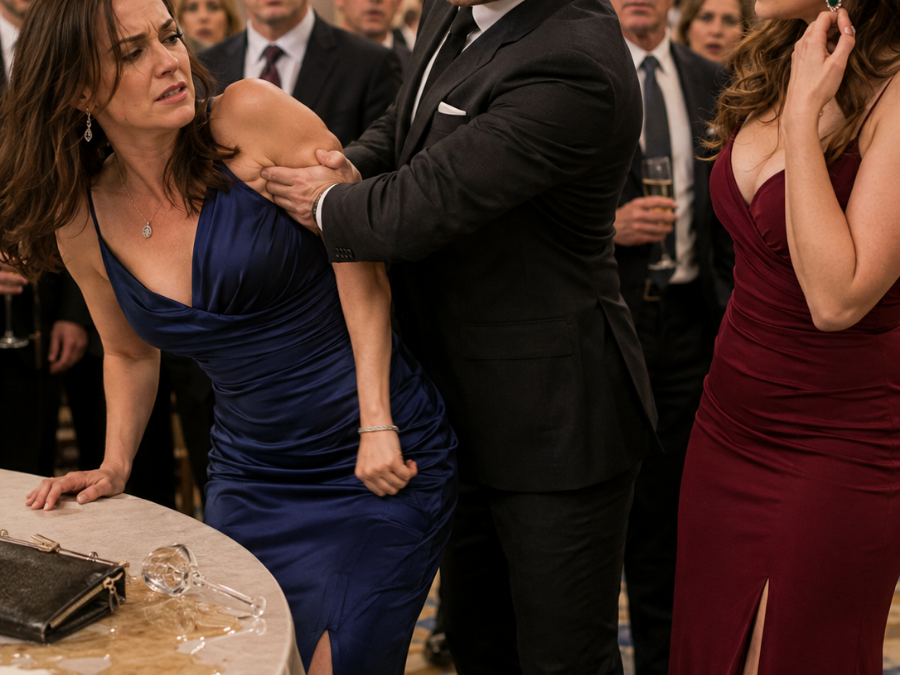
Then he drove two fingers hard into the muscle beneath my shoulder, shoving me sideways just enough to make me stumble into a tall cocktail table.
Three glasses rattled.
One tipped over.
Several employees turned.
Nathan immediately adjusted his jacket as if nothing had happened.
My shoulder burned.
Vanessa glanced down to hide a smile.
For eleven years, Nathan had never struck me openly.
He had grabbed my arm during arguments.
Blocked doorways.
Squeezed my wrist.
Spoken close enough to make intimidation feel physical.
But this was different.
He had done it in public because he believed nobody important would challenge him.
I steadied the table.
Across the ballroom, Arthur Bell was watching.
Beside him stood Benjamin Cross and HarborVale’s general counsel, Margaret Sloan.
Arthur touched his cuff.
That was our signal.
Everything was finished.
The acquisition documents had closed that afternoon.
Whitmore Capital now controlled sixty-one percent of HarborVale Industries.
Nathan did not know.
Neither did Vanessa.
I picked up a glass of sparkling water.
Nathan turned away.
“Enjoy yourself,” he muttered.
“I intend to.”
The ballroom lights dimmed.
Arthur stepped onto the stage.
Nathan immediately straightened.
His anger disappeared beneath the polished smile he used for cameras and board members.
Vanessa touched his arm.
He whispered something to her.
Probably about becoming president.
Arthur tapped the microphone.
The room quieted.
“For twenty-five years, HarborVale Industries has survived because of the people in this room,” he began. “The last eighteen months have tested that survival.”
Nathan nodded solemnly.
I almost admired the performance.
Arthur continued.
“We carried too much debt, expanded too quickly, and trusted decisions that should have received greater scrutiny.”
A few executives shifted.
Nathan did not.
“But this afternoon, HarborVale secured its future.”
Applause began cautiously.
“A new majority investor has acquired the company’s most dangerous debt, provided restructuring capital, and guaranteed that our current operating facilities will remain open.”
This time the applause grew louder.
Nathan clapped.
Then Arthur looked toward me.
“Please welcome the managing principal of Whitmore Capital and HarborVale’s new majority owner, Claire Whitmore.”
Silence.
Nathan stopped clapping.
Vanessa’s hand fell away from his arm.
I placed my glass on the table.
Then I walked toward the stage.
Every step felt strangely quiet.
Behind me, Nathan said my name.
Not lovingly.
Not even angrily.
He said it like a man watching the floor disappear.
“Claire?”
I did not turn.
Arthur extended his hand.
I stepped onto the stage.
When I faced the ballroom, Nathan looked physically ill.
Vanessa had gone pale.
I took the microphone.
“Good evening.”
Nathan shouted from below.
“What is this?”
Arthur looked toward him.
“Mr. Cole, please allow her to speak.”
Nathan stared at me.
“You own Whitmore Capital?”
A small, stunned laugh moved through the crowd.
I looked directly at my husband.
“Yes.”
His mouth opened.
Nothing came out.
For the first time in eleven years, Nathan had no idea who I was.
Part 3: The public humiliation he planned for me became his own
I explained only what the employees needed to know.
Whitmore Capital had acquired controlling interest.
HarborVale would remain open.
No mass layoffs were planned.
Operational restructuring would begin immediately.
The room slowly shifted from shock to relief.
Then I said one more thing.
“However, protecting HarborVale requires acknowledging why the company became vulnerable.”
Nathan’s face changed.
He knew.
Maybe not everything.
But enough.
Margaret Sloan joined me onstage carrying a thick folder.
Benjamin stood near the projection controls.
The screens behind us changed.
No private photographs appeared.
No messages.
No accusations about adultery.
Only financial records.
Dates.
Vendor payments.
Travel expenses.
Transfers.
Nathan immediately stepped toward the stage.
“What are you doing?”
Security moved into the aisle.
He stopped.
I continued.
“For nearly two years, HarborVale paid recurring consulting fees to a vendor with no verifiable operations.”
Vanessa turned toward Nathan.
Her panic became visible.
I looked at her.
“The vendor was controlled by a close relative of one HarborVale executive.”
Employees began whispering.
Nathan pointed at me.
“This is personal.”
“No.”
My voice remained calm.
“Our marriage is personal.”
I gestured toward the screens.
“This is corporate fraud.”
His face reddened.
“You secretly investigated me?”
“I investigated a company Whitmore Capital was preparing to acquire.”
“You used our marriage.”
“No, Nathan.”
My hands were steady around the microphone.
“You used your job.”
Margaret opened the folder.
“The board met this afternoon following review of an independent forensic audit.”
Nathan looked toward Arthur.
“You approved this?”
Arthur’s expression remained cold.
“Yes.”
Nathan laughed sharply.
“You can’t remove me. My contract guarantees severance.”
Margaret answered.
“Not for termination with cause.”
The room became completely silent.
She read the resolution.
Nathan was terminated immediately for unauthorized vendor payments, undisclosed conflicts, falsified expense reporting, and misuse of corporate funds.
Vanessa was suspended pending a separate investigation.
Nathan’s fists tightened.
“You think you can steal my company?”
“It was never your company.”
His eyes locked on mine.
“This is revenge because you think I slept with Vanessa?”
A gasp moved through the ballroom.
Vanessa closed her eyes.
Nathan realized too late what he had admitted publicly.
I said nothing about it.
Instead, I looked toward the earrings.
“Vanessa.”
She opened her eyes.
“The earrings you’re wearing belonged to my grandmother.”
Her face went white.
“She gave them to me,” Nathan said immediately.
Several people turned toward him.
I almost smiled.
“Thank you for confirming that.”
His face changed again.
Arthur stepped forward.
“Nathan, this evening is finished.”
“No.”
Nathan moved toward the stage.
“You don’t get to do this to me.”
Two security officers blocked him.
He pointed over their shoulders.
“You think this makes you powerful?”
I looked at him.
“No.”
My voice softened.
“I think owning the company makes me responsible.”
He laughed bitterly.
“You’ve been lying to me for eleven years.”
“You never asked.”
“I knew you had investments.”
“You knew what you wanted to know.”
Nathan tried to step around security.
“You were my wife.”
“Yes.”
“And you hid an entire company from me.”
“You called my work charity budgets.”
A few employees lowered their eyes.
I continued.
“You told people my family money was passive inheritance.”
His expression twisted.
“You let me believe that.”
“I corrected you many times.”
My throat tightened.
“You preferred the version where I was smaller.”
For the first time, Nathan had no quick response.
I looked across the ballroom.
Some employees were angry.
Others looked stunned.
Many looked relieved.
These people had sacrificed bonuses and raises while executives moved money into fake consulting arrangements.
That mattered more than my marriage.
Margaret announced that HarborVale would pursue recovery of improperly paid funds and refer evidence to appropriate financial investigators.
Vanessa stepped away from Nathan.
He noticed.
His expression turned on her instantly.
“Don’t.”
She shook her head.
“You told me nobody could trace it.”
The words escaped before she could stop them.
The crowd reacted.
Nathan turned pale.
“That’s enough.”
“No,” Vanessa said, suddenly terrified. “You said your wife didn’t understand any of this.”
I looked at her.
That almost hurt more than the affair.
Not because of what she believed.
Because of where she had learned it.
Nathan.
He had built his affair partly on the idea that I was too insignificant to become dangerous.
Security escorted them from the ballroom separately.
As Nathan reached the doors, he turned.
“You’ll regret this.”
I stared back.
“No.”
He disappeared into the hallway.
And for the first time since I discovered the earrings missing, I believed myself.
Part 4: Winning in public did not erase what happened in private
The next morning, I filed for divorce.
It was less dramatic than people imagine.
No champagne.
No triumphant music.
Just me, my attorney, a conference room, and a pen.
Nathan called sixteen times.
I did not answer.
He sent messages that moved through every predictable stage.
Rage.
Blame.
Threats.
Apology.
Nostalgia.
Then rage again.
Vanessa resigned before HarborVale formally terminated her.
Financial investigators eventually recovered enough evidence to support a civil fraud case against her brother’s consulting company and Nathan’s related accounts.
I did not celebrate.
People expected me to.
Online, strangers would probably imagine the gala as some glorious revenge fantasy where I walked away laughing while my husband lost everything.
Reality was quieter.
I went home that night and stood alone in our bedroom.
Nathan’s clothes were still in the closet.
His shaving cream was beside the sink.
Our wedding photograph was still on the dresser.
I sat on the floor and cried until there was nothing graceful left about it.
Because betrayal does not stop hurting simply because you win the argument.
For weeks, I woke up reaching toward the other side of the bed.
My body remembered a marriage my mind could no longer trust.
I missed conversations.
Private jokes.
Vacations.
Sunday breakfasts.
Some of those memories were real.
That made grieving harder.
Nathan had not been cruel every day.
If he had been, leaving might have been easier.
He had also been charming.
Funny.
Generous when generosity benefited his image.
Tender when he needed reassurance.
The complicated truth was that I had loved a man who sometimes made me happy and increasingly made me smaller.
Both things could be true.
Meanwhile, HarborVale demanded nearly every hour I had.
The company was in worse condition than expected.
Vendor relationships were damaged.
Morale was terrible.
Several senior managers had stopped trusting leadership entirely.
Instead of moving HarborVale into Whitmore Capital’s headquarters, I moved my own office into HarborVale.
People noticed.
I ate lunch in the cafeteria.
Visited engineering teams.
Sat through manufacturing meetings.
Asked supervisors what they needed before telling them what they had done wrong.
One engineer named Samuel Grant had spent twenty-three years with HarborVale.
He told me during my second month, “People don’t need speeches right now.”
“What do they need?”
“To see somebody stay.”
So I stayed.
We canceled unnecessary executive perks.
Sold a rarely used corporate retreat property.
Renegotiated supplier debt.
Reopened a training program Nathan had cut.
Most importantly, we restored employee bonuses only after cash flow stabilized.
Nine months later, HarborVale posted its first profitable quarter in more than two years.
We held a company lunch.
No hotel.
No ballroom.
No chandeliers.
Just folding tables, catered food, music, and employees bringing their families.
Arthur stood beside me.
“You saved it.”
I shook my head.
“No.”
I looked across the room.
“They did.”
That afternoon, I promoted Samuel to Chief Operating Officer.
He tried to refuse.
I told him refusing would require more paperwork than accepting.
He laughed.
I had not realized how much I missed ordinary laughter.
The divorce finalized shortly afterward.
Nathan lost his executive position, a large portion of his remaining compensation, and much of the social circle that had existed because of his title.
I learned later he moved to another state.
I did not ask where.
Vanessa eventually returned the earrings through attorneys.
When the small evidence envelope arrived at my office, I opened it alone.
The emeralds were exactly as I remembered.
For several minutes, I held them in my palm.
Then I locked them away.
Not because they had been ruined.
Because I was not ready.
Healing, I discovered, was not a dramatic staircase you climbed once.
It was a thousand small decisions.
Sleep tonight.
Answer this email.
Eat something.
Go outside.
Stop rereading the message.
Do not call him.
Tell the truth.
Rest.
Begin again.
Part 5: I learned the difference between revenge and rebuilding
A year after the gala, HarborVale hosted another company celebration.
We held it inside the main manufacturing facility after the final shift ended.
Employees had cleared part of the floor.
Long tables were covered with food.
Someone brought speakers.
Families wandered through guided tours where workers proudly showed children what they built.
I wore jeans, a gray sweater, and comfortable shoes.
No armor.
No performance.
Arthur handed me a sparkling water.
“Different from last year.”
“Much better.”
Across the room, Samuel was explaining something to a group of apprentices.
HarborVale had hired fifty new trainees that year.
The company was profitable.
Debt was manageable.
Employee turnover had fallen sharply.
Whitmore Capital had made money too.
But that no longer felt like the most important measurement.
I had spent years believing control meant being impossible to hurt.
It didn’t.
Strength was not making sure nobody could betray you.
Strength was knowing betrayal would not destroy your identity if it happened.
That evening, I finally wore my grandmother’s emerald earrings again.
A young employee named Jenna noticed them.
“They’re beautiful.”
“Thank you.”
“Family?”
“Yes.”
She smiled.
“Those are the best things to keep.”
Her comment stayed with me.
Because inheritance is complicated.
My grandmother left me money.
She left me a company.
She also left me an example of a woman who refused to become smaller simply because powerful men found that more comfortable.
But there were things I wanted to inherit differently.
My grandmother had been brilliant and hard.
Sometimes too hard.
She taught me independence so thoroughly that I often mistook secrecy for safety.
That had helped create the blind spot in my marriage too.
Nathan never truly knew my professional life.
Some of that was because he did not care enough to ask.
Some of it was because I eventually stopped offering.
In another marriage, with another person, I would not repeat that pattern.
Not because Nathan deserved more access.
Because I deserved a relationship where hiding strength was unnecessary.
Months later, I sold the house Nathan and I had shared.
I bought a smaller home near the coast.
The first evening there, I ate dinner on the floor because my table had not arrived.
There were boxes everywhere.
Rain tapped against the windows.
No one was expected home.
And the silence did not frighten me.
It felt peaceful.
For years, Nathan had treated silence as something he could use against me.
He withdrew affection.
Stopped speaking.
Closed doors.
Made me feel as if emotional distance were punishment.
Now I learned silence could belong to me too.
Quiet mornings.
Coffee near the window.
Books left open.
Music I liked.
Friends who came over without asking whether Nathan would approve.
A life that no longer required me to calculate someone else’s mood before entering a room.
People occasionally asked whether I regretted staying with him so long.
I never knew how to answer.
Regret can become another form of punishment.
I wish I had recognized certain things sooner.
I wish I had challenged the first controlling behavior instead of explaining it away.
I wish I had not mistaken his confidence for character.
But I also know that the woman who finally walked onto that stage existed because of every version of me that came before her.
The young woman who loved him.
The wife who compromised.
The woman who doubted herself.
The executive who followed the money.
The granddaughter who remembered what she had inherited.
None of those women deserved contempt.
They were all me.
Two years after the gala, I attended another HarborVale event.
This time, Samuel stood onstage announcing a major expansion.
He called me up briefly.
I almost refused.
Then I walked beside him.
The applause was warm.
Not shocked.
Not fueled by scandal.
Simply appreciative.
I looked across the room and remembered Nathan standing beneath chandeliers, ordering me to go home because he believed another woman belonged beside him.
That moment once felt enormous.
Now it seemed small.
A desperate act from a frightened man who needed me diminished so he could feel powerful.
I no longer hated him.
That surprised me.
Hatred still requires a kind of attention.
Eventually, I simply stopped giving him any.
After the event, I stepped outside.
The evening air was cool.
Arthur joined me near the entrance.
“You ever think about that night?”
“Sometimes.”
“What part?”
I smiled.
“Not the stage.”
He looked surprised.
“What, then?”
“The moment before it.”
“When he pushed you?”
“Yes.”
I looked toward the parking lot.
“For a long time, I thought the important thing was that ten minutes later everyone learned who I was.”
Arthur waited.
“But that wasn’t the real victory.”
“What was?”
“I already knew.”
He smiled slowly.
That was the difference.
Nathan believed the revelation mattered because other people finally saw my power.
But my life changed before the announcement.
It changed when I stopped accepting his definition of me.
The stage only made it visible.
If the chairman had never called my name, Nathan still would have been wrong.
If Whitmore Capital had failed to acquire HarborVale, he still would have been wrong.
If nobody in that ballroom had ever learned my net worth, my title, or my ownership percentage, he still would have been wrong.
My worth was never created by the surprise on his face.
That realization freed me more than revenge ever could.
Nathan had wanted a wife who stood quietly behind him.
Vanessa wanted the position beside him.
I eventually understood that I did not want either place.
I wanted my own.
And I built it.
The End. This story is entirely fictional and was created for entertainment purposes. All characters, names, locations, events, and situations depicted in this story are imaginary. Any resemblance to actual people, organizations, places, or events is purely coincidental.








