My family ignored my children after our home burned down, then publicly shamed me for refusing to rescue the same father who abandoned us when he needed money
My family ignored my children after our home burned down, then publicly shamed me for refusing to rescue the same father who abandoned us when he needed money
Part 1: The night my children learned who actually shows up
At 2:37 on a freezing November morning, I stood barefoot in the parking lot of the Cedar Hollow Apartments in Briar Glen, Tennessee, holding my seven-year-old daughter against my chest while my four-year-old son clung to my leg and watched orange flames consume the windows of the only home he could remember. Smoke rolled through the cold air, firefighters shouted over bursting glass and sirens, and my daughter kept whispering the same sentence into my shirt: “Dad, please don’t let our house disappear.”
My name is Mason Reed, and at thirty-six I had learned how to fix broken roofs, busted pipes, crooked framing, and almost anything else a house could throw at me, because I had spent fifteen years working construction. What I had never learned was how to explain to two children that everything they owned could vanish in less time than it took to cook breakfast.
The fire had started in the wall between our unit and the apartment next door, probably from old wiring that management had patched instead of replacing. By the time the alarms screamed, smoke was already pushing beneath the bedroom doors, and I had less than two minutes to grab Sophie and Eli, wrap them in blankets, and get down three flights of stairs.
We escaped with my phone, my wallet, and the clothes we had slept in.
Nothing else.
Sophie’s handmade quilt from her grandmother was gone, Eli’s wooden train set was gone, the framed picture of my late mother was gone, and the shoebox filled with every birthday card my children had ever made for me disappeared before sunrise. I kept telling them that things could be replaced, because that was what parents said when the alternative was admitting they were grieving stuffed animals and family photographs too.
At 3:14 a.m., while paramedics checked Eli’s breathing, I sent a message to our family group chat.
“The kids and I got out safely, but the apartment is gone. We have nowhere to stay tonight. Can somebody please call me?”
My father, Warren, read it first.
Then my older sister, Melissa.
Then my cousin Grant.
Then my aunt Carol and my uncle Dale.
Five little indicators told me they had seen the message.
Nobody replied.
I waited ten minutes.
Then twenty.
By four in the morning, a relief volunteer had given Sophie a sweatshirt three sizes too big and Eli a stuffed dog from an emergency supply bin. We were sitting in a twenty-four-hour breakfast place across town when I checked my phone and saw a photo my cousin Grant had posted.
Half my family was gathered around his backyard firepit.
My father was holding a drink.
Melissa was smiling beside him.
Aunt Carol had commented, “Nothing matters more than family.”
I stared at those words while my son slept with his head on my thigh.
Something inside me went very quiet.
Our family had never been particularly warm, but I had always been the one who answered the phone.
When Dad’s transmission failed, I loaned him money.
When Melissa’s husband walked out for three weeks during one of their fights, I fixed her back door and checked on her every evening.
When Grant needed help replacing the roof on his rental house, I gave up two Saturdays and never asked for a dime.
I had believed helping was simply what families did.
That night, I learned some families only believe in that rule when they are receiving.
Before the fire, life had already been difficult.
Three months earlier, the remodeling company where I worked had lost two major contracts, and I was cut along with several other supervisors. I picked up small repair jobs wherever I could, but by November my savings were almost gone.
My children did not know how bad things had become.
They still woke up expecting cereal.
They still argued over the bathroom sink.
They still believed Dad knew where everything was going.
So I kept smiling.
I sold some tools, canceled subscriptions, and postponed every bill that could survive another week.
Then the apartment burned.
The emergency housing voucher covered two nights at a roadside motel.
On the second morning, Sophie sat cross-legged on the bed and asked, “Where are we going tomorrow?”
I told her I was figuring it out.
She nodded because she trusted me.
That trust frightened me more than homelessness.
I called my father.
He answered after six rings.
“Mason,” he said, sounding tired.
“Dad, did you see my message?”
“Yeah.”
I waited.
Nothing.
“The kids and I lost everything.”
“I heard.”
“We need somewhere temporary. Maybe a week.”
He sighed.
“My place isn’t really good for little kids right now.”
Dad lived alone in a three-bedroom house.
One bedroom contained exercise equipment he never used.
Another had become storage for fishing gear.
Still, I swallowed my anger.
“What about Melissa?”
“She has her own problems.”
“What problems?”
“Mason, everybody has things going on.”
I looked through the motel window at Sophie helping Eli put on donated sneakers.
“Yeah,” I said. “I guess they do.”
My best friend, Caleb Morgan, answered the phone before the second ring.
I barely finished explaining before he said, “Bring them here.”
Caleb lived in a small two-bedroom bungalow with an unfinished basement.
He moved his home office downstairs that afternoon so Sophie could use the second bedroom, then dragged a mattress into the living room for Eli.
“You don’t have to do all this,” I told him.
“Yes, I do.”
“Why?”
He looked at me like the question was ridiculous.
“Because you called.”
That sentence almost broke me.
Within three days, strangers had helped more than my relatives had.
Sophie’s teacher brought clothes.
A neighbor gave Eli shoes.
Someone from the school office handed me a grocery card in an envelope.
Caleb filled his refrigerator without mentioning it.
My family remained silent.
Until twenty-six days after the fire.
That morning I had an interview for a maintenance supervisor position with a local housing company, and for the first time in weeks I felt like our life might move forward.
Then my phone started ringing.
Dad.
Again.
And again.
By the time I left the interview, I had thirty-seven missed calls and one message.
“Mason, I need $4,500 before tonight. Please. This is serious.”
I sat behind the wheel and read it twice.
The man who could not make one phone call when his grandchildren were homeless suddenly remembered I existed.
I called him.
He answered immediately.
“Thank God.”
“What happened?”
“I owe some people money.”
My stomach tightened.
Dad had gambled on and off for years, always promising the last mess had finally taught him something.
Apparently it had not.
“How much?”
“Forty-five hundred.”
“I don’t have that.”
“You got money from the apartment settlement, didn’t you?”
I froze.
The property manager had issued displaced tenants a small emergency compensation payment after investigators found multiple maintenance violations. Mine was $3,200, barely enough for a deposit, used furniture, and clothing for the kids.
“How do you know about that?”
“Melissa heard.”
Of course she had.
Dad continued talking, but I barely heard him.
I was thinking about Sophie sleeping in Caleb’s spare room and Eli asking every night when we would have “our own door” again.
Then Dad said something that made everything sharper.
“You’re my son. I need you.”
I closed my eyes.
Twenty-six days earlier, I had needed him.
So had his grandchildren.
He had seen the message.
And stayed by the firepit.
Part 2: The family dinner where they tried to make me ashamed
I told Dad I would talk to him after I picked up the kids.
Instead, Melissa called first.
Her voice had that careful softness she used whenever she wanted something.
“Dad told me what happened.”
“I assumed.”
“Mason, he’s scared.”
“So were Sophie and Eli.”
She went quiet.
“That’s different.”
I laughed once.
“How?”
“This could get dangerous.”
“My children watched their home burn down.”
“You know what I mean.”
I did.
She meant Dad’s emergency counted because it inconvenienced the rest of the family.
Mine had only inconvenienced me.
That evening, Grant invited everyone to his house for what he called “a family discussion.”
I almost refused.
Then I decided I wanted to hear what they would say while looking me in the face.
Caleb offered to keep the kids.
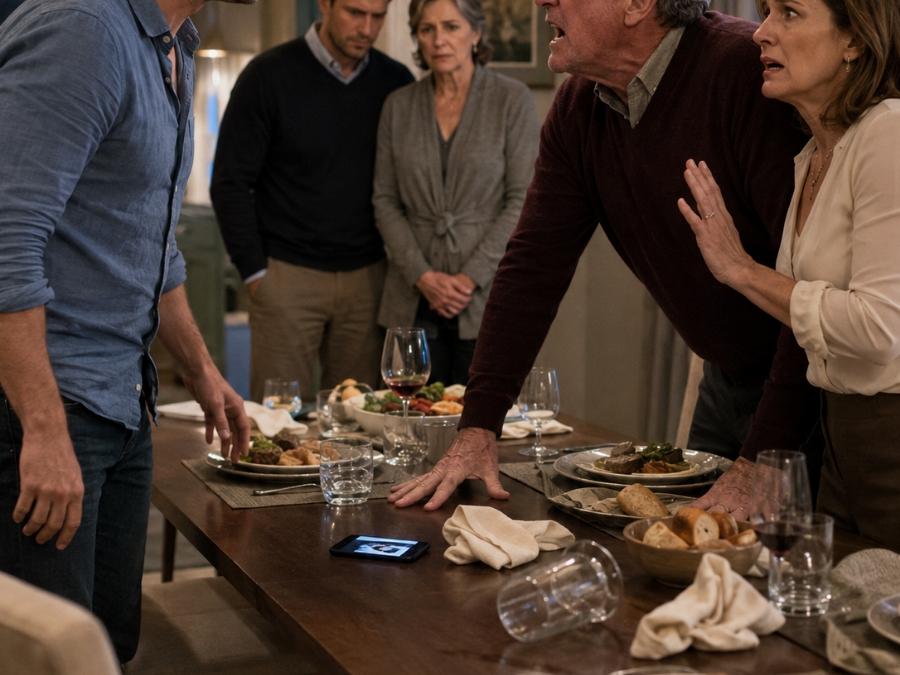
When I arrived, Dad was seated at the dining room table with Melissa on one side and Aunt Carol on the other. Grant stood near the kitchen island with his arms crossed.
The atmosphere felt less like a family meeting and more like a trial.
Dad looked exhausted.
“Mason,” he said, “I messed up.”
“Yes.”
“I’m asking for help.”
“Yes.”
Melissa leaned forward.
“You have the settlement money.”
“That money is for the kids.”
“You could lend Dad some and replace it later.”
“With what?”
“You got that new job, didn’t you?”
The interview had resulted in an offer.
I had not even started yet.
“You all know I’m staying with Caleb.”
“That’s temporary,” Grant said.
“So is Dad’s debt.”
Dad’s jaw tightened.
“You don’t understand the situation.”
“No, I understand it perfectly. You gambled. You lost. Now you want money meant to rebuild your grandchildren’s home.”
Aunt Carol looked offended.
“You don’t need to humiliate him.”
I stared at her.
“Humiliate him?”
Her eyes shifted.
“You could show some compassion.”
I pulled out my phone.
Then I opened the screenshot I had saved from the night of the fire.
Grant’s backyard.
Melissa smiling.
Dad holding his drink.
Aunt Carol beneath the string lights.
“Here’s compassion,” I said, placing the phone on the table.
Nobody spoke.
“My daughter was wearing a stranger’s sweatshirt while you took this picture.”
Melissa looked down.
“My son didn’t have shoes.”
Dad rubbed his forehead.
“And every one of you had read my message.”
Grant pushed away from the counter.
“Mason, we didn’t know how bad it was.”
“It said we lost everything and had nowhere to go.”
“That could mean a lot of things.”
“It meant exactly what it said.”
Dad suddenly slammed his palm onto the table.
“Enough!”
Everyone jumped.
His face flushed.
“I know I failed you that night, okay? I know. But does that mean you let something happen to your father?”
I looked at him.
There it was.
The oldest weapon in our family.
Guilt.
Dad had used it for years.
A favor became obligation.
A mistake became leverage.
Blood became debt.
“I’m not responsible for saving you from gambling,” I said.
His expression hardened.
“I raised you.”
“And I’m raising them.”
Melissa shook her head.
“You’re really going to choose money over your father?”
“No.”
I stood.
“I’m choosing my children over his choices.”
Aunt Carol whispered something about selfishness.
I turned toward her.
“Where were you when Sophie cried because she thought the fire killed her stuffed rabbit?”
She opened her mouth.
Nothing came out.
“Where were you when Eli woke up screaming in Caleb’s house because he smelled smoke in a dream?”
Silence.
“Where was anybody?”
Dad looked away.
For the first time that night, he seemed ashamed.
But shame was not the same as accountability.
I picked up my phone.
“The answer is no.”
Dad stood abruptly.
“Mason.”
“No.”
“If something happens to me—”
“That belongs to the people who created the situation, including you.”
I walked toward the door.
Behind me, Melissa called my name.
I turned.
She looked angry.
“You’re destroying this family.”
I stared at her for a long moment.
“No. I just stopped pretending it wasn’t already broken.”
Then I left.
Part 3: The truth went public before they could rewrite it
The following morning, Grant posted a vague message online about “people who forget where they came from once money gets involved.”
Melissa commented with a broken-heart emoji.
Aunt Carol wrote, “Respect your parents while they are still here.”
They never used my name.
They did not need to.
Within hours, relatives who had not called after the fire were messaging me.
One cousin told me I should forgive.
Another said Dad had made mistakes but deserved loyalty.
Nobody asked whether Sophie had a bed.
That was the moment I stopped protecting them.
I wrote one post.
I did not insult anyone.
I did not exaggerate.
I simply told the truth.
I explained that our apartment burned, my children lost everything, my family saw the emergency message, and no one responded.
I explained that weeks later, my father wanted the small compensation payment meant to rebuild our lives because he had gambling debt.
Then I wrote:
“Please stop telling me family means sacrifice when the only person expected to sacrifice is always me.”
I attached no names.
No private messages.
Just the photograph Grant himself had publicly posted the night of the fire.
The response spread far beyond anyone I knew.
People shared their own stories about relatives who disappeared during emergencies and returned when money was involved.
Some criticized me.
Most understood.
Grant called furious.
“You made us look horrible.”
“I posted something you posted yourself.”
“You changed the context.”
“The context was that my children were homeless.”
He hung up.
Melissa sent three paragraphs accusing me of trying to embarrass Dad.
I answered with one sentence.
“Truth feels like humiliation when someone has spent years hiding from it.”
Then I blocked the conversation.
The real change came somewhere else.
My new employer, Harbor Ridge Property Services, confirmed my position and gave me a modest signing advance because they knew about the fire.
Caleb loaned me enough for a deposit.
Within two weeks, I signed a lease on a small duplex on Hawthorne Street.
It was nothing impressive.
The floors creaked.
The kitchen cabinets were old.
The backyard fence leaned.
Sophie walked into her bedroom and smiled like I had bought her a mansion.
Eli ran to the front door.
“This one is ours?”
“Yes.”
“For how long?”
I swallowed.
“As long as we take care of it.”
He hugged my leg.
That weekend, people showed up.
Not relatives.
People.
Caleb carried a used couch through the doorway.
Sophie’s teacher brought a bookshelf.
One of my new coworkers delivered a kitchen table.
Our neighbor across the street gave Eli a box of toy trucks her grandson had outgrown.
By Sunday evening, the duplex looked mismatched, crowded, and beautiful.
I ordered pizza because nobody had energy left to cook.
We sat on the floor around the table.
Sophie looked around.
“Is this home?”
I smiled.
“Yeah.”
She nodded.
“Good.”
That was all she needed.
Part 4: My father came back asking for something money couldn’t buy
Three months passed.
Dad’s gambling problem did not disappear.
Eventually he sold his truck and worked out arrangements with the people he owed.
Apparently the disaster he insisted only I could prevent had solutions once I stopped being one of them.
He did not call me.
Then one rainy Saturday afternoon, someone knocked on the duplex door.
Dad stood on the porch.
He looked smaller than I remembered.
Not physically.
Just diminished.
I almost closed the door.
Then Sophie walked behind me.
“Grandpa?”
Dad’s face changed.
“Hey, sweetheart.”
She did not run to him.
That hurt him.
I could see it.
I stepped outside and closed the door behind me.
“What do you want?”
“To talk.”
“About money?”
“No.”
I folded my arms.
Dad looked toward the wet street.
“I went to a counseling group.”
That surprised me.
“I’ve been going for six weeks.”
I said nothing.
He rubbed his palms together.
“They ask us to talk about the people we hurt.”
“Sounds uncomfortable.”
“It is.”
For a moment, neither of us spoke.
Then Dad looked directly at me.
“I saw your message that night.”
I already knew.
“But I want you to hear the whole truth.”
I waited.
“I didn’t ignore it because I couldn’t help.”
His voice shook.
“I ignored it because I didn’t want the inconvenience.”
Something inside my chest tightened.
Dad continued.
“I knew if I answered, you might ask to stay with me, and I didn’t want kids in the house. I told myself you’d figure something out because you always do.”
There was no excuse in that sentence.
That made it worse.
“I chose comfort,” he said, “while my grandchildren had nowhere to sleep.”
My anger rose so quickly I had to look away.
Dad’s eyes filled.
“And then when I got scared about my own mess, I expected you to rescue me because that’s what you always did.”
“Yes.”
“I’m sorry.”
I studied his face.
For years, I had imagined hearing those words.
They did not heal everything.
But they mattered.
“I don’t trust you,” I said.
“I know.”
“The kids don’t know you anymore.”
“I know.”
“And you don’t get to come back because you said sorry once.”
“I know.”
That answer surprised me most.
Dad nodded toward the house.
“Can I earn it?”
I looked through the front window.
Sophie was helping Eli build something from cardboard.
“You can try.”
Dad started crying.
I did not hug him.
Not yet.
Forgiveness and access were not the same thing.
He needed to learn that too.
Part 5: We rebuilt our family with the people who stayed
Dad began visiting every other Sunday.
At first, he stayed one hour.
Then two.
He brought no expensive gifts.
I had asked him not to.
Instead, he helped Eli build a birdhouse and sat through one of Sophie’s endless stories about school without checking his phone.
There were awkward moments.
There were silences.
There were questions from the kids he could not answer without admitting he had failed them.
When Sophie asked why he did not come after the fire, Dad told her the truth in simple terms.
“I was selfish.”
She stared at him.
Then she said, “That was mean.”
“Yes,” he answered.
“It was.”
Children have a way of reducing complicated moral failures to sentences adults spend years avoiding.
Melissa took longer.
She never apologized publicly for calling me selfish.
Eventually she called and said she had been embarrassed by the post because she knew it was true.
I did not demand more.
But I also did not restore the old relationship.
We met occasionally.
We spoke politely.
Trust rebuilt slowly, if at all.
Grant never truly changed.
He continued posting motivational sayings about loyalty.
I stopped reading them.
Aunt Carol sent Christmas cards.
That was about it.
And somehow, that became okay.
The greatest change was in me.
For years I had believed being a good man meant never refusing family.
Now I understood that kindness without boundaries becomes permission.
My children needed a father who could protect their stability, even when the person threatening it shared our last name.
By spring, the duplex looked completely different.
Sophie chose pale blue curtains.
Eli covered the refrigerator with drawings.
I replaced the leaning fence with help from Caleb and two coworkers.
We bought a secondhand grill and held a small backyard dinner to mark six months since moving in.
Caleb came.
Sophie’s teacher came.
Our neighbor came.
A few coworkers brought their families.
Dad arrived early and helped set up folding chairs.
At sunset, I stood near the porch watching everyone talk.
There were no matching last names.
No perfect history.
No speeches about loyalty.
Just people who had shown up.
Eli ran toward me carrying a paper plate.
“Dad!”
“What?”
“We need more chairs.”
I looked around.
Every seat was full.
That realization hit me harder than I expected.
Months earlier, my children had been sitting beneath emergency blankets while their relatives ignored them.
Now our backyard was so full of people who cared that we had run out of places to sit.
Caleb caught my expression.
“You good?”
I nodded.
“Yeah.”
He smiled.
“Need more chairs?”
“Apparently.”
Dad came over carrying two from the kitchen.
He handed one to me.
Our eyes met.
There were still things between us that would probably never disappear completely.
Some scars are not meant to vanish.
They are meant to stop bleeding.
That night, after everyone left, Sophie helped me collect paper plates while Eli fell asleep on the couch with his shoes still on.
“Dad?”
“Yeah?”
“Remember when we didn’t have a house?”
“I remember.”
She looked around our living room.
“Were you scared?”
I considered lying.
Then I remembered what we had all learned about truth.
“Very.”
“But you knew we’d be okay?”
“No.”
She stopped.
I smiled softly.
“I just knew I wasn’t going to stop trying.”
She hugged me.
“You didn’t.”
Later, after putting them to bed, I stood in the hallway and listened to the ordinary sounds of our home.
The refrigerator humming.
Rain beginning against the windows.
Eli talking quietly in his sleep.
Nothing dramatic.
Nothing impressive.
Just safety.
The fire had taken almost every possession we owned.
My family’s abandonment had taken something else: the comforting lie that blood guaranteed loyalty.
But losing that belief made room for something stronger.
I learned that family is the friend who clears a bedroom without being asked twice.
It is the teacher who quietly sends clothes home in a backpack.
It is the coworker carrying a used couch up three steps.
Sometimes it is even a father standing on a porch months later, admitting he failed and asking whether he can earn another chance.
And sometimes family is simply the person who chooses to stay when leaving would be easier.
I do not thank the fire for what it taught me.
Some lessons cost too much to call blessings.
But I am grateful for what we built afterward.
Sophie knows she is safe.
Eli knows our meeting place in case of another emergency.
I know exactly where our fire extinguisher is.
And all three of us know something far more important.
When disaster comes, pay attention to who shows up.
Those are your people.
The End. This story is entirely fictional and was created for entertainment purposes. All characters, names, locations, events, and situations depicted in this story are imaginary. Any resemblance to actual people, organizations, places, or events is purely coincidental.








