My Sister Told the Room I Just “Read Things for the FBI” — Until the Director Said What No One Else Would
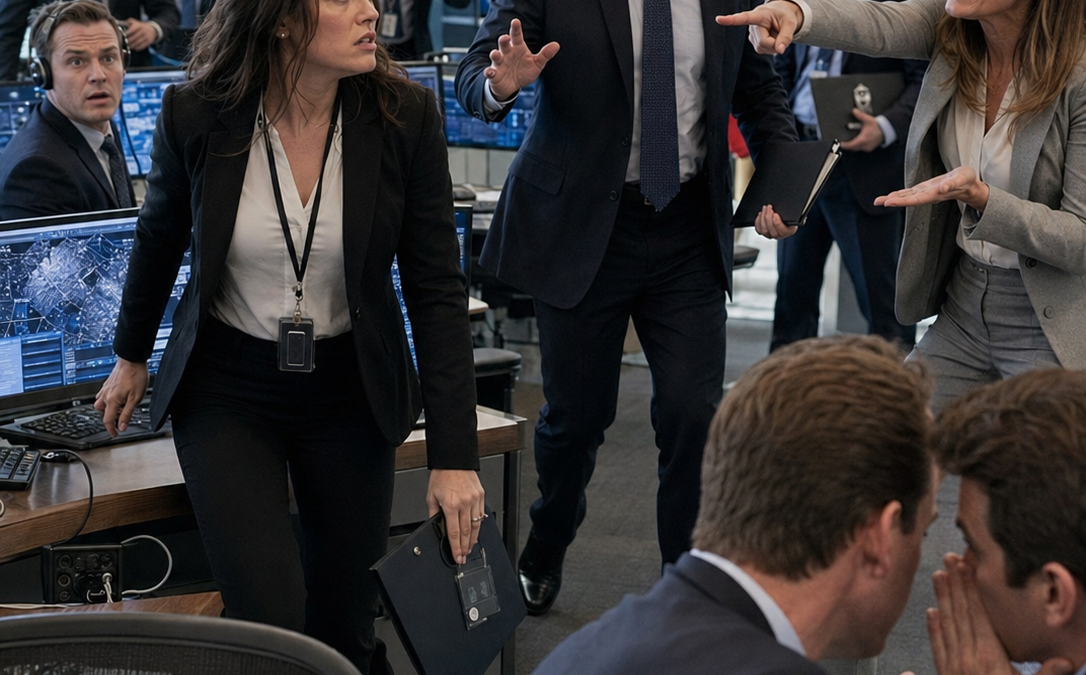
My Sister Laughed: “You Just Read Things for the FBI. The FBI Doesn’t Need People Like You.” She Turned, Pointing At The Director: “Now She Is A Real Leader.” But The Director Stopped, Eyes On Me: “Are You The Phantom?”
### Part 1
My father introduced us the same way every time.
At church barbecues, courthouse fundraisers, Friday night football games, the diner where the waitress knew his coffee order before he sat down, he would put one wide hand on my sister’s shoulder and say, “This is Brooke. She’s going places.”
Then he would look at me.
Not with cruelty. Cruelty would have been cleaner. He looked at me with that soft, proud-looking smile people use when they’ve already decided you are not the main event.
“And this is Sloan,” he’d add. “She’s the quiet one.”
People would smile like he had said something sweet.
I would stand there with my hands folded in front of me, smelling charcoal smoke or lemon furniture polish or somebody’s too-strong perfume, and pretend the label didn’t stick to my skin.
Brooke was three years older and born knowing how to take up space. She laughed big. She cried pretty. She told stories with her hands. When she lost class president in high school, she gave such a dramatic concession speech that half the school remembered it more than the winner’s speech.
By twenty-two, she had talked her way into a community liaison role with the Harland County sheriff’s office. It came with a badge on a lanyard, a county email address, and unlimited opportunities to stand in photographs with important-looking men.
My father loved photographs with important-looking men.
He had been a county judge for thirty-one years, and even after retirement, he still carried himself like every room owed him quiet. His house had framed awards in the hallway, a portrait of him in black robes above the study desk, and an entire coffee-table album dedicated to Brooke shaking hands with sheriffs, mayors, school principals, veterans, and one visiting senator who clearly did not know who she was.
I was in that album twice.
In one photo, half my face was hidden behind a Christmas wreath.
The first time I told my father I wanted to work in federal law enforcement, he was reading the Knoxville paper at the kitchen table. The morning light came through the blinds in narrow gold bars, striping his newspaper and the old oak table my mother had kept polished with orange oil.
“I got the scholarship,” I said.
He did not lower the paper. “Which one?”
“UT Knoxville. Criminology.”
That made the paper dip.
His eyes moved over me once, like he was checking whether I was serious.
“Criminology,” he said.
“Yes, sir.”
“What exactly do you plan to do with that?”
I had rehearsed my answer in the mirror the night before. I had practiced saying it without apology.
“I want to work in federal law enforcement. Maybe behavioral analysis. Maybe forensics. I don’t know yet.”
My mother was in the hallway. I couldn’t see her, but I could hear her stop folding laundry. The cotton sheets made a soft whisper, then silence.
My father folded the newspaper in half.
“Brooke already has a real job in law enforcement,” he said. “You might want to think about whether the world needs more people doing the same thing.”
Then he opened the paper again.
That was the whole conversation.
I stood there for three seconds longer than I should have, listening to the refrigerator hum, smelling burnt toast from the counter, feeling something inside me lower itself carefully into a place where no one could reach it.
Later, my mother found me on the back porch.
She handed me a mug of coffee I had not asked for and sat beside me while cicadas screamed in the trees.
“The people who change things quietly,” she said, “nobody sees them coming.”
I looked at her.
She tapped one finger against her mug.
“That’s the whole point, Sloan. That’s your advantage. Not your flaw.”
I wrote that sentence down that night on the first page of a blue notebook.
I did not know then that years later, someone would find that notebook in a place it should not have been.
And by the time I understood why it mattered, Brooke would already be smiling across a crowded room, turning my silence into a joke.
### Part 2
Thanksgiving at my grandmother’s house always smelled like butter, sage, old carpet, and tension.
Her dining room was too small for our family, but nobody admitted it. We squeezed around the table with our elbows pinned in, balancing plates over our laps when the sideboard filled up. The wallpaper had faded orange pumpkins on it, though I was pretty sure it had been meant to look cheerful sometime around 1983.
That year, I was twenty-two and leaving for Quantico in three weeks.
I had not told the extended family.
Not because I was ashamed. I had learned early that anything good in my life could be turned into a measuring stick, and Brooke was always willing to hold the other end.
My father stood at the head of the table with a glass of sweet tea raised like champagne.
“I’d like to say a word about Brooke,” he began.
Nobody looked surprised.
Brooke lowered her eyes in fake embarrassment, but her mouth was already lifting. She knew exactly how long to let praise wash over her before acting humble.
My father talked for four full minutes about her new county award, some interagency collaboration plaque the sheriff’s office had given her after a school safety campaign. He mentioned her initiative, her leadership, her heart for service, her gift for bringing people together.
My aunt dabbed her eyes with a napkin.
My cousin whispered, “Again?” and got kicked under the table.
I kept eating sweet potatoes.
Then my father turned toward me.
“And Sloan,” he said, as if he had almost forgotten the second item on a grocery list, “starts some kind of federal program next month. We’ll see how that goes.”
The room gave a polite little murmur.
Brooke leaned toward me. Her perfume smelled like vanilla and expensive department-store paper.
“Don’t worry,” she whispered, loudly enough for our cousin to hear. “Most people wash out of Quantico in the first two weeks. No shame in coming home.”
Then she patted my hand.
Her fingers were cool. Her nails were perfect. Her smile was soft enough to look sisterly from across the table.
I looked at her hand on mine and thought, very clearly, I will remember this.
Not in the dramatic way people mean when they want revenge. I did not imagine shouting or humiliating her or making some movie-scene speech while everyone gasped.
I simply stored the moment.
That was what I did. I stored things.
The way Brooke’s smile tightened when someone mentioned my scholarship. The way my father’s praise always came with a public witness. The way my mother watched me with both sadness and belief, as if she could see the version of me no one else had bothered to imagine.
After dinner, I went into the kitchen to rinse plates.
My mother came in behind me and closed the swinging door with her hip.
“You don’t owe them a performance,” she said.
Water hissed into the sink.
“I know.”
“Do you?”
I set a gravy-streaked plate into the dishwasher. “I’m going to do the work.”
She came beside me and picked up a towel.
“That’s not the same as disappearing.”
I looked at her then.
She was tired. Not sick yet, or not that we knew, but tired in the way women get when they have spent decades translating men to daughters and daughters to men, never getting thanked by either side.
“I’m not disappearing,” I said.
But I think part of me already had.
Three weeks later, I arrived at Quantico under a gray Virginia sky that made every building look official and unforgiving. My duffel bag dug into my shoulder. The air smelled like wet leaves, asphalt, and institutional coffee.
Everyone around me seemed louder, faster, more certain.
A woman named Torres from Arizona laughed while doing push-ups. A former Marine from Ohio made friends before lunch. A man with law school hair and runner’s calves asked what field office I wanted like we were choosing dorm rooms.
I sat in the back of the briefing room and took notes.
The first instructor who noticed me was named Hartley. He had silver hair, a flat voice, and the emotional range of a locked filing cabinet.
On the fourth week, after a behavioral assessment exercise, he stopped beside my desk.
“You see things other people don’t bother looking for,” he said.
I looked up, heart kicking once.
“Thank you.”
“I didn’t say it was a compliment.”
Then he walked away.
By week six, I had failed my first field simulation so badly that even I could not defend myself. I had spent the entire mock interrogation tracking the subject’s baseline behavior, watching his blink rate, his shoulder angle, the timing of his deflections.
I forgot to actually get the confession.
Hartley tore me apart in the debrief room while rain ticked against the windows.
I did not cry.
That night, in the barracks, I opened the blue notebook my mother had given me and wrote down every mistake.
Then, underneath, I wrote one sentence.
The truth lives in the gap between what should have happened and what did.
I did not know that sentence would become the foundation of everything.
I did not know someone would one day call it a methodology.
And I definitely did not know Brooke would later repeat those words in public as if they were hers.
### Part 3
I did not become the star at Quantico.
That kind of lie makes a good movie, but not a truthful story.
Torres was the star. She could outrun men who looked carved out of gym equipment, and she smiled like pressure was a weather condition she enjoyed. Hartley used her for demonstrations. Instructors nodded when she answered questions. People turned when she entered a room.
I was useful in a less visible way.
By the second month, people started borrowing my notes.
Not because I was popular. Popularity had a sound to it, a warmth, a buzz. This was quieter. Someone would slide into the seat next to me before a test and say, “Reeves, do you have the timeline chart from the arson unit?” or “Can I see how you broke down that fraud profile?”
My notes were ridiculous.
I color-coded motives, stressors, opportunity windows, escalation markers. I built backwards timelines from outcomes and forward timelines from known facts, then compared the two until the contradiction showed itself.
That was where things got interesting.
People lied in predictable ways. Systems failed in predictable ways. But when a person’s behavior did not match the story everyone had agreed to tell, the air around a case changed.
It was like smelling smoke before seeing fire.
Hartley began leaving case packets on my desk without explanation.
No note. No praise.
Just a folder and a deadline.
“Look at this by morning,” he would say.
The first time, I assumed everyone had gotten one. They had not.
I stayed up until 2:17 a.m. in the common room with burnt coffee cooling beside me, highlighter ink staining the side of my hand, reading an old missing-person simulation with three witness statements that did not belong together.
The next morning, Hartley changed the entire debrief.
No one said why.
That became the pattern.
I would find the thing nobody had asked me to find. Someone else would use it. The room would improve without acknowledging the repair.
Strangely, I didn’t mind.
Acknowledgment had never felt safe to me. In my family, praise was not a gift; it was a spotlight someone else could redirect. I had learned to measure worth by usefulness instead.
When I graduated, my father came to Virginia.
So did Brooke.
My mother wanted to come, but she had a fever that week and said it was probably nothing. She sounded angry about it on the phone, like her own body had offended her.
After the ceremony, Brooke hugged me in front of everyone.
“My baby sister,” she said, loud enough for nearby families. “An FBI girl now.”
The word girl landed wrong, but I smiled.
My father shook my hand.
An actual handshake.
“Congratulations,” he said.
“Thank you.”
He looked over my shoulder at Torres, who was laughing with three instructors. “She seems impressive.”
“She is.”
He nodded. “Well. You made it through.”
That was all.
We ate dinner at a steakhouse off the highway. The carpet was burgundy. The waiter forgot my water twice. Brooke told a story about being asked to speak at a school safety panel, and my father leaned forward like she was describing a hostage rescue.
When the check came, Brooke excused herself to the restroom.
My father took out his wallet and said, “Your sister worries about you.”
I looked up.
“She says you keep things bottled up. That you might struggle in a field where presence matters.”
I folded my napkin slowly. “Brooke said that?”
“She wants what’s best.”
“No,” I said before I could stop myself. “She wants what’s visible.”
His face hardened.
It was quick, but I saw it. The old judge returning to the bench.
“You two have always been different,” he said. “No need to make it ugly.”
Ugly.
That was the word people used when quiet women finally named what loud people had been doing for years.
I looked toward the restroom hall. Brooke was standing just inside it, half-hidden by a fake plant, looking at her phone. She had not missed anything.
When she saw me see her, she smiled.
Not guilty.
Interested.
That smile followed me back to Tennessee when I got assigned to the behavioral analysis support unit out of Nashville. It was not glamorous. No television music. No kicking down doors. No heroic silhouette against flashing lights.
Mostly, I read.
Interview transcripts. Financial histories. Communication logs. Cold case files that smelled like dust and toner. I sat under fluorescent lights while vending machines hummed and agents with field jackets walked past carrying urgency on their shoulders.
I looked for the things people missed.
For months, nothing dramatic happened.
Then an old case landed on my desk with no sender name, no explanation, and a yellow sticky note in Hartley’s handwriting.
Reeves — find the gap.
Under that, in handwriting I did not recognize, someone had added one word.
Phantom.
### Part 4
The first case that taught me what my silence was worth involved three missing women, two state lines, and one pattern everyone had mistaken for coincidence.
I was not supposed to be important.
That part matters.
I was twenty-six, still new enough that some agents called me kid by accident and old enough to understand correcting them would not help. My cubicle was outside the main conference area, close enough to hear arguments through the walls and far enough away that people forgot I existed.
The case came from a lead agent named Callaway.
He was built like a man who had wrestled refrigerators for practice, with gray at his temples and a permanent expression of disappointment. He had seventeen years in and no patience for analysts who talked like textbooks.
“You’re Reeves?” he asked, stopping beside my desk.
“Yes.”
He dropped a file box on my keyboard.
The impact made my coffee jump.
“Behavioral consult. Don’t overcomplicate it.”
Then he walked away.
Inside the box were eighteen months of reports. Three disappearances. Similar age range, similar travel corridors, similar last-known locations near gas stations off rural highways. The obvious theory was opportunistic abduction. Wrong place, wrong time, bad luck wearing different faces.
I spent eleven days reading.
I read until the words blurred. I read in my apartment with crime scene photos spread across the floor and ramen going cold on the counter. I read while rain ran down my windows in silver lines and the neighbor’s dog barked at nothing.
By the fourth night, I knew the official timeline was wrong.
By the seventh, I knew why.
The suspect was not choosing victims based on access. He was choosing locations based on emotional rehearsal. Each site had a service road within nine minutes of an abandoned commercial property. Each property had changed ownership within the same two-year period. Each disappearance occurred within seventy-two hours of a local event that increased traffic and decreased attention.
The case was not random.
It was ritual disguised as convenience.
I built the map on my living room wall with index cards, yarn, and painter’s tape. It looked insane. It was not.
When Callaway came to my apartment because I had stopped answering emails, he stood in the doorway holding a gas-station coffee and stared at the wall for a full minute.
“My God,” he said.
I waited.
“Tell me I’m wrong,” I said.
He stepped closer. The room smelled like coffee, rain, and old paper. His eyes moved from card to card, highway to highway, date to date.
“If you’re right,” he said, “we have been looking east when he’s been moving west.”
“Yes.”
He turned toward me. “Do you understand what that means?”
“It means you need to reposition the operation.”
He looked almost offended that I had said it calmly.
Six days later, they found the fourth woman alive.
I was not at the scene. I was not in the press release. I did not stand beside anyone at the podium while microphones glittered under county building lights.
Callaway sent me one text.
Good work, Reeves.
I saved it.
Not because it was warm. It wasn’t. But it was exact. It meant what it said and nothing else.
That same week, Brooke received a county leadership award.
My father drove three hours to watch her accept it.
The photo appeared in the local paper: Brooke in a navy blazer, my father beside her looking brighter than I had seen him look in years. The headline called her “a rising voice in public safety.”
My mother clipped the article and put it on the refrigerator because that was what mothers did when one child was celebrated publicly and the other secretly carried the weight of something no one could know.
On Sunday, she called me.
“You sound tired,” she said.
“I’m fine.”
“Fine is a hallway word. It means you’re not ready to open the door.”
I smiled despite myself. “You always say things like that.”
“And you always pretend they don’t land.”
I sat on my apartment floor, the map still half-attached to the wall. Empty tape curls clung to the paint. My knees hurt from sitting too long.
“I helped find someone,” I said quietly.
My mother did not gasp. She did not demand details.
She just breathed in.
“Alive?”
“Yes.”
On the other end of the line, I heard her start to cry without making noise.
“That is enough,” she said after a moment.
I closed my eyes.
For a little while, it was.
Then Brooke called three days later.
“I hear you’ve been hard to reach,” she said brightly. “Big important FBI things?”
“Work has been busy.”
“I bet. Dad says you mostly read reports. Honestly, Sloan, I could never sit at a desk all day. I need to feel like I’m doing something real.”
I looked at the bare wall where the map had been.
The woman we found had a daughter. Six years old. Purple glasses.
Something real.
Brooke kept talking, filling the silence the way she always did. Then, just before hanging up, she said, “Oh, and when you come home next month, try not to be weird about my award dinner. Dad worked hard planning it.”
I did not answer right away.
Because behind her voice, faint but unmistakable, I heard my father say, “Ask her if she’s still with the Bureau.”
Still.
As if I had already faded from it.
As if my life was a rumor they were waiting to correct.
### Part 5
My mother got sick in February.
She told me on a Sunday, because Sunday was our day and she respected routine even when the world was coming apart.
I was folding laundry in my apartment, pairing black socks under the yellow kitchen light, when she said, “They found something.”
My hands stopped.
Outside, someone was dragging trash bins along the sidewalk. The plastic wheels made a hollow, rattling sound that seemed to go on forever.
“What kind of something?”
“The kind we don’t pretend is nothing.”
Breast cancer. Stage three. Appointments already scheduled. Treatment plan forming. Words like lymph nodes and aggressive and margins moving through the conversation like furniture being carried into a room that was too small.
I drove home the next Friday.
And the Friday after that.
And almost every Friday for four months.
The road from Nashville to Harland County became a tunnel I could drive without thinking. Gas station coffee. Pine trees. Church signs with jokes about salvation. The same billboard advertising personal injury lawyers with identical white teeth.
I arrived before Brooke and left after her.
That became the secret rhythm of my mother’s illness.
I organized medications in plastic boxes with labels my mother teased me for making too neat. I created treatment calendars. I made soup she could tolerate and toast she sometimes couldn’t. I sat beside her in waiting rooms where every chair seemed designed by someone who hated the sick.
Brooke came when people were looking.
She brought flowers too fragrant for a chemo patient and posted photos of holding my mother’s hand, careful to angle the IV pole out of frame. She cried in front of neighbors. She answered questions at church with a trembling voice and accepted casseroles like tribute.
My father believed she was holding the family together.
One Saturday, I was washing a pot in the kitchen, scrubbing dried chicken broth from the bottom while my mother slept upstairs. My father stood by the sink with his hands in his pockets.
“I don’t know what we’d do without Brooke,” he said.
The sponge froze in my hand.
“She’s been incredible,” he added.
Water steamed up into my face. The kitchen smelled like dish soap and boiled carrots and the faint medicinal odor that seemed to cling to everything now.
I wanted to say, I was here when Mom threw up until her throat bled.
I wanted to say, Brooke left early last weekend because she had a charity luncheon.
I wanted to say, I know exactly which anti-nausea pill works best at 3 a.m. because I am the one sitting on the bathroom floor with her.
Instead, I rinsed the pot.
My mother was asleep. I would not turn her sickness into another courtroom.
Later that night, she woke while I was sitting in the chair beside her bed with a cold mug of tea in my hands. The lamp cast a small amber circle over the quilt. Her face looked sharper than it had a month before.
“You’ve been here every week,” she said.
“Yes.”
“Does your father know?”
I looked at the mug.
“I don’t think that matters.”
“It matters,” she said.
“Not enough.”
She studied me for a long time. Even sick, my mother could make silence feel like a room you had to tell the truth in.
“He will know one day,” she said.
“I’m not planning a presentation.”
“You won’t need one. The truth builds up whether you pour it or not.”
Her voice was weak, but the sentence had weight.
I wrote it in the blue notebook later that night, sitting at the kitchen table while the house settled around me. My handwriting wavered once. I blamed exhaustion.
My mother died in April.
The funeral smelled like lilies and rain.
Brooke stood at the church entrance receiving condolences as if she were hosting the event. My father looked carved out of wax. I stood near the side door because I could not bear the open casket or the way people said “better place” like grief was a travel inconvenience.
After the service, I went upstairs to my old bedroom to breathe.
The room had not changed. White dresser. Narrow bed. The dent in the window screen from when I had pushed on it as a child, imagining escape.
My blue notebook was in my overnight bag.
I know it was.
I remember because I reached for it before going downstairs, then stopped when I heard Brooke’s voice in the hall.
She was talking to someone on the phone.
“No, she’s always been like that,” Brooke said softly. “Secretive. Dad thinks she’s still in Nashville doing some desk thing. Honestly, I think she likes people not knowing because then nobody can ask too many questions.”
I stood with my hand on the doorknob.
Then she laughed.
“Anyway, I found some of her notes. Very intense. You’d think she was writing a spy novel.”
My stomach dropped.
I opened the door.
Brooke turned. She was holding my blue notebook against her chest.
For once, she did not have a speech ready.
And for once, I did.
### Part 6
“Put it down,” I said.
Brooke blinked at me.
The hallway outside my childhood bedroom was narrow, with old family photos lining both walls. Brooke in a graduation cap. Brooke at a courthouse podium. Brooke beside our father at a Veterans Day breakfast. I was present in frames only as background: a shoulder, a braid, a blur.
She lowered the phone from her ear.
“I was just looking,” she said.
“My notebook is not yours to look at.”
Her expression shifted. Offended innocence. She had worn it since we were kids, usually right before I got blamed for making her cry.
“Sloan, Mom just died.”
The words hit like a slap because they were true and because she used them like a shield.
“I know,” I said. “I was here.”
Her mouth tightened.
The phone in her hand gave a tiny voice. “Brooke? You there?”
She ended the call without looking.
“What is this stuff?” she asked, tapping the notebook. “Case notes? Weird little sayings? ‘The truth lives in the gap.’ Very dramatic.”
My skin went cold.
That sentence was mine. Not classified, not official, not dangerous in the legal sense. But private in a way that mattered more.
“Give it back.”
She held it out after one theatrical pause, like she was granting mercy.
I took it and put it in my bag.
“You know,” she said, leaning against the hallway wall, “people wouldn’t wonder about you so much if you just acted normal.”
There it was.
Normal meant explainable. Digestible. Smaller.
“You mean if I made myself easier for you to summarize.”
“I mean if you didn’t make everything so tense.”
I laughed once. It sounded strange in that hallway.
“Brooke, you went through my bag at Mom’s funeral.”
“I thought it was one of Mom’s journals.”
“No, you didn’t.”
A flush climbed her neck.
For half a second, the performance slipped. Beneath it was something old and bitter and surprisingly plain.
“You always think you’re above us,” she said.
I stared at her.
That was the red herring of my whole life. Brooke had spent years standing on every table available, and somehow she had convinced herself I was looking down from a height I had never claimed.
“I don’t think I’m above you,” I said. “I think you can’t stand not being the center of a room.”
Her eyes shone, but not with sadness.
With calculation.
My father appeared at the end of the hall before she could answer.
“What’s going on?”
Brooke turned toward him immediately. “Nothing. Sloan’s upset.”
Of course.
Not Brooke violated my privacy. Not Brooke was snooping. Sloan’s upset.
My father looked at me with that tired, disappointed expression I knew too well.
“Today is not the day,” he said.
I wanted him, just once, to ask a second question.
He did not.
I zipped my bag.
“You’re right,” I said. “It isn’t.”
I left after the luncheon.
Nobody stopped me.
Back in Nashville, grief did not soften me. It sharpened everything. I worked longer hours because exhaustion was easier than mourning. I read files until my eyes burned. I built behavioral models with such precision that my supervisor started forwarding cases before anyone officially requested support.
Then came the Meridian case.
I cannot tell every detail. Some doors stay closed for good reasons.
I can say this: several agencies had been watching a domestic extremist cell for months, and everyone agreed something was coming. The problem was timing. Evidence suggested talk. My map suggested transition.
People change before they act.
Not dramatically. Not the way television teaches you. They alter routine. They simplify language. They shed hypotheticals. They stop fantasizing about violence and begin making room for logistics.
I saw the shift in a communication pattern at 11:43 p.m. on a Tuesday.
A man who had been speaking in slogans began speaking in inventory.
That was the gap.
I flagged it through Callaway. Callaway pushed it up. Someone with more authority than patience demanded my reasoning. I sent sixteen pages.
Seventy-two hours later, the operation moved.
Eighteen hours after that, the whole country did not learn what almost happened.
That is the strange mercy of prevented disasters. If you do your job well, people complain about traffic and bad coffee and never know what missed them.
A week later, I was walking past a conference room when I heard voices inside.
“Who caught the language shift?” someone asked.
“Behavioral support out of Nashville.”
“Name?”
A pause.
Then another voice, lower, amused. “They call her Phantom.”
I stopped walking.
Phantom.
I should have hated it.
But the word did not feel like absence. Not then.
It felt like proof that something invisible could still move the room.
Then my phone buzzed.
A text from my aunt.
Brooke gave a speech today. Used something about “truth living in the gap.” Isn’t that what your mom used to say?
I stood in the hallway while agents moved around me, their badges clicking, phones ringing, coffee burning in the pot nearby.
And for the first time in years, I was not quiet because I chose discipline.
I was quiet because if I opened my mouth, I did not know what would come out.
### Part 7
I did not confront Brooke about the speech.
That surprises people when I tell it now. They expect a fight. They expect slammed doors, a family meeting, me waving the blue notebook like evidence in court.
But I had spent too many years watching people use volume as camouflage.
Brooke wanted confrontation. She understood confrontation. In a fight, she could cry first, speak louder, turn the room toward her. She could make the question not what did you take, but why are you being so mean about it?
So I did what I knew how to do.
I watched.
I found the video of her speech on the county sheriff’s Facebook page. It had been filmed in a high school auditorium under harsh fluorescent lights. Brooke stood behind a podium with the county seal on it, wearing a cream blazer and pearl earrings.
“We in public safety know,” she said, pausing with practiced softness, “that the truth lives in the gap between what should have happened and what did.”
The audience nodded.
My father, seated in the front row, nodded hardest.
I paused the video.
Her face froze mid-sincerity.
Behind her, a projector screen showed the title of her presentation: Seeing What Others Miss: A Community Safety Framework.
Seeing what others miss.
I closed the laptop.
The apartment was quiet except for the hum of the refrigerator and a siren several blocks away. I sat at my kitchen table with my palms flat against the wood, feeling my heartbeat in my fingers.
Then I opened the laptop again and watched the rest.
The framework was shallow. Borrowed phrases, public-facing warmth, anecdotes about school resource officers and neighborhood watch programs. Nothing operational. Nothing classified. Nothing she could get in trouble for.
But it had my fingerprints all over it.
Not enough to prove theft to people who did not understand the original.
Enough to make me feel skinned.
The next Sunday, my father called.
It was his first call since the funeral.
“Brooke did a remarkable job this week,” he said.
No hello beyond the minimum. No asking how I was sleeping in a world without my mother.
“She has your mother’s way with words,” he added.
I looked at the blue notebook on the table.
“No,” I said. “She doesn’t.”
Silence.
“What does that mean?”
“It means those weren’t Mom’s words.”
He sighed. “Sloan.”
There it was. My name as warning.
“I’m not doing this with you,” I said.
“Doing what?”
“Pretending you don’t understand because understanding would require you to change your mind.”
He went very quiet.
For one bright, dangerous second, I thought maybe I had reached him.
Then he said, “Your sister is trying to serve this community. I wish you two could support each other.”
I ended the call.
My hand shook afterward, but I did not regret it.
At work, the name Phantom kept spreading. Quietly at first, then with a strange inevitability. A case with a behavioral unknown would cross someone’s desk, and a note would come back: Has Phantom reviewed this?
I never used the name. I never signed anything with it. I did not even like hearing it spoken directly to me.
But Director Evelyn Weston did.
She was not technically my director at first. She oversaw a multi-agency behavioral threat initiative out of Washington, the kind of program that had an acronym nobody outside government could remember. She was in her late fifties, Black, precise, and calm in a way that made loud people look silly.
The first time she called, I nearly let it go to voicemail because the number was unfamiliar.
“Sloan Reeves?” she said.
“Yes.”
“This is Director Weston. I read your Meridian analysis.”
My apartment seemed to shrink.
“Yes, ma’am.”
“There’s a financial crimes working group forming. On paper, it’s fraud. In practice, it has a behavioral structure nobody wants to admit is behavioral.”
I picked up a pen without meaning to.
“I can review whatever materials you send.”
“No,” she said. “You misunderstand me. I don’t want a review. I want you in the room.”
The room.
People like me were usually sent files after rooms had failed.
“When?” I asked.
“Monday.”
I flew to D.C. with one carry-on bag and the blue notebook zipped inside an inner pocket.
The working group met in a windowless conference room that smelled like stale coffee, dry-erase markers, and twelve people who had spent six months not listening to each other. FBI. IRS Criminal Investigation. DEA. Treasury. State-level liaison. Everyone had a folder. Everyone had a theory.
I sat near the end of the table and said almost nothing for forty-five minutes.
A deputy director named Marcus Webb sat at the head, rubbing one thumb over his wedding ring while two agents argued about shell companies.
Finally, I asked, “Why are we assuming the suspect is hiding money?”
The room turned.
An IRS investigator frowned. “Because he built a laundering network.”
“No,” I said. “He built a stage.”
Nobody spoke.
I pointed to the timeline on the screen. “The transfers are too elegant. Too visible to the right people. This isn’t concealment behavior. It’s invitation behavior.”
Marcus Webb leaned forward.
“Run that back,” he said.
So I did.
And somewhere between the second timeline and the third contradiction, I saw Director Weston watching me with the expression of someone who had already known where the conversation would go.
That afternoon, Marcus Webb said, “Reeves stays on every communication from here forward.”
A man from DEA approached me afterward near the elevators.
“You’re Phantom,” he said.
“I’m Sloan Reeves.”
He smiled. “Sure. But you’re Phantom.”
The elevator doors opened.
Inside, my phone buzzed with a text from Brooke.
Dad says you’ve been distant. Try not to punish him because you’re unhappy with your choices.
I looked from her words to my reflection in the elevator’s steel doors.
For the first time, I did not feel small.
I felt unknown.
And there is power in being unknown right up until the second people realize they should have been afraid to underestimate you.
### Part 8
The Knoxville recognition dinner was not supposed to change my life.
I need that understood.
I did not go there planning a reveal. I did not imagine my father’s face collapsing in public. I did not picture Brooke finally losing control of a room she thought she owned.
I went because Director Weston asked.
“She’s receiving a leadership award,” Marcus Webb told me over the phone. “She wants you at the table.”
“I’m not necessary.”
“She disagrees.”
Director Weston took the phone from him. I knew because the line went quiet in a way that had posture.
“Reeves,” she said, “some people need to be seen by people who understand what they are seeing.”
“I’m not good at events.”
“I didn’t ask if you were good at them.”
That was Weston.
So on a cool October evening, I drove to Knoxville in a black dress I had owned for six years and heels I regretted before leaving my apartment. The convention center ballroom smelled like carpet cleaner, roasted chicken, and the metallic scent of too many chafing dishes. Round tables filled the room. Blue uplighting climbed the walls. A jazz trio played near the bar, soft enough to be ignored.
Law enforcement people have a specific sound at formal events. Badge clips hidden under jackets. Low voices. Controlled laughter. Men saying “good to see you” to people they did not like. Women scanning exits without seeming to.
I recognized more faces than I expected.
More recognized me than I expected.
That made me uneasy.
I had just found my table near the back when I heard Brooke.
“Oh, my God. Sloan?”
Her voice carried perfectly. It always had.
I turned.
She crossed the room with my father behind her, both dressed for photographs. Brooke wore emerald green and gold earrings that flashed when she moved. My father wore a dark suit and the red tie he reserved for civic importance.
“What are you doing here?” she asked.
Not happy. Not curious.
Alert.
“I was invited.”
“By who?”
“Director Weston.”
Brooke’s eyes flickered. The name meant something to her, though not enough.
My father kissed my cheek. It was stiff, almost formal.
“You didn’t say you were coming,” he said.
“I didn’t know I needed to.”
Brooke laughed.
A few people nearby glanced over.
“Well,” she said, sliding one arm around my shoulders, “the mystery fed appears.”
My body went still under her touch.
She turned to the couple beside us, a sheriff from some neighboring county and his wife. “This is my little sister, Sloan. She works for the FBI. Sort of behind the scenes.”
The wife smiled politely. “How interesting.”
Brooke tilted her head. “I always tell people she reads things. Reports, emails, whatever. She’s very good at being quiet with paper.”
My father chuckled.
Not cruelly.
Automatically.
That made it worse.
Brooke continued, warmed by the response. “Honestly, I wish I could explain it better. People ask, and I say, ‘Well, she just reads things for the FBI.’”
A small laugh moved through the nearby cluster.
There are moments when humiliation becomes physical.
I felt it in my throat first. Then behind my ribs. The old childhood heat, the instinct to disappear before the room fully turned.
But I did not move away.
I looked at Brooke’s hand still resting on my shoulder.
Then I lifted it off me and let it fall.
Her smile sharpened.
“Oh, come on,” she said softly. “Don’t be sensitive.”
My father gave me a warning look.
The same hallway look from my mother’s funeral. The same courtroom look from my graduation dinner. The same look that said, do not make your sister’s behavior inconvenient.
I was about to walk away.
Not because I was defeated. Because I had learned not every stage deserves your presence.
Then Director Weston stopped behind Brooke.
I knew she was there before anyone spoke. The air changed. Conversations around us thinned.
“Sloan,” she said.
I turned. “Director.”
Brooke adjusted instantly, smiling brighter.
Director Weston looked at my sister, then at my father, then back at me.
“I’m sorry,” she said, in a voice calm enough to cut glass. “Do these people know you?”
My father straightened.
“I’m her father,” he said.
Brooke gave a laugh. “And I’m Brooke. Her sister. We were just teasing her a little.”
Director Weston did not smile.
“About what?”
The question landed like a trap because it was not one. It was simply a request for honesty in a room built on reputation.
Brooke hesitated.
My father cleared his throat. “Sloan can be private about her work.”
“Her work,” Director Weston said.
She looked at me. I gave the smallest shake of my head.
Please don’t.
Not because I wanted to protect them.
Because I did not want my life turned into their lesson.
Director Weston understood the gesture.
And ignored it.
She turned back to my father.
“Judge Reeves, is it?”
His eyebrows lifted. “Retired.”
“Then precision should matter to you.”
The sheriff’s wife stopped smiling.
Brooke’s hand tightened around her clutch.
Director Weston said, “Your daughter does not ‘read things for the FBI.’ Your daughter is one of the primary reasons three major federal operations did not fail.”
The ballroom noise seemed to move farther away.
“She identified the behavioral pivot in Meridian before any field unit confirmed preparation. She developed a gap-analysis method now used across multiple agencies. And when a case has a behavioral structure no one can make sense of, there are people in operational command who will not move until Phantom has reviewed it.”
My father’s face changed.
Not all at once.
First confusion. Then resistance. Then the slow, awful recognition that someone he respected was describing a daughter he had never bothered to meet.
Brooke laughed once.
It died quickly.
Director Weston looked at her.
“As for being quiet with paper,” she said, “I have watched rooms full of decorated agents go silent because Sloan Reeves asked one question they should have asked six months earlier.”
No one nearby laughed now.
Then, from behind my father, a retired FBI section chief named Garrett stepped forward. I had worked one case with him two years before and exchanged maybe twelve sentences.
“She caught the Meridian shift eighteen hours before we did,” he said. “Eighteen hours was the difference between containment and catastrophe.”
My father turned toward him like he needed a second witness.
Garrett nodded once.
“In my office, her name is spoken with a very specific kind of respect.”
Brooke’s smile remained on her face, but it had become a mask nailed to a door.
My father looked at me.
For the first time in my life, he looked at me without Brooke’s shadow standing between us.
And I felt no triumph at all.
Only grief.
Because the one person who had never needed this proof was buried under Tennessee clay.
### Part 9
People think vindication feels clean.
It doesn’t.
It feels like standing in a room where the air has been sucked out, watching people rearrange their faces around a truth they should have recognized when it was still small and asking gently to be seen.
Director Weston moved on because powerful people know when a point has landed. She touched my arm once, briefly, then walked toward the podium to accept her award.
The program resumed.
Forks clicked against plates. The jazz trio began again. Someone at the bar laughed too loudly, trying to prove the room had not shifted.
But it had.
I could feel people looking without looking.
Brooke excused herself to the restroom.
My father did not follow her.
That was new.
He stood beside me for a moment, his mouth slightly open, then closed, like every sentence available to him was inadequate and he knew it.
“Sloan,” he said.
I looked at the stage. Director Weston was being introduced by a man with a polished voice and no idea what had just happened near table fourteen.
“Not here,” I said.
He nodded.
I thought that would be the end of it for the evening.
It wasn’t.
During dinner, Brooke returned with fresh lipstick and dry eyes. She sat at our table as if nothing had happened. That was one of her gifts: the ability to step over emotional wreckage and complain about the salad.
“Well,” she said lightly, “that was dramatic.”
No one answered.
My father stared at his plate.
A county commissioner across from us suddenly became fascinated by his butter knife.
Brooke took a sip of wine. “I mean, obviously I’m proud of you, Sloan. I just didn’t know we were making speeches in the middle of cocktail hour.”
I folded my napkin in my lap.
“Director Weston made a correction.”
Brooke’s smile twitched.
“To a joke.”
“No,” I said. “To a lie.”
The table went silent.
My father looked up sharply.
Brooke’s eyes widened, not hurt but warning. She glanced around as if checking who had heard.
“Wow,” she said softly. “Okay.”
I could have stopped there.
I almost did.
Then I thought of my blue notebook in her hands at my mother’s funeral. I thought of her cream blazer, her county podium, her voice saying my sentence to a room that clapped.
I leaned forward.
“And while we’re correcting things,” I said, “the framework you presented after Mom died? The one about truth living in the gap?”
Her face drained.
My father frowned. “What framework?”
Brooke set down her glass too carefully. “Sloan, don’t.”
Two words.
Not I didn’t.
Not that isn’t true.
Don’t.
My father heard it too. I saw the exact second he did.
“That was from my notebook,” I said. “The one you took out of my bag during Mom’s funeral.”
Brooke whispered, “I thought it was Mom’s.”
I looked at her.
“No, you didn’t.”
The county commissioner pushed his chair back. “Excuse me.”
His wife followed so fast her purse fell off the chair.
My father’s face had gone gray.
“Brooke,” he said.
She turned on him with sudden tears. “I was grieving.”
“So was I,” I said.
The tears stopped working before they fully arrived.
That was the thing about Brooke. Her emotions were real enough to her, but they always had an audience in mind. When the audience refused the role, she did not know where to put them.
My father placed both hands flat on the table.
“Did you use your sister’s work?”
Brooke’s mouth opened.
Closed.
Opened again.
“It wasn’t classified,” she said.
The words hung there, ugly and naked.
Not no.
Not I’m sorry.
It wasn’t classified.
I stood.
My chair legs scraped against the ballroom floor. Several people turned.
“I’m going to congratulate Director Weston,” I said.
My father reached for my wrist, then stopped before touching me.
“Sloan.”
I looked at his hand hovering in the space between us.
I remembered Brooke’s cool fingers on my wrist at Thanksgiving years ago. No shame in coming home.
“I won’t make a scene,” I said. “That’s never been my role.”
Then I walked away.
Director Weston saw me coming and stepped aside from the group surrounding her.
“You all right?” she asked.
“No.”
She nodded once. “Good. Honest answer.”
Behind me, through the dinner noise, Brooke’s voice rose.
Not loud enough for the whole room.
But loud enough for me.
“You all act like she’s some hero. She never even told us.”
I stopped walking.
Director Weston’s eyes moved past my shoulder.
Then my father spoke, low but clear.
“She tried.”
The room did not stop this time.
Only I did.
Because for one foolish second, some broken younger version of me wanted those two words to be enough.
They weren’t.
But they were still the first true thing my father had said about me in years.
### Part 10
My father found me near the windows after the awards ended.
Outside, the parking lot shone under sodium lights. Rain had started, light and steady, turning windshields into blurred mirrors. Inside, people drifted between tables with dessert plates and coffee cups, their voices softened by carpet and fatigue.
I was standing alone because I needed to be.
My father approached like a man nearing a witness stand.
He stopped beside me, leaving a careful foot of space between us.
For almost a minute, neither of us spoke.
Then he said, “Why didn’t you tell me?”
I almost laughed.
Not because it was funny.
Because the question was so small beside the years it wanted to cover.
“I did,” I said.
His reflection in the window flinched.
“No. Not about all this.”
“You never asked about my work,” I said. “You asked how it compared to Brooke’s. That’s different.”
He swallowed.
Behind us, Brooke laughed too loudly near the exit, surrounded by two women who looked trapped but polite.
My father did not turn toward her.
That was also new.
“I thought I knew what mattered,” he said.
“You knew what photographed well.”
He closed his eyes.
I expected defensiveness. A judge’s correction. A speech about doing his best after Mom died, about family being complicated, about how I had always been hard to know.
He gave me none of that.
“I failed you,” he said.
The sentence should have healed something.
Instead, it opened the wound wider.
Because I had imagined those words for so long that by the time they arrived, they felt late. Not meaningless. Late.
Late love is strange. It asks to be praised for finding the address after the house has burned.
I looked at him fully.
His hair had thinned more than I remembered. His face seemed older under ballroom lights. Grief and embarrassment had made him smaller, but smallness was not the same as humility. I had learned to be careful with men who mistook one for the other.
“Mom knew,” he said.
“Yes.”
“She used to say you were the one nobody was watching.”
“She was right.”
“I thought she was being kind.”
“She was being accurate.”
His mouth trembled once.
“I miss her,” he said.
That nearly undid me.
The rain tapped the glass. A woman behind us laughed. Somewhere, a fork fell and rang against a plate.
“I miss her too,” I said.
He looked at me with wet eyes.
“I want to start over.”
There it was.
The plea people make when they do not want to sit inside what happened.
Start over.
As if life were a courtroom transcript you could strike from the record.
I turned back to the window.
“No.”
He went still.
“I don’t mean I’ll never speak to you,” I said. “I mean we don’t get to start over. You don’t get a clean beginning because someone important finally told you I mattered.”
“Sloan—”
“I’m not punishing you. I’m telling you the truth.”
His breathing grew uneven.
“You’re my daughter.”
“Yes,” I said. “And I was your daughter when I got the scholarship. I was your daughter at Quantico. I was your daughter when Mom was sick and you thanked Brooke for work I was doing in your kitchen. I was your daughter when Brooke stole from me at Mom’s funeral and you told me not to make the day ugly.”
His face collapsed around that one.
Good, I thought.
Then hated myself for thinking it.
But not enough to take it back.
“I can’t forgive that tonight because it became inconvenient for you to misunderstand me,” I said.
He nodded slowly, like each word cost him something.
“What can I do?”
The younger me would have handed him a map. A list. A way back.
The woman I had become knew better.
“You can stop asking me to guide you through the damage you helped create.”
He looked down.
At the exit, Brooke was watching us.
Her face was bright with anger now, tears gone, mask gone. For once, she looked exactly as furious as she was.
My phone buzzed in my clutch.
A text from an unknown number.
You don’t know me, but Brooke just told three people you’re exaggerating your role and Director Weston was “being political.” Thought you should know. — Erin, Knox County Emergency Management
I stared at the message.
Then another came through.
Also, there’s something else. She’s been using your name for months.
I looked up.
Brooke smiled at me from across the room.
Not guilty.
Interested.
Like the real game had only just begun.
### Part 11
I left the ballroom without saying goodbye to Brooke.
My father followed me as far as the lobby, but I stopped him with one look. The kind of look I had learned from Director Weston, maybe, or from my mother before her patience had been mistaken for weakness too many times.
“Not tonight,” I said.
He stopped.
The lobby smelled like wet wool, perfume, and cold air rushing in every time the automatic doors opened. Outside, rain silvered the curb. Valets jogged beneath black umbrellas.
“Sloan,” he said, voice rough.
“No.”
For once, he listened.
I drove to my hotel with both hands locked on the steering wheel. Rain blurred the traffic lights into red wounds. My heels lay on the passenger floorboard, one tipped sideways like it had given up.
In the room, I did not turn on the television. I did not cry. I sat on the edge of the bed in the dark and called Erin from Knox County Emergency Management.
She answered on the second ring.
“I’m sorry,” she said immediately. “I know this is weird.”
“Tell me.”
There was a pause. Paper rustled. Somewhere behind her, an ice machine clattered.
“I work regional planning. Brooke has been consulting on a grant proposal for a threat-assessment education program.”
“That sounds like Brooke.”
“She’s been implying you’re involved.”
My grip tightened around the phone.
“Involved how?”
“Not officially. More like… name-dropping. Saying she has access to federal behavioral insight through family channels. She used the word Phantom once at a luncheon. I thought it was a joke until tonight.”
The hotel air felt too dry.
“Did she use my name in writing?”
“I don’t know. But I can find out.”
“No,” I said quickly. “Don’t put yourself in anything.”
Erin gave a humorless laugh. “Honey, I work emergency management in East Tennessee. I live in things.”
Despite everything, I almost smiled.
After we hung up, I sat very still.
There are betrayals that hurt because they surprise you.
This one hurt because it didn’t.
I could see the whole shape of it. Brooke hearing the nickname somewhere, maybe from a careless local contact, maybe from my aunt, maybe from the dinner circuit where law enforcement gossip moved faster than official memos. Brooke realizing the mysterious thing attached to my name had value. Brooke borrowing it, polishing it, making it sound like access.
Not theft, in her mind.
Translation.
She had always believed my life was raw material she could make presentable.
The next morning, I called Director Weston.
She listened without interrupting.
When I finished, she said, “Forward me the texts.”
“Is this serious?”
“It may be nothing. It may be misuse of federal association for local grant influence. It may be embarrassing rather than actionable. But we do not guess when names and agencies are involved.”
I closed my eyes.
“I didn’t want this.”
“I know.”
“She’s my sister.”
“That does not make her safe.”
The sentence landed hard.
By noon, Director Weston had someone from professional responsibility advise me to document everything and say nothing directly to Brooke. By three, Erin had sent screenshots from a planning email where Brooke wrote, My sister’s behavioral review work with the Bureau has helped shape some of my thinking here.
Not illegal.
Not exactly.
But the fog was deliberate.
My father called six times that day.
I did not answer.
Brooke called once.
Then texted.
You really enjoyed humiliating me, didn’t you?
I stared at the words while standing in the hotel bathroom, the fluorescent light making me look pale and older than I felt.
Then another text arrived.
After everything I did for this family, you couldn’t let me have one room.
One room.
I thought of our father’s photo album. Her awards. Her speeches. The county fair panel. The funeral receiving line. The kitchen where I washed dishes while everyone praised her for holding us together.
I typed one sentence.
You had every room. You just couldn’t stand that one of them finally saw me.
I did not send it.
I deleted it.
Then I blocked her.
At 5:40 p.m., there was a knock on my hotel door.
I looked through the peephole and saw my father in the hallway, holding his hat in both hands.
Behind him stood Brooke.
Her eyes were red.
But her posture was ready.
And in that moment, I understood they had come not to apologize, but to negotiate the version of the story that would survive.
### Part 12
I opened the door with the chain still on.
My father looked at the chain first. The small brass line between us seemed to embarrass him more than anything that had happened the night before.
“Sloan,” he said. “Please.”
Brooke stood behind him in a beige coat, arms crossed tightly. Rain had darkened the ends of her hair. She looked tired, but not humbled.
“What do you want?” I asked.
My father glanced down the hallway. “Can we come in?”
“No.”
Brooke laughed once under her breath.
My eyes moved to her.
She stopped.
My father inhaled slowly. “We need to talk as a family.”
“No,” I said. “You want privacy for something that became public because Brooke made it public.”
Brooke stepped forward. “I made a joke.”
“You made a habit.”
Her face hardened.
My father raised one hand. “Let’s keep our voices down.”
There he was again, still trying to manage the sound instead of the wound.
I almost closed the door.
He saw it and rushed on.
“Brooke told me about the grant.”
I looked at her.
She looked away.
“She says there may have been some… overstatement.”
I felt something inside me go calm.
Not peaceful. Calm.
The way I got in case rooms when the pattern finally stopped pretending to be random.
“Overstatement,” I repeated.
Brooke snapped, “I never said you endorsed anything.”
“You implied access to my work.”
“I referenced my own family.”
“You used the nickname.”
Her mouth closed.
My father turned to her.
“What nickname?”
Brooke’s eyes flashed. “Oh, come on. Everybody was throwing it around last night like she’s Batman.”
My father flinched.
I did not.
“Did you use it before last night?” I asked.
She said nothing.
That was answer enough.
The hallway lights buzzed softly overhead. Somewhere down the hall, a door opened and closed. Ice rattled in a bucket.
My father’s voice lowered. “Brooke.”
She turned on him. “Don’t say my name like that. You loved every award. Every speech. Every time someone said I was making a difference, you were right there. Don’t act like I invented this family by myself.”
For the first time, she was not wrong.
My father looked stricken.
Brooke saw it and pushed harder.
“You needed me to be impressive after Mom died. You needed one daughter who made sense. Sloan was off doing secret whatever, never explaining anything, never showing up the way normal people show up—”
“I was there every weekend,” I said.
The words were not loud.
They did not need to be.
Brooke froze.
My father turned toward me slowly.
“What?”
I looked at him.
“I drove in every Friday. I handled her medications. I cooked. I sat through appointments. I left late Sundays or Monday mornings before work. Brooke came when people would notice.”
My father’s face drained.
Brooke whispered, “That’s not fair.”
“No,” I said. “It wasn’t.”
He gripped the brim of his hat. “Why didn’t I know?”
I stared at him through the narrow opening.
“Because you didn’t want to.”
That broke something in him.
I saw it happen. His shoulders lowered. His eyes closed. All the old authority ran out of him, leaving only a man in a hotel hallway holding proof of his own blindness.
“I’m sorry,” he said.
Brooke made a sharp sound. “Dad.”
He did not look at her.
“I am,” he said. “Sloan, I am sorry.”
I waited for the younger part of me to reach for it.
She did not.
“I believe you,” I said. “But I am not interested in rebuilding a family around your regret.”
He opened his eyes.
“I don’t know what that means.”
“It means I’ll decide what contact looks like. It means Brooke does not get access to me, my work, my reputation, or my grief. It means you do not call me to translate her behavior into something forgivable.”
Brooke’s eyes filled again.
“You’re really going to cut me off?”
I looked at her for a long moment.
My sister. My first bully. My father’s favorite evidence. The girl who learned early that applause could drown out truth and never chose to stop.
“Yes,” I said.
Her face twisted.
“You think you’re better than me.”
I felt tired suddenly. Deeply, finally tired.
“No, Brooke. I think I’m done being useful to you.”
Then I closed the door.
The chain clicked softly against the frame.
For a while, no one moved outside.
Then I heard Brooke’s footsteps retreat first, sharp and fast down the hallway.
My father stayed longer.
“Sloan,” he said through the door.
I rested my forehead against the wood.
“I loved you,” he said, voice breaking. “I just didn’t know how to see you.”
Tears came then, silent and hot.
But I did not open the door.
Because love that requires witnesses to become accurate is not the kind I build my life around anymore.
### Part 13
The investigation into Brooke did not become a scandal.
Real life rarely offers clean public consequences. There was no dramatic arrest, no headline, no courthouse steps confession while cameras flashed.
There was a quiet review. A grant committee withdrew her proposal. A regional planning board removed her from an advisory role. Someone at the sheriff’s office advised her, firmly, to stop invoking federal relationships she did not have.
In Harland County, that was enough.
People began speaking differently.
Not loudly. Small towns punish through tone before action. Invitations slowed. Compliments thinned. When Brooke gave speeches, people still clapped, but some of them now watched her hands too carefully, as if checking what she had picked up from someone else.
My father called every Sunday for seven weeks.
I answered twice.
Both conversations were awkward, careful things.
He asked real questions about my work, and I gave him non-classified answers. He listened. Sometimes he tried too hard. Sometimes he apologized in ways that sounded more like self-punishment than repair, and I told him I was not his priest.
He did not like that.
He accepted it anyway.
That was progress, but progress is not forgiveness.
People confuse those.
I did not forgive him. Not then. Not in the easy way people mean when they want a story to end warm. I allowed limited contact because he was willing to sit with discomfort without demanding I make it noble.
Brooke sent letters.
Three of them.
The first accused me of ruining her career. The second said Mom would be ashamed of us both. The third, written after someone must have told her the first two were bad strategy, said she missed her sister.
I read each one once.
Then I put them in a folder labeled Brooke — Documentation and locked it in my file cabinet.
That may sound cold.
It was not.
It was clean.
Six months after the Knoxville dinner, Director Weston called me into her office in Washington. By then, I had accepted a permanent role on the behavioral threat review initiative. My apartment in Nashville was packed into boxes. My blue notebook sat in my bag, more worn now, the cover soft at the corners.
Weston’s office had a view of another federal building and, if you leaned slightly, a strip of sky.
She handed me a document.
“What’s this?” I asked.
“Routing protocol update.”
I read the first page.
Behavioral gap analysis review category.
My throat tightened.
The methodology was described in official language, stripped of poetry, made procedural and durable. No nickname in the title. No drama. But halfway down the page, under internal shorthand, I saw it.
PHANTOM review.
I looked up.
Director Weston’s expression did not change, but her eyes warmed slightly.
“You built something useful,” she said. “Useful things should outlast the person who built them.”
I thought of my mother’s coffee mug on the porch. Her finger tapping ceramic. The people who change things quietly, nobody sees them coming.
“Thank you,” I said.
Weston nodded. “Don’t thank me. Keep making it better.”
So I did.
A year later, I started a small scholarship in my mother’s name for first-generation women studying criminology or forensic psychology at UT Knoxville. I did not announce it to my family. I did not let my father fund it, though he asked. The first recipient wrote me a letter on lined notebook paper, saying she was quiet too and hoped that was okay.
I wrote back by hand.
Quiet is not the problem. Disappearing for other people’s comfort is.
I kept that sentence for myself as much as for her.
My life did not become perfect. No life does. I worked too much. I burned dinner more often than I admitted. I went on three bad dates with men who wanted FBI stories and one good date with a pediatric trauma surgeon named Eli who did not ask for a single case detail all evening.
Instead, he asked what kind of coffee I liked.
I married him two years later in a small courthouse ceremony with Director Weston, Callaway, Torres, and my aunt in attendance.
My father asked if he could come.
I said no.
Not to wound him. To tell the truth.
He had not earned a front-row seat to the life he had spent years refusing to see.
Brooke found out afterward and sent one final message from a new number.
You really don’t forgive people, do you?
I looked at it while standing in my kitchen, sunlight on the floor, Eli humming badly in the next room as he tried to assemble a bookshelf.
I typed back one sentence.
I forgive people who stop taking.
Then I blocked that number too.
Years later, when people asked how I became the kind of person who could sit inside silence without being swallowed by it, I thought of all the rooms where I had been mislabeled. The Thanksgiving table. The courthouse hallway. My mother’s sickroom. The Knoxville ballroom.
I thought of my father saying, She’s the quiet one.
He had been wrong, but not in the way he thought.
Quiet was never emptiness.
Quiet was storage.
Quiet was observation.
Quiet was the place where the truth gathered weight until the floor could no longer hold the lie.
And when it finally broke through, I did not need to shout.
The room heard me anyway.
THE END!
Disclaimer: Our stories are inspired by real-life events but are carefully rewritten for entertainment. Any resemblance to actual people or situations is purely coincidental.








