“Show Us Then, SEAL?” They Took Her Weapon — She Dropped Four Elite Commandos In 79 Seconds
### Part 1
The first thing I noticed about Iron Haven wasn’t the razor wire or the guard towers or the gray Atlantic pushing cold wind across the training compound.
It was the smell.
Gun oil, wet concrete, burnt coffee, and ocean salt. The kind of smell that gets into your clothes and stays there long after the day is over. The kind of smell that tells you men have been here since before sunrise, trying to prove something to themselves before anyone else can question them.
I stepped into Building 447 at 0603 with my kit bag over one shoulder and my Sig Sauer M19 riding snug on my hip. The overhead lights hummed like tired insects. Somewhere down the corridor, a steel door slammed hard enough to rattle the glass in the briefing room window.
Eighteen Marines looked up when I walked in.
Not all at once. That would have been polite. They did it in pieces. First the eyes, then the boots, then the hands, then the trident over my left breast pocket. Some faces stayed flat. Some sharpened with curiosity.
One man smiled like he’d already decided I was the joke.
Major Grant Reic stood at the front of the room with a dry-erase marker in his hand and a Marine Raider patch on his sleeve. He was built square and heavy, the kind of man who looked like he’d rather walk through a door than open it. His hair was cut close enough to show the sun damage on his scalp. His jaw worked once when he saw me.
Colonel Abram Doyle stood near the observation window, coffee cup in hand, expression unreadable. Doyle had requested me personally for the exchange. He had not explained why in the email. Men like Doyle rarely wasted words when silence would make people reveal more.
“Special Warfare Operator First Class Cross,” he said.
“Colonel.”
My voice came out calm. It usually did. Calm was useful. Calm made people show you their real faces because they assumed you weren’t paying attention.
Major Reic’s eyes dropped to my sidearm, then came back to my face.
“You’re the Navy instructor?”
“I am.”
One of his instructors coughed into his fist. Another smirked down at his boots.
Reic set the marker down slowly, like he wanted the room to appreciate the restraint involved. “You really think you earned that trident, sweetheart?”
The words landed soft and ugly.
No one moved.
The fluorescent lights buzzed above us. A coffee machine clicked behind the partition. Outside, wind pushed rain against the cinder-block wall in a thin, nervous spray.
I felt every person in that room waiting for me to react.
That was always the first test. Not the insult itself. The invitation hidden inside it. Get angry, and they call you emotional. Stay quiet, and they call you weak. Smile, and they think you didn’t understand. Correct them, and suddenly you’re the problem.
So I looked at Major Reic the way I’d once looked through a scope at a compound door in Helmand Province, waiting for the wrong shadow to move.
“Yes, sir,” I said.
His smile twitched.
Colonel Doyle took a sip of coffee. His eyes stayed on me.
I let my hand rest near the grip of my M19, not touching it, just close enough to feel its familiar weight in my awareness. Seven years in Naval Special Warfare had taught me that equipment has memory. Not magic. Repetition. Metal, polymer, sling, blade, belt, radio, tourniquet. You learn where everything sits until your body can find it in the dark while your brain is busy trying to stay alive.
Reic walked toward me. Slow. Deliberate. Performing for his room.
“Since this is a Marine Special Operations evaluation,” he said, “we’ll be using our house safety protocols.”
“Understood.”
He stopped close enough that I could smell wintergreen dip under his coffee breath.
“Hand over your weapon.”
A few heads turned.
That was not in the written protocol.
Colonel Doyle did not speak.
I unholstered the Sig, cleared it cleanly, locked the slide, and handed it grip-first to the range safety officer standing by the wall. His fingers hesitated before closing around it.
Reic watched my hands.
Maybe he expected shaking. Maybe he expected protest.
He got neither.
“Don’t worry,” he said. “Nobody here bites.”
From the back row, a staff sergeant muttered, “Unless she asks nice.”
A few men laughed.
Captain Tessa Ward, the intelligence officer assigned as observer, did not. She wrote something in a small black notebook, her pen moving quick and neat.
That was the first clue.
Most people missed quiet women with notebooks. I never did.
Doyle finally set his coffee down. “Major, proceed.”
Reic’s smile returned, but thinner this time. “Today’s simple. Weapons handling. Marksmanship. Close quarters. Decision-making under stress. At the end, Operator Cross will demonstrate whether Navy standards translate to our environment.”
Our environment.
I had heard that phrase in a dozen uniforms from a dozen men. It always meant the same thing: you are on our ground, so we get to decide what counts.
I looked at the mats beyond the glass. Four instructors stood there waiting.
Gunnery Sergeant Cole Trager, scar through one eyebrow, shoulders hunched forward like a wrestler. Staff Sergeant Reed Navarro, light on his feet, too eager, taping his fingers like he wanted everyone to notice. Sergeant Mason Holt, quiet, watching my breathing instead of my body. Staff Sergeant Blake Arden, huge and relaxed, the only one not trying to look dangerous.
Four men.
No sidearm.
No clear rules yet.
And when Reic turned back toward me, I saw him glance at Doyle with the confidence of a man who believed the trap had already closed.
Then Captain Ward wrote one word in her notebook and angled the page just enough for me to see it.
Approved.
And that was when I realized this morning was not the test Major Reic thought it was.
### Part 2
They started me on the weapons lane, which was funny considering they had taken my sidearm less than five minutes after I entered the building.
The range sat behind a reinforced wall of concrete and rubber, smelling of cordite and old dust. Rain ticked against the overhead vents. Steel targets waited downrange, gray shapes in dim light, each one scuffed from a thousand rounds fired by men who had walked in believing the gun would tell the truth about them.
It never does.
A gun tells the truth about the moment. Nothing more.
Major Reic stood behind the safety line with his arms crossed. “Borrowed M18. Standard load. Timed draw, controlled pairs, failure drills, transition to rifle, barricade work.”
He looked at me like he expected me to ask for special treatment.
I rolled my shoulders once and stepped to the line.
The pistol he handed me was clean but unfamiliar in the small ways that matter. Different grip wear. Slightly different trigger feel. Rear sight with a nick on the right edge. Magazine seated too hard by someone who liked noise.
I noticed. I always noticed.
Then I deliberately shot well enough to pass and not one inch better.
That takes more discipline than showing off.
Two rounds center mass. One high thoracic. Smooth reload. Kneel behind barricade. Rifle transition. Controlled breathing. Let the front sight settle. Let the men behind me decide I was competent but nothing special.
It was an old habit.
My father taught me that in the desert outside Twentynine Palms, back when I was small enough to sit cross-legged in the dust while he cleaned rifles under a yellow porch light.
“Never show every card to a stranger, Riley,” Marcus Cross used to say. “Most folks don’t need the truth. They just need enough to make their mistake.”
He’d been a Marine scout sniper before a roadside bomb and a medical board sent him home with a limp, a Purple Heart, and silence where stories should have been. He raised me alone in a trailer that smelled of Hoppe’s No. 9, canned chili, and sun-baked plywood. I learned wind calls before I learned mascara. I learned how to sleep light before I learned how to make friends.
My mother was a blank space in the family Bible.
No photograph. No explanation. No grave.
By eight, I could strip an M4 blindfolded. By twelve, I could find north without a compass. By seventeen, I could read disappointment in a man’s posture from fifty yards away.
When my father died three weeks before my eighteenth birthday, I walked into a Navy recruiting office with his Purple Heart in my pocket and no backup plan.
So when Major Reic watched me run the range and saw only a woman performing at seventy percent, I almost thanked him for proving how easy men like him made it.
“Acceptable,” he said after my final string.
“Thank you, sir.”
Navarro snorted behind me. “Acceptable’s generous.”
I cleared the weapon and set it down.
Trager leaned toward him. “Navy probably gives medals for not dropping it.”
They laughed just loud enough.
Holt did not.
That was the second clue.
Sergeant Mason Holt watched the target, not me. His eyes moved over the grouping, the timing, the intentional hesitation I had placed before each shot. He saw what the others missed. He might not know what it meant yet, but he knew there was a shape under the cloth.
Captain Ward wrote again in her notebook.
Reic waved toward the next station. “Combatives warm-up.”
The mats waited in the west wing. Blue-gray padding over reinforced flooring, heavy bags hanging from steel beams, grappling dummies lined against the wall like bodies waiting to be identified. The air was warmer there. Human sweat lived in those mats no matter how often they cleaned them.
Navarro stepped out first. “We’ll keep it basic.”
He said basic the way people say cute to a dog they expect to nip at their boot.
He demonstrated a grip break, slow and theatrical, then motioned me forward.
I gave him exactly what he wanted.
A decent defense. A controlled pivot. A clean but unremarkable escape.
Then again.
Then again.
Each repetition made his smile wider.
My muscles began to ache from holding back. That is a specific kind of fatigue, like driving with the brakes half pressed. Your body knows the efficient path. You force it away. You stay smaller than you are because someone in the room needs to believe he is bigger.
At lunch, I sat alone at the far end of the table with black coffee and a protein bar that tasted like sweetened cardboard.
The Marines clustered near the water station.
“Bottom of the barrel,” Navarro said.
“Political exchange,” Trager answered. “Check the box. Put the SEAL Barbie on the schedule.”
A chair scraped.
I looked up.
Holt had stood and walked away from them without a word.
Captain Ward sat across the room, eating an apple with a pocketknife, watching everyone.
Major Reic entered, spoke quietly to Ward, then glanced at me.
Ward shook her head once.
Reic’s face tightened.
That was the third clue, and it came with a small cold twist under my ribs.
Because I knew that look.
The plan had changed.
And whatever Reic had expected from me before lunch, he had decided it was not enough to make me fail.
### Part 3
I found an empty locker room behind the west wing and shut the door without turning on the main lights.
Only one fluorescent strip worked near the showers, flickering every few seconds with a soft electrical buzz. The cinder-block walls held the damp cold. Someone had left a towel on the bench, folded too neatly to be forgotten by accident. The drains smelled faintly of bleach and old water.
I sat with my back against the wall and let my head rest on painted concrete.
My hands hurt.
Not from the drills. From restraint.
People think control feels peaceful. Sometimes it does. More often, it feels like holding a wild animal under your sternum and pretending you cannot hear it clawing.
I took out my phone and opened the hidden album.
Six digits. One breath. Thumbprint.
The first photo was my father in the desert, sun behind him, rifle slung across his back, squinting like the whole world was too bright and too stupid. His left knee brace showed under his cargo shorts. He would have hated that I kept that picture. He would have said sentiment made people sloppy.
The second photo was BUD/S graduation. I looked younger than twenty-two. Everyone does when you look back. My face was lean, eyes sunken from sleep debt, hair hidden under a cover, trident newly pinned. I remembered the weight of it. Not heavy physically. Heavy because of every person waiting for me to prove I had not stolen it.
The third photo took longer to open.
Lieutenant Jonah Hail stood in front of a Hesco barrier in Helmand Province with one arm slung over my shoulders. We were both filthy. His beard was full of dust. I was laughing at something outside the frame. I could not remember what.
That bothered me more than it should have.
Jonah had one of those laughs that made people forgive him faster than they should. He was not reckless, exactly. Just convinced the universe respected charm. Men followed him because he made danger feel temporary.
The night he died, the moon had not bothered showing up.
Our target was a Taliban coordinator operating out of a compound near Lashkar Gah. The intel looked clean. Too clean, in hindsight. The approach was quiet. The dogs didn’t bark. The outer gate gave under the breacher’s charge exactly the way it should have.
Then Jonah stepped on the pressure plate.
The blast was not a sound at first.
It was white heat.
It punched through the dirt, through my teeth, through the air in my lungs. One second Jonah was moving. The next he was on his back, legs ruined, blood spreading black in night vision.
The world split into tasks.
Tourniquet high on the right leg. Twist until the bleeding slows. Tourniquet left. Check airway. Return fire. Call extraction. Move cover. Keep pressure. Keep talking. Do not look at his face too long.
Rounds cracked past us from firing ports cut into walls we had been told were empty.
Someone screamed for smoke.
Someone else yelled that medevac was twelve minutes out.
Jonah had three.
I did everything right.
That was the part that stayed.
Not failure. Not panic. Not hesitation. Perfection.
I followed Tactical Combat Casualty Care so cleanly an instructor could have filmed it. Massive hemorrhage first. Airway next. Respiration. Circulation. Hypothermia prevention if time allowed.
There was no time.
Jonah looked at me with dust on his eyelashes and tried to say something. I leaned close enough to feel his breath.
“Don’t let them make you smaller,” he said.
At least, that is what I remember.
Memory is not a recording. Memory is a wound with lighting.
He died four minutes before the helicopter arrived.
The after-action report cleared me. The commendation praised me. The men who survived told me I saved the team. None of that changed the weight of his blood drying under my fingernails.
My phone screen dimmed.
I locked it.
Breathe in four. Hold four. Out four. Hold four.
Again.
Again.
By the time my pulse settled, the flickering light had become steady. Or maybe I had.
Voices moved outside the door.
Reic.
Trager.
Navarro.
I heard my name through the thin metal frame.
“Final evolution,” Reic said. “Change of plan. Four-man sequence. No rest. Take the weapon away before entry.”
Trager chuckled. “She already gave it up.”
“Not the sidearm,” Reic said. “Training blade. Let her feel exposed.”
A pause.
Then Navarro, lower this time. “Colonel approved that?”
Reic’s answer was too quiet to catch.
But the silence after it told me enough.
I stood, slipped my phone into my pocket, and looked at myself in the cracked mirror above the sink.
There was a faint scar under my left ear, pale against the skin. Jonah’s night had given me that one. Shrapnel, small enough to ignore until the blood ran warm down my neck.
I touched it once.
Then I smiled without warmth.
They thought taking my weapon would make me harmless.
What they did not know was that I had been dangerous long before anyone ever handed me one.
### Part 4
When I walked back onto the mats, the room had changed shape.
Not physically. The heavy bags still swayed slightly in the draft from the ventilation system. The padded floor still held dull impressions from boots and knees. The observation window still reflected pale strips of ceiling light.
But the air had tightened.
Every operator knows that feeling. The moment before the brief becomes the mission. The moment jokes die on people’s tongues. The moment bodies square toward the problem without anyone giving an order.
Major Reic stood with a clipboard now. Theater needs props.
“Final evolution,” he said. “Modified close-quarters assessment.”
Colonel Doyle watched through the glass from the observation room. Captain Ward stood beside him, notebook closed for once. That interested me more than the four men waiting at the edge of the mats.
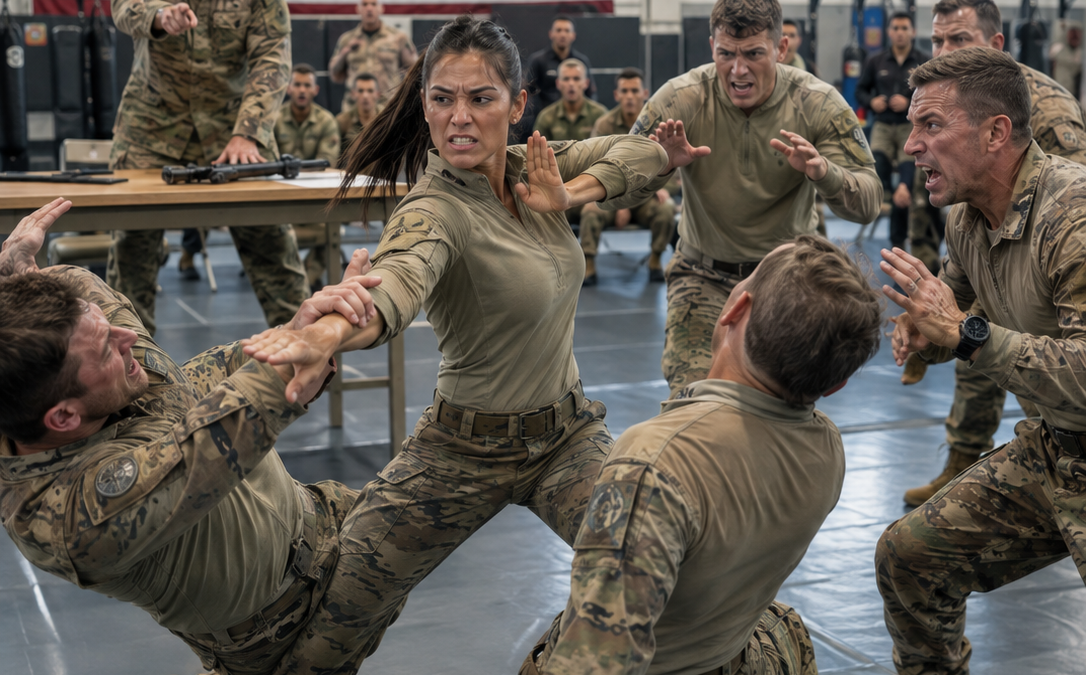
Reic continued. “You’ll face four instructors in sequence. Thirty seconds each. No rest. Grappling, control, disarms, training blade allowed.”
“Rules?” I asked.
“No strikes to the face. No joint destruction. No intentional injury.”
“Victory condition?”
His mouth twitched. “Survive.”
A few Marines shifted.
That word had weight. Survive was not evaluate. Survive was not demonstrate technical proficiency. Survive meant he wanted the frame to be emotional. Primitive. Small woman against larger men. Outsider against house cadre. Navy against Marine.
I nodded. “Understood.”
A young corporal brought out a rubber training blade and held it to me.
Before I could take it, Reic reached over and plucked it from his hand.
“Actually,” he said, “we’ll start you empty-handed.”
There it was.
The title of the lesson he thought he was teaching.
Someone behind me whispered, “Show us then, SEAL.”
I looked toward the sound but did not bother identifying the face. It didn’t matter. Rooms like this always produce one voice for the group’s cowardice.
Reic stepped closer. “Problem?”
“No, sir.”
“You sure? We can slow it down.”
“No, sir.”
His eyes narrowed at the second answer. He wanted me angry. He wanted me defensive. He wanted me to argue about fairness so the room could label me fragile before the buzzer ever sounded.
Instead, I rolled my neck once and stepped barefoot onto the center of the mat.
Cold padding under my soles. Damp air in my throat. Sweat drying between my shoulder blades. My heartbeat was steady enough that I could hear individual sounds around it: Velcro ripping as Trager tightened his gloves, Navarro bouncing lightly on the balls of his feet, Arden exhaling through his nose, Holt saying nothing at all.
Sergeant Mason Holt caught my eye.
He gave the smallest shake of his head.
Warning.
Not about himself. About the setup.
That was the fourth clue, and maybe the only kind one.
I shifted my stance half an inch. Left foot forward, weight centered, hands loose, elbows relaxed. Not a fighting pose. A waiting pose.
Reic noticed. “Comfortable?”
“No.”
That made him smile.
“Good.”
The buzzer sat in the hand of the range safety officer. Red plastic. Cheap. Loud.
Before it sounded, my mind did what it always did before contact. It emptied the room of anything useless.
Reic disappeared.
The whispers disappeared.
The trident on my chest disappeared.
Jonah’s face tried to rise, and I let it pass through me without grabbing it.
There would be time for ghosts later.
Now there were angles.
Distances.
Hips.
Hands.
Breathing.
Gunnery Sergeant Cole Trager stepped forward first. He outweighed me by at least fifty pounds and carried himself like someone who had won most of his fights by making the other man regret standing upright. His right eyebrow scar turned white when he grinned.
“Ready, sweetheart?”
I did not answer.
The buzzer shrieked.
Trager came in fast, level changing for a double-leg takedown with the confidence of a man who believed physics belonged to him.
He expected me to sprawl.
I didn’t.
I gave him half a step of what he wanted, then pivoted off the line, my left palm guiding his head past my hip, my right arm cutting across his shoulder. His momentum kept going. Mine disappeared.
For one sharp second, his back was open.
I took it.
Hook in. Seatbelt grip. Chest glued to spine. Weight dropped exactly where it needed to be.
His hands clawed for mine.
Too late.
My forearm slid under his jaw. Not crushing. Not careless. Clean carotid pressure, enough to let him feel the edge of sleep without stepping over it.
The room changed again.
No one laughed now.
Five seconds.
I released and shoved away before the safety officer could intervene.
Trager hit one knee, coughing, face flushed dark with disbelief.
The buzzer had not even finished echoing.
And when I looked up, I saw Major Reic’s expression flicker for the first time.
Not anger.
Fear.
Because he had just realized the first thirty seconds might not belong to him.
### Part 5
Navarro stepped onto the mat before Trager had fully caught his breath.
That was the plan, of course. No reset. No kindness. No space for the smaller body to recover after dealing with the larger one. Wear her down, crowd her senses, turn skill into fatigue, then call the result reality.
I had seen worse plans succeed.
Staff Sergeant Reed Navarro was the kind of fighter who loved being watched. He circled lightly, shoulders loose, chin tucked, hands twitching in little invitations. Brown belt in jiu-jitsu, according to the whispers at lunch. He had taped his fingers carefully and left the tape bright white, as if the room needed proof that he belonged to a harder world.
“Nice trick,” he said.
I kept my breathing even.
The clock restarted.
Navarro didn’t rush. That made him more dangerous than Trager. Ego with patience is harder to exploit than ego with speed.
He feinted a collar tie, retreated, then reached for wrist control with his left hand. He wanted grip hierarchy. He wanted me reacting to his game. He wanted the fight to become a language he already spoke.
So I mistranslated it on purpose.
I let him catch my wrist.
His eyes sharpened.
For half a beat, he thought he had the first word.
Then I stepped across his centerline, rotated my captured arm inward, and folded his grip against him. My free hand climbed behind his elbow. My hips turned. His shoulder locked into a standing kimura before his brain could file the paperwork.
Pain changes people’s faces honestly.
Navarro’s did not show fear. It showed betrayal. As if technique itself had switched sides.
I applied only enough pressure to make the joint speak.
He tapped once against my forearm.
Eight seconds.
I released immediately.
Navarro staggered back, holding his shoulder, eyes wide and furious. Not injured. Humbled. Men like him often preferred the first.
Somewhere behind me, a chair scraped in the observation room.
I did not look.
Looking gives people gifts.
The third man moved forward.
Sergeant Mason Holt.
Unlike the others, Holt did not bounce, grin, or perform. He stepped onto the mat as if walking into bad weather. Respectful. Measured. His mouth was flat, but not hard. There was a small scar along his chin, old and pale. His hands stayed open.
“Cross,” he said softly.
“Holt.”
The buzzer sounded.
He closed distance with care, aiming for a clinch instead of a shot. Smart. He had watched the first two exchanges and adjusted. His right arm sought underhook control while his left hand posted near my shoulder. If he secured posture, his size would matter. If his size mattered, the room could breathe again.
My goal was not to embarrass Holt.
That made it harder.
The cleanest solutions in fighting are often rude.
I let him establish partial contact, then shifted my weight outside his lead foot. My right hand framed across his bicep. My left hooked behind his tricep. His pressure came forward exactly when I needed it.
I took his balance, not his body.
A short reap behind his ankle.
A turn through the hips.
Holt hit the mat on his back with a sound like someone dropping a heavy bag of wet sand.
I followed, knee sliding across his waist, mount secured, hands posted wide enough to show control without threat.
He looked up at me and exhaled one laugh.
“Damn,” he said.
The buzzer ended his round.
I stood and offered him a hand.
He took it.
For the first time all morning, someone on Reic’s cadre looked at me without trying to reduce me into an argument.
Then Blake Arden stepped in.
The room seemed to make space for him.
Arden was big in the way doors are big. Quietly structural. Thick neck. Long arms. Heavy hands. But there was no swagger in him. No insult waiting behind his teeth. His gaze moved over my stance, my breathing, the sweat gathering at my collar.
He gave me a small nod.
I returned it.
The buzzer shrieked again.
Arden attacked with balance.
Not rage. Not theater. Pressure. Real pressure.
He hand-fought past my first frame, forced me backward two steps, and nearly caught inside position. I pivoted, but he followed. His grip closed briefly on my shoulder seam, strong enough to bunch fabric against skin.
There it is, I thought.
A real problem.
My lungs burned now. The first three exchanges had been short, but intensity taxes the nervous system even when the body looks calm. My forearms felt hot. Sweat slid down my spine. The mat squeaked under my heel.
Arden tried to steer me toward the wall.
I dropped my weight, cut under his arm, and came up on his flank. He turned before I could take his back. Good. Very good.
We collided again.
Chest, shoulder, hand, breath.
The room fell away until there was only the small brutal honesty of contact. No sexism. No politics. No interservice nonsense. Just two trained bodies solving each other in real time.
At twenty seconds, I caught his wrist.
At twenty-four, he broke it.
At twenty-eight, I threatened a sweep.
At thirty, the buzzer sounded.
We separated.
No submission. No takedown. No clean dominance.
Then Arden touched his fist lightly to mine.
“Respect,” he said.
I nodded.
“Same.”
But the safety officer did not lower the buzzer.
Major Reic’s voice cut through the silence.
“Again.”
Colonel Doyle’s head turned sharply behind the glass.
Captain Ward opened her notebook.
And I realized Major Reic was no longer trying to evaluate me.
He was trying to break the evidence.
### Part 6
Nobody moved for half a second after Reic said it.
Again.
That one word told me more about him than the whole morning had. A fair man can dislike what he sees and still respect it. An insecure man keeps changing the rules until reality starts apologizing.
Colonel Doyle stepped out from the observation room before the safety officer could reset the timer.
“Major,” Doyle said.
The word was quiet.
It still stopped the room.
Reic turned, jaw tight. “Sir?”
“You outlined four rounds.”
“Yes, Colonel. I’m assessing fatigue response.”
“No,” Doyle said. “You’re reacting.”
The air thinned.
Reic’s face flushed under the overhead lights. For a moment, I thought he might make the old mistake and confuse rank with invincibility. But even pride has survival instincts. His mouth closed.
Captain Ward came through the side door with her notebook tucked against her ribs. Her eyes flicked over Trager, Navarro, Holt, Arden, then me. She had the stillness of someone who already knew where every witness stood.
“Time?” Doyle asked.
The safety officer swallowed. “Seventy-nine seconds of active contact, sir. Total sequence.”
A murmur went through the room.
Seventy-nine.
That number would travel faster than the truth. Numbers always do. By dinner, it would become a legend. By next week, people would add punches I never threw and injuries I never caused. By next month, someone would swear I smiled before choking out a gunny.
Stories are unreliable animals.
But Reic heard the number like a verdict.
“She didn’t finish Arden,” he said.
Arden’s face hardened. “She didn’t need to.”
Reic turned on him. “I didn’t ask you.”
“No, sir,” Arden said. “You didn’t.”
That was the fifth clue.
Loyalty in a room can shift silently at first. A look. A pause. One man refusing to laugh. Another refusing to lie. By the time a commander notices, he is usually already alone.
Doyle walked onto the mat. His boots made no sound on the padding.
“Operator Cross,” he said, “recover your weapon.”
The range safety officer brought me my Sig. Still cleared. Still locked. Still mine.
I took it, checked it, holstered it.
The motion was small, but the room felt it.
Reic had taken the weapon as a symbol. Doyle returned it as a correction.
I could have let myself enjoy that.
I didn’t.
Enjoyment dulls the blade.
“Briefing room,” Doyle said. “Now.”
The Marines filed in differently than they had gathered that morning. Less noise. Fewer smirks. Trager avoided my eyes. Navarro rolled his shoulder and stared at nothing. Holt walked beside Arden, the two of them quiet as church ushers at a funeral.
I entered last.
The briefing room smelled worse after the mats. Coffee gone bitter on a warmer. Damp uniforms. Marker ink. The trapped heat of bodies pretending not to be uncomfortable.
Doyle stood at the front.
Reic remained near the side wall, arms crossed, but his posture had lost its earlier width. He looked like a man trying to occupy less space without admitting he had been pushed out of it.
Doyle picked up the remote and turned on the screen.
My service photo appeared first.
Younger face. Hair pulled tight. Expression flat.
Then a list.
Three deployments.
Instructor qualifications.
Advanced marksmanship.
Close-quarters combat.
Combatives.
Tactical Combat Casualty Care.
Direct action experience.
Joint operations.
Some sections remained blacked out in thick bars.
The room went quiet in a different way.
The kind of quiet that happens when people realize the book they mocked had chapters they were not allowed to read.
Reic stared at the screen. “Her file sent to my office was abbreviated.”
“Yes,” Doyle said.
“Why?”
Doyle looked at him. “Because you were not cleared for the full one.”
The sentence landed clean.
No shouting. No insult. Just structure collapsing under its own poor engineering.
I kept my eyes on the screen, not because I cared what it said, but because I did not want to watch their faces while they recalculated me. I had been recalculated by men my whole career. It is not the same as being seen.
Doyle clicked again.
A map appeared.
Helmand Province.
My throat tightened before I could stop it.
The room blurred at the edges, just for a second. Dust. Heat. A hand slipping in mine. Jonah’s breath wet in the dark.
Doyle’s voice continued, steady and formal.
“During a mission outside Lashkar Gah, Operator Cross performed life-saving intervention under direct fire after an IED initiated an ambush against her team.”
He paused.
“Her actions enabled extraction of surviving personnel.”
Surviving.
That word always had teeth.
Navarro looked over at me then, and for once, he did not look cocky.
He looked young.
Doyle turned off the screen.
“There is one more thing you should understand,” he said.
Major Reic straightened, maybe sensing the ground was about to open under him.
Doyle looked directly at him.
“Operator Cross was not sent here to be evaluated by you.”
The room stopped breathing.
And for the first time all day, I almost wished he had not said it out loud.
### Part 7
Doyle let the silence work.
Good commanders know silence is not empty. It is pressure. It gives people room to understand the shape of their mistake without being handed the mercy of noise.
Reic’s mouth opened, then closed.
Captain Ward stood near the door, notebook open again, pen still. She was watching him the way intelligence officers watch a man who has just stepped on a wire and has not yet heard the click.
Doyle continued.
“When I requested support from Naval Special Warfare, I asked for their strongest combatives instructor available for a curriculum review. Operator Cross was sent to evaluate this program and identify gaps.”
Reic’s hand moved toward the insignia on his chest. A small unconscious touch. Reassurance. Proof. Metal and cloth telling him he was still who he had been that morning.
Nobody else seemed convinced.
“Her participation in today’s lanes,” Doyle said, “was intended to give her direct insight into your instruction model, not to provide you an opportunity to question whether she belongs in uniform.”
Trager stared at the table.
Navarro swallowed.
Holt watched Reic, not Doyle. Arden watched me.
I wished they would all stop watching.
People think vindication feels warm. Sometimes it does. Mostly it feels like standing under too much light while everyone finally notices the knife sticking out of your side.
Doyle turned toward me.
“Operator Cross. Your assessment.”
There it was.
The real reason I had not shown every card.
I stepped to the front of the room. My boots sounded too loud on the floor. The marker tray held three dry-erase pens, one black, one blue, one red. The red one had teeth marks in the cap. Someone here chewed when stressed.
I picked up the black marker.
“My assessment is preliminary,” I said.
No one interrupted.
“Your fundamentals are strong. Your people are physically capable, aggressive, and comfortable under pressure. Those are assets.”
Reic’s shoulders loosened a fraction.
Then I kept going.
“Your weaknesses are cultural before they are technical.”
The loosening stopped.
I wrote three words on the board.
Selection. Metrics. Ego.
“The instructor cadre is too similar in body type, fighting preference, and mindset. That creates a false standard. Students who succeed under that model will look strong inside the model. Students who solve problems differently may be undervalued or mishandled.”
I capped the marker, uncapped it again. My hands were steady.
“Your evaluation metrics reward visible dominance over tactical efficiency. A clean disengagement is treated as less impressive than a rough takedown. Technical restraint is mistaken for inability. Smaller operators are forced to prove survival before they’re allowed to demonstrate skill.”
Navarro looked down at his taped fingers.
“Third,” I said, “leadership pressure has created performance theater.”
That one hit hardest.
Even Captain Ward’s pen moved.
“Instructors here appear motivated to defend an image rather than expose weaknesses. That limits learning. It also makes them predictable.”
Reic finally spoke. “That’s your conclusion from one morning?”
I turned toward him.
“No, sir. That’s my conclusion from one morning, four instructor interactions, overheard peer commentary, three deviations from the written protocol, one unauthorized change to the final evolution, and your attempt to extend the sequence after the result failed to match your expectation.”
The room went very still.
A truck backed up somewhere outside, its alarm beeping faintly through the wall.
Reic’s eyes hardened. “You’re making assumptions about my intent.”
“Yes, sir,” I said. “Based on behavior.”
Holt’s mouth twitched like he almost smiled.
Doyle did not.
I looked back to the board because eye contact can turn assessment into argument if you let it.
“My recommendation is a three-week curriculum adjustment. Rotate instructor pairings by size and style. Add decision-based scoring. Include disengagement, weapon retention, wall work, ground survival, and fatigue management. Bring in outside instructors quarterly. Not for optics. For stress-testing.”
I set the marker down.
“And remove language that frames outside personnel as inferior before they step on the floor.”
No one had to ask what language.
Sweetheart still hung in the room like smoke.
Reic’s face had gone flat now. That worried me more than anger. Anger burns. Humiliation ferments.
Doyle nodded once. “Thank you.”
I stepped back.
That should have been the end of it.
It wasn’t.
Because as the room began to break, as chairs scraped and men avoided looking at one another, Captain Ward crossed to Doyle and handed him a folded sheet from her notebook.
He opened it.
Read it.
Then looked at Reic.
“Major,” Doyle said, voice colder than before, “why does Captain Ward have a written safety objection from last week with your initials on it?”
Reic went pale.
And suddenly the morning was not about me anymore.
### Part 8
The folded page made a soft sound in Doyle’s hand.
Paper should not be able to change the temperature of a room, but that one did. Reic stared at it like it had crawled out of a grave.
I did not know what was written there. Not yet. But I knew how guilt moves through a body. The eyes first. Then the jaw. Then the hands finding something useless to do.
Reic’s right thumb rubbed the edge of his wedding ring.
Captain Ward spoke before he could.
“Last week, I submitted concerns regarding unsanctioned intensity increases in evaluation lanes. Specifically, outside personnel being placed into disadvantage sequences without proper notification or warm-up.”
Her voice was crisp. Not dramatic. Paperwork given a pulse.
Doyle’s eyes did not leave Reic. “You acknowledged receipt.”
“Yes, sir,” Reic said.
“And today?”
“Today was controlled.”
Arden made a low sound in his throat.
Reic’s head snapped toward him. “Something to add, Staff Sergeant?”
Arden stood straighter. “Sir, I was told the final sequence would include two instructors. Not four.”
The room shifted again.
Trager looked at Navarro.
Navarro looked away.
Holt said, “Same, sir.”
That one landed worse than Arden’s statement because Holt did not sound angry. He sounded disappointed.
Reic’s face tightened. “Adjustments were made for training value.”
Ward turned a page. “After the sidearm removal?”
“That was safety protocol.”
I said nothing.
There are moments when defending yourself gives the other person room to drag you into mud. Better to let the facts stand clean.
Doyle placed Ward’s paper on the table.
“Major Reic, you will provide a written explanation of all deviations from the approved schedule by 1700.”
“Yes, sir.”
“Captain Ward will attach her prior objection.”
Reic’s jaw flexed.
“Yes, sir.”
Doyle looked at the room. “Dismissed, except Operator Cross.”
Chairs scraped. Boots moved. Nobody talked.
As they filed out, Navarro paused near the doorway. For a second I thought he might apologize. His hand hovered near his bad shoulder. His eyes met mine, then dropped.
He left without speaking.
That was fine.
An apology dragged out by exposure is just embarrassment wearing manners.
Holt remained a second longer.
“You okay?” he asked quietly.
I almost laughed.
It was such a normal question. Such a civilian-shaped thing to ask in a room still smelling of testosterone, coffee, and institutional failure.
“Yes,” I said.
He nodded like he knew that meant no.
Then he left.
When the door closed, only Doyle, Ward, and I remained.
The fluorescent lights made the tabletop shine in streaks.
Doyle exhaled through his nose. “I owe you an apology.”
“No, sir.”
“Yes,” he said. “You do not need it, but you are owed it.”
I said nothing.
That was the thing about apologies in uniform. They often arrived after the damage had already done its job. Still, Doyle looked like a man who understood that.
“I expected resistance,” he said. “Not that.”
Ward closed her notebook. “I did.”
Doyle turned to her.
She shrugged. “The language was in the pre-brief. The structure was there. Major Reic has a pattern with anyone who disrupts hierarchy by competence instead of rank.”
I liked her immediately and resented that it had taken me all morning to know it.
Doyle looked at me again. “Will this affect your written assessment?”
“No.”
“You’re sure?”
“I was not surprised, Colonel.”
That made him look older.
Ward’s expression softened, not with pity, but recognition. There is a difference.
Doyle nodded slowly. “The three-week course you recommended. Would you be willing to lead it?”
My first instinct was to refuse.
Not because I couldn’t. Because I was tired. Tired in the deep, marrow-colored way that comes from being invited into rooms where people sharpen knives and call it assessment. Tired of teaching men who only listened after impact. Tired of turning old wounds into lesson plans.
Then Jonah’s voice moved through me.
Don’t let them make you smaller.
I looked through the glass toward the empty mats.
“I’ll lead it,” I said. “But not as a favor.”
Doyle’s mouth almost smiled. “Understood.”
“I want full control of curriculum structure. Mixed pairings. No hidden changes. No instructor ego games. If somebody wants to test me personally, they can put it in writing and explain the learning objective.”
Ward’s pen moved again.
Doyle nodded. “Agreed.”
“And Major Reic does not participate.”
The room held that for a moment.
Doyle did not answer quickly.
That told me the answer was complicated.
Outside the door, a raised voice cut through the hallway.
Reic.
Then another voice.
Navarro, sharp and angry.
A locker slammed hard enough to shake the wall.
Ward opened the door before Doyle could stop her.
Down the corridor, Navarro stood chest-to-chest with Reic, face red, one hand gripping his injured shoulder.
And I heard him say, “You knew she wasn’t the one being evaluated.”
### Part 9
Hallways tell the truth differently than briefing rooms.
In briefing rooms, people sit upright, choose words, aim their faces toward rank. In hallways, anger catches them before discipline can dress it properly.
Navarro stood near the lockers with his taped fingers curled into fists. His shoulder had to hurt. I had torqued it carefully, but pain does not care how professional you were about delivering it.
Reic stood in front of him, close enough to intimidate. Too close for a commander correcting a subordinate. His voice was low, but the corridor carried every word over the smell of floor wax and wet boots.
“You need to remember yourself, Staff Sergeant.”
Navarro laughed once. Ugly. “I remembered plenty today, sir.”
Trager hovered behind him, uncertain. Arden stood farther back with his arms crossed. Holt leaned against the wall, quiet but ready.
Doyle stepped into the corridor.
Everyone froze.
“Major,” Doyle said.
Reic turned. “Sir, I’m handling a discipline issue.”
“No,” Doyle said. “You’re creating one.”
That ended the hallway performance.
Navarro’s eyes flicked to me, then away. Shame had replaced anger now, and that was harder to watch. He had been cruel at lunch because the room rewarded it. Now the room had changed, and he was trying to decide what kind of man he wanted to be without the old applause.
Doyle ordered everyone back to their quarters until the afternoon debrief. Reic left first, walking stiffly, shoulders high. His boots struck the floor with too much force.
Navarro stayed.
“Cross,” he said.
I waited.
He rubbed the back of his neck. “I was out of line.”
“Yes.”
His jaw tightened, not in anger this time. In acceptance.
“I apologize.”
I could have made it easy for him.
No worries. All good. Heat of the moment.
Women learn those phrases young. We smooth the floor after someone else drops the glass. We call cuts scratches so nobody has to feel guilty about the blood.
I did not do that.
“Thank you for saying it,” I said. “It doesn’t undo it.”
He looked at me then.
Really looked.
“No,” he said. “It doesn’t.”
That was the closest thing to respect he had offered all day.
I nodded and walked away.
The three-week course started the following Monday.
By then, Reic was still technically in command, but his shadow had shortened. He attended none of the practical sessions. Doyle observed the first morning. Ward observed all of them. Marines arrived with the tense curiosity of people who had heard too many versions of a story and wanted to see which one bled.
I began with no speeches.
I put Trager against a corporal half his size and told him the objective was not takedown, but exit.
He failed three times.
The corporal smiled on the fourth.
Trager did not.
Good.
Humility hurts before it helps.
I paired Navarro with a quiet female Navy corpsman brought in for medical integration drills. She used wall frames and wrist angles to make his strength irrelevant. He tapped twice, swore once, then asked her to show the entry again.
That was better.
Arden became my best assistant by accident. He absorbed corrections without making them about identity. If I told him his left underhook was late, he fixed it. If I told him his pressure gave smaller opponents predictable energy, he asked what variable to change.
Holt watched everything and asked the questions other men were too proud to ask.
On day six, he stayed after class while rain sheeted against the high windows.
“You knew from the start,” he said.
I was wiping down a training blade with disinfectant. “Knew what?”
“That Reic was setting you up.”
“Yes.”
“And you still let it happen.”
I looked at the rubber blade in my hand. Black. Flexible. Harmless until someone used it as a symbol.
“I let him show the room what the problem was.”
Holt leaned against the wall. “That cost you.”
“Most useful things do.”
He studied me for a moment. “Helmand?”
My hand stopped moving.
He did not apologize for asking. That made it easier not to punish him for it.
“Some of it,” I said.
He nodded. “I lost two in Sangin.”
The rain got louder.
There it was. The hidden bridge men rarely build out loud. Not sympathy. Not comparison. Just two people placing separate griefs on the same table and not pretending they matched.
“I’m sorry,” I said.
“Me too.”
He looked toward the empty mats.
“Does it get quieter?”
I thought of Jonah’s photo. My father’s desert. The scar under my ear. The way blood smells coppery and hot even when the night air is cold.
“No,” I said. “You get better at hearing other things with it.”
Holt nodded slowly.
Before he could answer, Captain Ward stepped into the doorway.
“Cross,” she said. “You should see this.”
She held up a printed email.
No subject line.
No signature.
Only one sentence in the middle of the page.
Ask her what really happened to Lieutenant Hail.
### Part 10
For a moment, the training room lost all sound.
Rain kept hitting the windows. A ventilation fan rattled overhead. Somewhere beyond the wall, Marines laughed at something in the corridor. All of it became distant, like noise heard underwater.
Captain Ward handed me the page.
The paper was warm from the printer.
Ask her what really happened to Lieutenant Hail.
The sentence sat there in plain black font, almost childish in its simplicity. No threat. No accusation stated directly. Just a hook dropped into old blood.
Holt’s eyes moved from the page to my face. “What is that?”
“Bait,” Ward said.
Her voice had gone flat in the way professionals get when something stops being administrative and becomes operational.
I read the sentence again.
My first emotion was not fear.
It was anger.
Clean and cold.
Because whoever sent it knew the name. Not just Helmand. Not just “your dead officer.” Lieutenant Hail. Specific enough to wound. Vague enough to spread.
Ward watched me carefully. “This came to the shared training inbox eleven minutes ago. Spoofed sender. Routing is being traced.”
“Who saw it?”
“Me. Doyle. IT. Not Reic, unless he sent it.”
Holt said, “Would he?”
Ward looked down the hall before answering. “Major Reic is cornered. Cornered men do many things. But this feels different.”
Different.
I knew what she meant.
Reic was proud, biased, reckless with authority. But this email had the smell of old intelligence, not fresh embarrassment. It reached into a part of my record most people could not see and touched the exact place where fact and rumor could breed.
I folded the paper once.
Then again.
My hands were steady, which told me nothing. My hands had been steady on Jonah’s tourniquets too.
Ward said, “Doyle wants you in his office.”
Holt stepped back. “I’ll clear the room.”
“No,” I said.
He paused.
“If this spreads, don’t deny it emotionally. Don’t defend me with adjectives. Say the record cleared the action, and the command is handling an unauthorized disclosure.”
Ward’s eyes sharpened. “That’s exactly right.”
Holt nodded once. “Understood.”
Doyle’s office was on the second floor, overlooking the motor pool. It smelled like old leather, printer toner, and coffee strong enough to qualify as equipment. A framed photograph of Marines in desert cammies sat on his shelf. Nobody in the photo was smiling.
Doyle stood behind his desk with the email open on his screen.
“I’m sorry,” he said.
I was starting to hate how often good men had to say that because bad ones had made a mess.
“Who has access?” I asked.
“To the full Helmand file? Very few. To enough metadata to know Hail’s name? More than I like.”
“Reic?”
“Not through official channels.”
Ward closed the door behind us. “There’s another possibility.”
I looked at her.
She hesitated.
That was new.
“Say it,” I told her.
“The original after-action file had a contested annex.”
My pulse stayed even.
I had not known that.
Doyle’s face hardened. “Captain.”
“She deserves to know,” Ward said.
Doyle looked at me for a long second, then reached into his desk and removed a thin folder with a red cover. Not thick. Not enough pages for the weight it carried.
He placed it on the desk.
I did not touch it.
“What annex?” I asked.
Doyle’s voice lowered. “A signal intercept after the ambush suggested the target had prior warning of the raid.”
The office window reflected my face back at me.
Not surprised.
Something worse.
Confirmed.
For years, a part of me had known the mission felt too clean until it wasn’t. Dogs quiet. Gate easy. Firing ports prepared. Pressure plate exactly where a team leader would step in the stack.
I had buried that knowledge under procedure because grief already had enough teeth.
Ward said, “The annex was sealed pending source verification. It never produced a formal finding.”
“Who had prior warning?” I asked.
Doyle did not answer fast enough.
My skin went cold.
“Colonel.”
He opened the folder and turned one page toward me.
Most of it was blacked out.
But one line remained visible.
Possible compromise through coalition liaison channel.
Coalition liaison.
Not Taliban luck. Not bad intel.
Someone had leaked the shape of our approach.
Jonah had not walked into random death.
He had been sent toward a prepared one.
I stared at the black bars until they seemed to move.
Then Ward’s phone buzzed.
She checked it, and all the color left her face.
“What?” Doyle asked.
Ward looked at me.
“The spoof trace came back,” she said. “The email originated from inside Iron Haven.”
### Part 11
Inside Iron Haven.
That phrase moved through Doyle’s office like gas under a door.
Not outside. Not some bored keyboard ghost. Not an old enemy across the ocean with too much time and a stolen file.
Inside.
Close enough to smell the same coffee. Close enough to watch the course. Close enough to know when to hit the bruise.
Doyle grabbed his phone and issued three orders in a voice that made even the walls seem to stand straighter. Lock down admin terminals. Preserve logs. No one leaves the compound without authorization.
Ward opened her laptop on the corner of his desk and began working with the focused aggression of someone dissecting a bomb.
I stood still because movement would have been too honest.
I wanted to find Reic.
That was my first ugly instinct. Walk down the stairs, put him against a wall, and ask what he thought he was doing digging Jonah out of the ground for leverage.
But instinct is not command.
My father’s voice came back, dry as desert dust.
Most folks hang themselves if you don’t interrupt.
So I waited.
Twenty-three minutes later, Ward had a name.
Not Reic.
Gunnery Sergeant Cole Trager.
For a second, that made no sense. Trager had been arrogant, yes. Cruel in the easy way men are cruel when they think cruelty is currency. But the email required access he should not have had.
Then Ward found the path.
Shared terminal. Temporary admin permissions from the prior week. An old file package attached to a curriculum archive. Not the full Helmand annex, but enough: my name, Jonah’s name, casualty summary, redacted inquiry note.
Trager had gone looking for dirt after the first day of the course.
He found bones instead.
Doyle had him brought in.
Trager entered with his hands at his sides and his face set in a hard mask. He did not look at me. That told me he was guilty before the first question.
Doyle placed the printed email on the desk.
“Explain.”
Trager’s jaw flexed. “I sent it.”
Ward stopped typing.
Doyle’s voice dropped. “Why?”
Trager looked at me then.
His eyes were not triumphant. That surprised me. They were angry, yes, but under that was something rawer.
“You come in here,” he said, “and everybody acts like we’re the problem. Like everything we built is trash because you dropped a few guys on mats.”
I said nothing.
“You embarrassed us.”
“No,” I said quietly. “You participated.”
His face flushed.
“I wanted people to know maybe you weren’t perfect either.”
There it was.
The disease.
Not justice. Not truth. Punishment for a woman refusing to be small.
Doyle stepped forward. “You accessed restricted material and distributed an insinuation about a classified casualty event to discredit an authorized evaluator.”
Trager swallowed.
The words had become too large for his excuse.
“Sir, I didn’t distribute it widely. Just the inbox.”
Ward said, “Which multiple personnel can access.”
“I didn’t know about the annex. I just saw the note.”
I looked at him then.
“You didn’t need to know. You wanted smoke. You didn’t care what was burning.”
He flinched.
Good.
Not enough. But good.
Doyle removed Trager from the course immediately. Formal investigation. Loss of instructor billet. Potential charges pending review. Trager stood through it pale and silent, then left with an escort.
When the door closed, Doyle looked exhausted.
Ward looked furious.
I felt nothing for about ten seconds.
Then the room tilted slightly, not enough for anyone else to notice. Jonah’s name had been used like a dirty tool. His death, my worst night, reduced to a lever in a petty internal war.
I went to the window and looked down at the motor pool.
Rainwater shone on the pavement in broken silver patches. A Marine in a poncho jogged between buildings with a clipboard under his arm. The world kept doing ordinary things. It always does, no matter what has just been torn open.
Doyle came to stand beside me.
“I can suspend the course.”
“No.”
“Cross.”
“No,” I said again. “That’s what he wanted. Make the work about the wound.”
Ward spoke from behind us. “There’s still the leak question from Helmand.”
I closed my eyes.
Yes.
There was that.
The email had been petty. The annex was not.
Someone had warned the enemy before our raid. Someone’s compromise had killed Jonah or helped kill him. And now, after years sealed in black ink, that old truth had stepped into the light because one arrogant Marine wanted to humiliate me.
I opened my eyes.
“Who handled the coalition liaison channel?” I asked.
Doyle and Ward exchanged a look.
I hated that look.
Ward answered carefully.
“At the time? Several people. But one name appears twice in the routing chain.”
She turned the laptop toward me.
The name on the screen was not one I expected.
And when I read it, the scar under my ear began to burn.
### Part 12
Lieutenant Commander Evan Sloane.
The name looked harmless on the screen. Names often do. Black letters, clean font, nothing to show the damage a person might have carried behind them.
I had met Sloane once in Afghanistan.
Not well. Not enough to call memory reliable. He had been one of those liaison officers who drifted in and out of operations spaces with a badge clipped too neatly to his chest and a face that never seemed tired enough. Brown hair. Careful smile. Voice soft in the way of men who want to sound reasonable before they ask for something unreasonable.
He had brought us updated route notes the afternoon before the raid.
I remembered that because Jonah made a joke after he left.
“Guy smiles like he bills by the tooth.”
I had laughed.
That memory hurt now.
Ward pulled up what she could. “Sloane separated from the Navy eighteen months after the Helmand incident. Consulting work since then. Security contracts. Training advisement. Nothing obviously criminal.”
Doyle’s face was hard. “Why is his name in the routing chain twice?”
“Initial liaison packet and revised movement confirmation,” Ward said. “The revised confirmation went through his terminal seven hours before the raid.”
Seven hours.
Long enough to prepare firing ports.
Long enough to place a pressure plate.
Long enough to turn a clean operation into a slaughterhouse.
My body wanted certainty.
Certainty is dangerous. It feels like strength while it quietly blinds you.
“Could his terminal have been used by someone else?” I asked.
Ward nodded. “Possible.”
“Could the file be wrong?”
“Also possible.”
“Could he have leaked it?”
She did not soften the answer.
“Yes.”
The office door opened after Doyle’s knock command, and Holt stepped in.
His eyes found the screen before anyone spoke. He read the name upside down, or maybe he read our faces.
“What do you need?” he asked.
That was why I had started trusting him. Not Are you okay. Not What happened. What do you need.
Doyle said, “Nothing you’re cleared for yet.”
Holt nodded once, ready to leave.
I stopped him. “You worked Sangin in 2021?”
“Part of it.”
“Did you ever hear Sloane’s name?”
His brow furrowed. “Liaison guy? Smooth talker?”
Ward looked up.
Holt’s eyes narrowed as memory caught. “There was a rumor after a bad hit near Gereshk. Bad route intel. Everybody blamed local partners first, but one of our comms guys said liaison traffic had been weird for weeks.”
“Do you remember the comms guy?”
“Staff Sergeant Peter Lasky. He’s out now. Runs a dive shop in Wilmington, last I heard.”
Doyle was already reaching for his phone.
Ward began typing again.
The day stretched from investigation into instruction and back into investigation, folding time into a shape that made lunch meaningless. I taught wall escapes at 1300 with Jonah’s ghost standing somewhere behind my left shoulder. I corrected Navarro’s posture at 1345 while wondering whether the man who had rerouted our death was still cashing consulting checks. I demonstrated blade retention at 1500 and felt every rubber knife like a question.
At 1620, Doyle got Lasky on speaker.
His voice came through rough, suspicious, coastal.
“You asking official or personal?”
Doyle glanced at me. “Both.”
Lasky sighed. “Then I’ll say what I couldn’t prove. Sloane was dirty or stupid. Maybe both. Twice before bad hits, liaison traffic got rerouted through his station outside normal chain. I flagged it. My chief told me to shut up unless I wanted to spend my career inventorying batteries.”
“Do you have records?” Ward asked.
“No classified records.”
That answer had a hook.
Doyle heard it too. “But?”
Lasky hesitated.
“I kept a notebook.”
Nobody breathed.
“Dates. Times. Terminal IDs. Not contents. I wasn’t dumb enough to walk out with classified material.”
Ward closed her eyes briefly, like a prayer had been answered by a man with poor filing habits.
“Can you bring it?” Doyle asked.
“No,” Lasky said. “But someone can come get a copy.”
Doyle looked at Ward.
Ward looked at me.
I knew what she was thinking before she said it.
Wilmington was close.
Too close not to go.
We left after sunset in an unmarked government sedan that smelled like vinyl seats and old french fries. Ward drove. Holt came because Doyle wanted someone Marine-side and trustworthy. I sat in the back with the red Helmand folder on my lap.
The highway shone black under the rain.
For miles, nobody spoke.
Then Ward’s phone rang through the car speakers.
Unknown number.
She answered.
A man’s voice filled the sedan, soft and reasonable.
“Riley Cross should stop asking about Helmand.”
I looked at Ward in the rearview mirror.
The voice continued.
“Some deaths are cleaner when they stay buried.”
And I knew, before he said another word, that Evan Sloane had just made his first mistake.
### Part 13
Ward did not brake.
That mattered.
A threat lands differently when the driver keeps the car steady.
Rain slid across the windshield in bright ropes, sliced apart by the wipers. Holt sat forward in the passenger seat, one hand braced near the dash, eyes scanning the dark highway like Sloane might step out between mile markers wearing guilt and a reflective vest.
Ward kept her voice mild. “Who is this?”
The man laughed softly.
I remembered that laugh now. Controlled. Polished at the edges. A man smoothing a tablecloth over rot.
“You already know.”
I leaned forward. “Sloane.”
Silence.
There are many kinds of confession. His pause was one.
When he spoke again, the softness had thinned. “You were always sharp.”
“You warned them.”
“I passed information through channels.”
“You warned them.”
Ward tapped her phone, recording, routing, tracing. Her face gave away nothing.
Sloane sighed, almost bored. “You operators always need a villain. It was a complicated environment.”
“Jonah Hail bled out in the dirt.”
“Yes,” he said. “People did that often there.”
The car seemed to shrink around me.
Holt turned halfway, eyes hard.
My hand moved to the scar under my ear before I realized it.
Sloane kept talking because men like him mistake cruelty for control once they think they’ve already won.
“The target was feeding us information. Valuable information. Your raid would have burned the source. Certain partners were advised to shift assets. What happened after that was unfortunate.”
Unfortunate.
That word cracked something open.
Not my composure. Something older and colder beneath it.
“You traded our route,” I said.
“I protected a broader intelligence channel.”
“You got my team ambushed.”
“I made a strategic decision above your level.”
Ward’s eyes flicked to mine in the mirror. Keep him talking.
I did.
“Then why call?”
Another pause.
There. Fear under the polish.
“Because you’re chasing ghosts with people who don’t understand what they’re touching.”
“Lasky’s notebook worries you.”
The silence this time was longer.
Holt’s mouth tightened.
Ward changed lanes smoothly.
Sloane said, “Destroy whatever he gives you. Walk away. Your career survives. Your reputation stays clean. No one needs to hear that your lieutenant died because command politics valued an informant more than a team.”
“My reputation?”
A small laugh escaped me, but there was no humor in it.
“You still think this is about me.”
“Everything is about someone, Riley.”
“No,” I said. “Some things are about the dead.”
His voice hardened. “Careful.”
“For years I thought Jonah died because war is random and I wasn’t fast enough. I carried that. I built a life around that. You don’t get to call now and offer me silence like it’s mercy.”
“You have no idea what consequences this creates.”
“I know exactly what consequences silence creates.”
Ward pointed ahead.
A black SUV sat on the shoulder near the next exit, lights off.
Holt saw it too.
Ward kept driving past.
The SUV pulled out.
Sloane said, “Last chance.”
Ward ended the call.
The sedan filled with the sound of rain and engine.
Holt checked the side mirror. “Following.”
Ward’s voice stayed calm. “I see it.”
I unbuckled my seat belt.
Holt glanced back. “Cross.”
“Relax,” I said, reaching under the seat where Ward had stashed a go bag before we left. “I’m not jumping out.”
Inside the bag were a flashlight, flex cuffs, medical kit, and my M19 in a secured holster. Doyle had insisted. Ward had not argued.
I checked the weapon by feel.
This time, no one took it from me.
Ward exited toward a closed weigh station lit by two flickering lamps. The sedan rolled in, tires hissing over wet pavement. The SUV followed too confidently.
Bad habit.
Predators hate believing they are being led.
Ward stopped under the light.
The SUV stopped thirty yards behind us.
Two men got out.
Not Sloane. Contractors, probably. Baseball caps. Rain jackets. One had a hand near his waistband.
Holt exhaled. “This is stupid.”
“Yes,” I said. “Theirs.”
Ward opened her door and stepped out with her badge already raised. “Federal personnel. Identify yourselves.”
The man on the left reached.
Holt moved first, slamming his door open hard enough to use it as cover.
I came out low on the opposite side, weapon drawn, rain cold on my face, sights steady on the man’s center mass.
“Hands,” I said.
He froze.
The second man tried to run.
Holt caught him in six steps and put him face-first into a puddle with professional disappointment.
It ended fast after that. Men who come to scare people rarely plan well for being arrested in the rain by the people they meant to frighten.
Lasky met us forty minutes later behind his dive shop, wearing flip-flops, a raincoat, and the expression of a man who had expected trouble for five years and was almost relieved it had finally arrived.
His notebook was wrapped in two freezer bags.
The pages smelled faintly of mildew and diesel.
Dates. Times. Terminal IDs.
Sloane’s station.
Twice before compromised operations.
Once seven hours before Jonah died.
By dawn, Doyle had enough to trigger a formal investigation above Iron Haven’s level. By noon, Sloane was detained for questioning after Ward’s recorded call and Lasky’s notebook hit the right desks. By the end of the week, men with better clearances than mine were pulling on threads he had thought buried under classification and bureaucracy.
The truth did not bring Jonah back.
I had known it wouldn’t.
But it shifted the weight.
That mattered.
### Part 14
Eight weeks after Major Reic asked if I had earned my trident, he received transfer orders to Quantico.
The memo praised his operational experience and identified a need for his background in doctrine development. That is how institutions write exile when they still want the furniture to look undisturbed.
He did not apologize.
I did not wait for him to.
Some people think forgiveness is the final proof of strength. Maybe for them it is. For me, strength was not handing absolution to a man who had sharpened his authority against anyone who didn’t match his picture of competence. I did not hate him. Hate takes maintenance. But I did not forgive him either.
I simply removed his voice from the room inside my head.
Gunnery Sergeant Trager lost his instructor billet and faced formal discipline for accessing and misusing restricted material. The last time I saw him, he stood outside the admin building in service alphas, face pale, cover tucked under one arm. He looked at me like he wanted to say something.
I kept walking.
Not every silence is avoidance. Some silences are boundaries.
Major Sarah Vance took over Company Bravo two weeks later. Former recon. Five Afghanistan deployments. Calm eyes. No patience for chest-beating disguised as standards.
Her first curriculum meeting lasted nine minutes.
“Technique over size,” she said. “Adaptability over ego. If your method only works when you’re bigger, stronger, and fresh, it’s not a method. It’s a wish.”
I liked her too.
The three-week course became six. Then quarterly. Navy instructors rotated through. Marines visited our side. Arden built a fatigue-based wall survival block that made half the class hate him and all of them better. Holt and I stayed in touch after he transferred to an advanced training cell. Navarro kept training with the Navy corpsman who had humbled him, and one afternoon I heard him correct a younger Marine for calling her “little lady.”
Progress is rarely poetic.
Sometimes it is just a man swallowing the words he once would have laughed at.
The Sloane investigation took longer. Real justice usually does. People imagine truth as a door kicked open. More often, it is a hallway of locked cabinets, missing signatures, frightened witnesses, and men arguing over what can be admitted without embarrassing the dead.
But the call was recorded.
The notebook existed.
Other names surfaced.
Other families got answers they had been told not to ask for.
When they finally let me read the unsealed portion of the report, I sat alone in my apartment with the blinds half-open and morning light lying across the floor. The paper confirmed what my body had known before my mind had permission.
Our route had been compromised.
Jonah Hail died in an ambush shaped by betrayal, not chance.
I expected to cry.
I didn’t.
I made coffee. I opened the hidden album on my phone. I looked at Jonah grinning in front of the Hesco barrier, dust on his face, arm around my shoulders.
“I know,” I said.
That was all.
Months later, Iron Haven invited me back for the final day of a new combatives cycle. I almost declined, then accepted because old rooms do not become new unless someone walks into them differently.
Building 447 smelled the same. Gun oil. Ocean salt. Coffee. Rubber mats. But the air had changed.
Morning light came through the briefing room windows in pale gold instead of gray. Eighteen Marines sat in front of me, mixed ranks, mixed builds, two women, one corpsman, one quiet kid with nervous hands who reminded me of every underestimated operator I had ever met.
Major Vance stood in the back.
Captain Ward leaned beside the door, notebook still in hand.
Holt had driven in for the day and sat near the side wall. Arden stood with the instructors. Navarro watched from the second row, shoulder healed, pride quieter.
I stood at the front without a marker.
No slides.
No performance.
“I’m not here to tell you size doesn’t matter,” I said. “It does. Strength matters. Speed matters. Aggression matters. But none of those things matter as much as honesty.”
The room stayed still.
“Honesty tells you when your favorite move only works on people who let it. Honesty tells you when your confidence is just fear with better posture. Honesty tells you when the person you dismissed has something to teach you.”
I looked toward the mats beyond the glass.
“I had a lieutenant once. Jonah Hail. He died in Helmand Province after an ambush that should not have been waiting for us. For a long time, I thought the lesson was that perfect technique still loses to bad luck.”
I let that sit.
“I was wrong. The lesson was that silence protects the wrong people. Ego protects the wrong systems. And skill, real skill, is not loud. It doesn’t need permission. It just keeps showing up until the truth has nowhere left to hide.”
No one clapped at first.
Good.
I didn’t want applause before thought.
Then Holt began.
One clean clap. Then another.
Arden joined. Ward. Vance. Navarro. The whole room followed, not wild, not theatrical, just steady.
I accepted it with a nod and nothing more.
Afterward, I stepped outside into the Carolina air. Pine and saltwater moved together on the wind. The sky had cleared after rain, and the pavement shone like black glass under the sun.
My phone buzzed.
A message from Holt.
Coffee before you leave?
I looked back through the glass. Inside, a new group of Marines moved onto the mats. Smaller operators paired with larger ones. Instructors watching instead of posturing. Mistakes happening honestly. Corrections landing without humiliation.
I typed back.
Another time.
Not because I was running.
Because for the first time in a long time, I was not.
I walked toward the parking lot with my kit bag over my shoulder and my sidearm where it belonged. The trident on my chest caught the light for one brief second, not asking anyone to believe in it, not begging anyone to understand what it had cost.
Some things do not need defending forever.
Some truths only need one clear moment, one locked room, one stolen weapon returned, one old ghost answered, and seventy-nine seconds for everybody watching to realize they had been wrong.
THE END!
Disclaimer: Our stories are inspired by real-life events but are carefully rewritten for entertainment. Any resemblance to actual people or situations is purely coincidental.








