“I Am The Law!” The Smug Black Belt Hit A Weak Boy, Then Realized His Sister Is ME, A USASOC Legend!
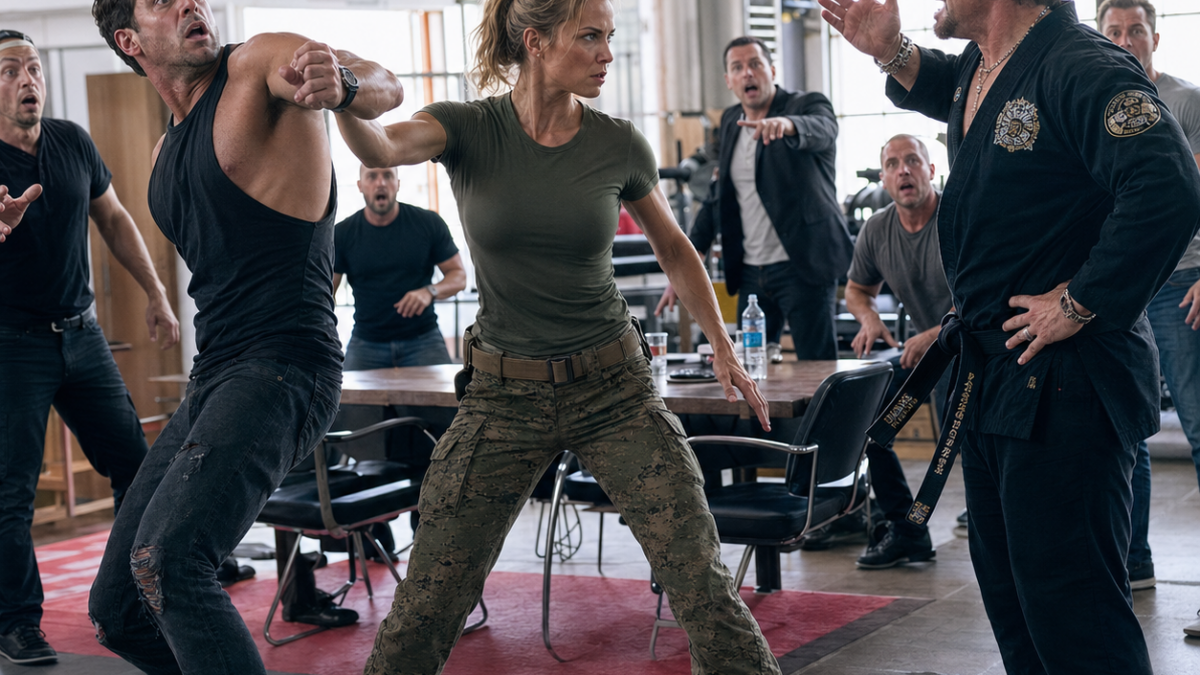
The Fake Black Belt Smirked As His Goon Swung. “I Am The Law!” He Roared. I Just Clamped The Thug’s Wrist. Exactly 1.5 Seconds Later, Bone Shattered, And He Crashed Down. Dropping The Weak Sister Facade To Expose The Instincts Of An Army Special Ops Veteran, I Whispered To The Boss, “You Forgot Who Taught You To Fight…”
### Part 1
“Get on your knees and pick up every piece.”
Trevor Kane’s voice cracked across Clara’s Diner a split second before a glass hit the floor.
The tumbler shattered beside my brother’s shoes.
Evan flinched so hard his shoulder struck the edge of the counter.
He was twenty years old, six feet tall if he remembered to stand straight, and thin enough that every winter jacket looked borrowed on him. People who didn’t know him sometimes mistook his silence for weakness or arrogance.
It was neither.
Evan had severe social anxiety. On bad days, ordering his own lunch could leave his hands trembling. Crowded rooms made his breathing shorten. Sudden confrontation could shut him down completely.
And Trevor knew that.
That was the part I couldn’t forgive.
“Come on,” Trevor said, smiling as Evan lowered himself toward the linoleum. “You work here. Clean it up.”
Three men behind Trevor laughed.
I had been sitting in the corner booth with coffee that tasted like burnt pennies, watching rain crawl down the front windows in silver threads.
I’d come home to Chicago nine days earlier.
Nine days.
That was how long I’d managed to pretend I was simply Rachel Quinn again.
Not First Sergeant Quinn.
Not the woman people called when situations had already gone bad.
Just Rachel.
Older sister.
Coffee drinker.
Terrible cook.
Woman trying to remember how civilian grocery stores worked.
Then Trevor walked into the diner.
At first I barely recognized him.
The last time I’d seen Trevor Kane, he was ten years old, red-faced and crying behind our elementary school’s portable classrooms because three older boys had thrown his backpack into a mud puddle.
I’d been thirteen.
I had stood between him and those boys.
Afterward, Trevor followed me around for months asking me to teach him how not to be afraid.
Back then, I’d told him something my grandfather used to say.
“Being strong doesn’t mean making somebody else feel small.”
Apparently Trevor remembered the first half and discarded the second.
Now he owned Apex Strike Gym two neighborhoods over. He wore an embroidered black belt around town like a sheriff’s badge and had developed a reputation for deciding who was welcome in which bars, which parking lots, even which neighborhood basketball courts.
People laughed about it.
Until they became his target.
“Pick it up,” Trevor repeated.
Evan reached toward a jagged piece of glass.
His fingers were shaking.
I stood.
“Don’t touch that.”
Evan froze.
Trevor turned.
For a moment, something flickered across his face.
Recognition.
Then embarrassment.
Then the smug smile returned.
“Rachel Quinn.”
“Trevor.”
He looked me up and down.
I wore jeans, work boots, and an old gray windbreaker. Nothing about me looked impressive, which suited me perfectly.
“I heard you were back.”
“I heard you’ve been busy.”
His friends chuckled.
Trevor spread his arms.
“I run things differently now.”
“Apparently.”
He pointed toward Evan.
“Your brother bumped into my table.”
“I saw what happened.”
“He disrespected me.”
“He apologized.”
“Not properly.”
I looked at Evan.
His breaths were coming too quickly.
Four in.
Hold.
Six out.
We’d practiced it a thousand times.
“Evan,” I said quietly. “Look at me.”
His eyes found mine.
“Breathe.”
Trevor rolled his eyes.
“Oh, come on. He’s twenty, Rachel. Stop treating him like a baby.”
I felt something inside me go very still.
“He has nothing to prove to you.”
Trevor stepped closer.
The smell of expensive cologne reached me before he did.
“You disappeared into the Army for what, fifteen years? Now you come back thinking you’re still everybody’s protector?”
“I came back because he’s my brother.”
“No.” Trevor tapped two fingers against his own chest. “You came back thinking you’re somebody important.”
Behind him, a thick-necked man named Mason gave an ugly little laugh.
Trevor leaned closer.
“Things changed while you were gone.”
“Clearly.”
“In this neighborhood, people know me.”
“I’m sure they do.”
His smile tightened.
“I am the law around here.”
The diner went silent.
Even Clara, standing behind the register with one hand wrapped around a dish towel, stopped moving.
I almost laughed.
Instead, I said, “Then your jurisdiction ends at my brother.”
Trevor’s face changed.
There it was.
The frightened boy hiding behind the grown man’s costume.
He couldn’t tolerate being challenged in front of an audience.
“Tell him to kneel and apologize.”
“No.”
“I’m not asking twice.”
“Good.”
Mason stepped forward.
“You need to learn some respect.”
I watched his shoulders.
His stance.
His right hand.
Some habits never leave you.
You can spend months trying to convince yourself you’re home, but the body remembers what danger looks like before the mind finishes naming it.
Mason raised his arm.
Trevor smiled.
Evan made a strangled sound behind me.
Mason swung.
I moved.
His wrist stopped inches from my face.
I caught it, turned with his momentum, and sent him stumbling hard into the counter.
Coffee cups jumped.
Someone screamed.
Mason tried to recover.
I redirected him again, controlled his arm, and put him on the floor before he understood how he’d gotten there.
The entire diner went silent.
Trevor stared.
I released Mason immediately and stepped away.
“I told you,” I said, “we’re leaving.”
Trevor’s pride wouldn’t let him.
He lunged with a wild kick.
On a padded gym floor, maybe it looked impressive.
On greasy diner linoleum, it was a mistake.
I stepped inside the arc, disrupted his balance, and drove him backward.
Trevor dropped to one knee, fighting for breath.
His two remaining friends stopped moving.
Suddenly nobody was laughing.
I took fifty dollars from my pocket and laid it beside Clara’s register.
“For the glass.”
Clara stared at me.
“Rachel—”
“Call the police if you need to.”
Then I crouched beside Evan.
His face was pale.
“Can you stand?”
He nodded.
I offered my hand.
He took it.
As we walked toward the door, Trevor finally managed to speak.
“This isn’t over.”
I looked back.
He was still on one knee.
Humiliation burned hotter in his eyes than pain.
That worried me more.
Because I remembered Trevor Kane before the muscles, the gym, and the fake authority.
And I knew exactly what frightened men did when an audience watched them lose.
They looked for a way to win when nobody was watching.
### Part 2
The apartment was too quiet after the diner.
Our building sat above a shuttered tax office on a South Side block where half the streetlights worked and everyone knew which stairwell step creaked.
Evan sat on the couch with his elbows resting on his knees.
I cleaned the scrape beneath his kneecap.
He flinched when the antiseptic touched it.
“Sorry.”
“It’s fine.”
It wasn’t.
Nothing about that afternoon was fine.
His hands were still trembling.
The refrigerator hummed in the kitchenette. Somewhere upstairs, a toddler ran from one end of an apartment to the other, tiny footsteps pounding across our ceiling.
I put the cotton pad down.
“Breathe with me.”
Evan inhaled.
“Four.”
He held it.
“Now out.”
His shoulders slowly dropped.
“I hate this,” he whispered.
“What?”
“That you have to keep doing this.”
I leaned back against the coffee table.
“Doing what?”
“Saving me.”
The words landed harder than anything Trevor had thrown.
“Evan—”
“I’m twenty.”
“I know.”
“Everybody else my age drives places, goes to parties, has girlfriends, argues with strangers without feeling like they’re going to die.”
“Everybody else isn’t you.”
“Exactly.”
He looked down.
“I’m the defective version.”
I hated that word.
Not because Evan invented it.
Because somebody had taught him to believe it.
Our father used to call him sensitive.
Our mother preferred difficult.
Teachers called him withdrawn.
Kids called him weird.
Eventually Evan had absorbed all of it and created his own label.
Defective.
I sat beside him.
“You’re not required to become the loudest person in a room just because loud people make you uncomfortable.”
He gave a humorless smile.
“Easy for you to say.”
He didn’t mean it cruelly.
That made it worse.
He knew almost nothing about what I’d done during the years I was gone.
He knew I was Army.
He knew I spent long stretches overseas.
He knew I had scars I never explained and slept badly whenever fireworks went off unexpectedly.
That was enough.
I intended to keep it that way.
I didn’t want him building some larger-than-life version of me.
I especially didn’t want him thinking strength looked like what happened in Clara’s Diner.
Strength was getting up tomorrow.
Strength was tying on his apron despite being humiliated.
Strength was returning to the room where everybody had seen him panic.
People misunderstood courage constantly.
They thought it meant not being afraid.
Most of the time, courage was being terrified and still putting your shoes on.
“You going to work tomorrow?” I asked.
Evan hesitated.
“Clara texted.”
“What did she say?”
He showed me his phone.
Please don’t quit. None of this was your fault. Trevor is banned. I changed the locks on the side entrance too.
Good woman.
“What do you want to do?”
Evan stared at the message.
“I don’t know.”
“That’s allowed.”
He rubbed his palms together.
“What would you do?”
I thought about answering.
Then stopped myself.
“No.”
He looked at me.
“No what?”
“No asking what I’d do.”
“Why?”
“Because you aren’t me.”
For a second he looked hurt.
I touched his shoulder.
“You’ve spent your whole life being told how you should react. I’m not adding my voice to that pile.”
His eyes dropped back to the phone.
After a long silence, he said, “I think I want to go.”
“Then go.”
“I’m scared.”
“Go scared.”
That got the smallest smile.
Later, while Evan watched a cartoon with the volume muted, I stood beside the front window.
Rain had begun again.
Orange streetlight reflected from the pavement.
A sedan passed.
Then another.
Nothing unusual.
Still, something bothered me.
Not fear.
Pattern recognition.
Trevor’s threat had been emotional, but humiliation tends to make unstable men predictable.
They don’t sleep.
They replay.
They invent explanations in which everybody else cheated.
Then they find witnesses willing to help repair their ego.
I checked the deadbolt.
Then the chain.
Then the lower lock.
“Rachel?”
I looked over.
Evan held up a box.
“We’re out of Pop-Tarts.”
I stared at him.
He stared back.
“That’s the emergency?”
“Strawberry.”
“Tragic.”
“Very.”
For the first time that evening, I laughed.
I promised I’d get some the next day.
At 11:17 p.m., Evan finally fell asleep.
At 11:31, I heard an engine idle outside.
I moved to the curtain.
A black SUV sat across the street.
Headlights off.
Engine running.
I watched for thirty seconds.
Then sixty.
The SUV pulled away.
Maybe nothing.
I told myself that twice.
But fifteen years in special operations had taught me one rule I trusted more than optimism.
Coincidences happen.
Patterns announce themselves.
And Trevor Kane had just started forming one.
### Part 3
The next morning, Clara’s Diner smelled like bacon grease, coffee, and lemon disinfectant.
Evan stood outside the entrance for nearly three minutes.
I didn’t rush him.
He held the strap of his backpack with both hands.
“You don’t have to walk me in.”
“I know.”
“Seriously.”
“I heard you.”
He looked at me suspiciously.
“Then why are you still here?”
“Because I’m deciding whether Clara’s coffee is bad enough to qualify as a crime.”
Evan snorted.
Mission accomplished.
He opened the door.
The bell overhead jingled.
Every head turned.
Evan stopped.
For one terrible second I watched the panic climb his spine.
Then Clara appeared from behind the counter.
She didn’t hug him.
Smart woman.
She simply slid a clean apron across the counter.
“Table six wants pancakes. You’re late.”
Evan blinked.
“I am?”
“By thirty-two seconds.”
He looked at the clock.
Clara winked.
Evan tied on the apron.
Life restarted.
I drank one coffee and left.
Outside, a man across the street lowered his phone.
I recognized him.
Reed Mercer.
Trevor’s smallest shadow.
Quick smile. Nervous eyes. Always standing slightly behind someone bigger.
He walked away before I could cross.
That afternoon I visited an old friend.
Dana Brooks had left the Army three years before me and now worked corporate security downtown. She had two kids, a mortgage, and a refrigerator covered in alphabet magnets.
Normal life looked good on her.
She opened her apartment door, saw my face, and said, “Who did you hit?”
“Nice to see you too.”
“Rachel, I have known you for eighteen years. You only get that calm when something is very wrong.”
Her husband took the kids upstairs without asking.
Dana handed me coffee.
I told her everything.
Not dramatically.
Facts.
Diner.
Trevor.
Mason.
The threat.
The SUV.
Reed photographing me.
Dana listened without interrupting.
Then she said, “Police.”
“I know.”
“Do you?”
“Yes.”
“Because your old instinct is to handle the threat yourself.”
“I’m retired, not stupid.”
“Debatable.”
I gave her a look.
She opened a laptop.
“Does Trevor have history?”
“Probably.”
“Probably isn’t useful.”
We searched public court records.
Two assault complaints withdrawn.
One civil harassment petition dismissed.
Several disputes involving Apex Strike Gym.
Nothing severe enough to explain his hold over the neighborhood.
Then Dana found a local forum thread.
The posts went back years.
Business owners complaining about groups of men from Apex Strike occupying parking lots, intimidating teenagers, demanding “security fees” during events.
Most posts disappeared quickly.
One remained.
A bakery owner wrote that her front window had been broken two days after she refused to pay Trevor for protection.
No charges.
I felt my jaw tighten.
Dana noticed.
“You’re making the face.”
“What face?”
“The one that ended a briefing in about eight different countries.”
“Don’t exaggerate.”
“Seven.”
My phone buzzed.
Evan.
I answered instantly.
“What’s wrong?”
“Nothing.”
His voice was strained.
“Where are you?”
“At work.”
“What’s wrong?”
Silence.
Then:
“Somebody left something in my locker.”
I stood.
Dana was already grabbing her keys.
“What?”
“A black belt.”
My stomach went cold.
“Anything else?”
“A note.”
“What does it say?”
He swallowed.
I could hear it through the phone.
“Tell your sister to kneel.”
Dana and I were in her car twenty seconds later.
When we reached Clara’s, two patrol officers were already there.
Clara had called before Evan called me.
Good.
The belt lay untouched in the employee locker room.
The note was inside a plastic evidence sleeve.
The responding officer, a tired-looking sergeant named Holloway, asked me what happened the day before.
I told him.
All of it.
His eyebrows rose once.
“So Mr. Kane assaulted you?”
“His associate tried. Trevor followed.”
“And you defended yourself.”
“Yes.”
“Any witnesses?”
I looked through the doorway toward the diner.
Every table had eyes.
“About twenty.”
Clara leaned over the counter.
“Thirty-one if you count my lunch crowd.”
The officer almost smiled.
Then the front bell rang.
Trevor walked in.
Alone.
His left side was stiff beneath his jacket, but the smile had returned.
“Officer,” he said brightly. “Good. You’re here.”
Holloway turned.
Trevor pointed at me.
“I’d like to file charges against this woman.”
Evan’s breathing caught.
Trevor looked at him and smiled.
Then he said something that told me this wasn’t merely retaliation anymore.
“It’s time people found out what Rachel Quinn really is.”
### Part 4
Trevor expected me to panic.
Instead, I asked Sergeant Holloway, “Do you have somewhere private?”
That disappointed Trevor immediately.
We moved into Clara’s storage office.
It smelled like onions and cardboard.
Trevor remained outside while Holloway took separate statements.
According to Trevor, I had entered Clara’s Diner looking for trouble, attacked Mason without provocation, then assaulted him.
According to reality, three cameras had recorded everything.
Clara hadn’t mentioned them.
Neither had I.
Holloway watched the footage twice.
The second time, he leaned closer.
Mason raised his hand.
I intercepted it.
Trevor attacked.
I stopped him.
Then I left.
“No question,” Holloway said. “Self-defense.”
I nodded.
“What does he mean by people finding out what you are?”
“Ask him.”
“I’m asking you.”
I studied the sergeant.
Older. Calm. Wedding ring worn almost smooth.
“I’m retired Army.”
“What unit?”
“I’d rather keep my service history private.”
He didn’t push.
But Trevor did.
When I stepped back into the diner, he laughed loudly enough for everybody to hear.
“Why don’t you tell them, Rachel?”
“Tell them what?”
“Special Operations.”
Evan looked at me.
My stomach sank.
Trevor saw it.
His smile widened.
“That’s right, kid. Your sister isn’t some office clerk.”
“Trevor.”
“First Sergeant Rachel Quinn. United States Army Special Operations Command.”
The diner changed.
Not dramatically.
No applause.
No gasps from every direction.
Just the quiet shift that happens when people suddenly reconsider someone they’d already categorized.
I hated it.
Evan stared at me.
“You never told me.”
“This isn’t the place.”
Trevor laughed.
“She’s embarrassed.”
“No,” I said. “I’m private.”
“Sure.”
He turned toward the customers.
“You want to know what kind of person breaks people in diners? Ask what she did overseas.”
Holloway stepped between us.
“Mr. Kane, leave.”
Trevor spread his hands.
“I’m talking.”
“You’re interfering.”
Something ugly flashed behind Trevor’s eyes.
Then he saw the cameras.
For the first time, he understood.
He couldn’t rewrite yesterday.
Not anymore.
He backed toward the door.
Before leaving, he looked directly at Evan.
“She won’t always be standing next to you.”
That sentence followed me home.
Evan didn’t speak for almost an hour.
He sat at the kitchen table while I cooked boxed macaroni and cheese because that was about the limit of my culinary skill.
Finally he said, “Were you really a first sergeant?”
“Yes.”
“USASOC?”
“Yes.”
“For how long?”
“Long enough.”
He pushed his food around.
“Why didn’t you tell me?”
“Because you’re my brother. Not my biographer.”
“That’s not an answer.”
I turned off the stove.
He deserved one.
“I didn’t want you looking at me the way everyone looked at me today.”
“How?”
“Like I’m something other than your sister.”
His expression softened.
Then hardened again.
“Trevor knew.”
“Trevor knew part of it.”
“How?”
I leaned against the counter.
“Because he used to know me.”
I told Evan about the schoolyard.
The muddy backpack.
The frightened ten-year-old Trevor.
How he’d followed me around.
How I’d shown him basic boxing footwork in our garage for maybe six months until his family moved.
Evan stared.
“You helped him?”
“Apparently not enough.”
“Or too much.”
That stayed with me.
At 9:40 p.m., my phone rang.
Unknown number.
I answered.
Silence.
Then breathing.
I hung up.
A message arrived.
YOU TOOK EVERYTHING FROM ME.
Another followed.
NOW I TAKE SOMETHING FROM YOU.
I called Holloway.
He documented it.
Patrol cars would increase passes near our building.
I appreciated it.
But patrol cars couldn’t be everywhere.
At 10:07, I looked into Evan’s room.
He was asleep wearing headphones without music.
At 10:12, I changed into running clothes.
I needed movement.
Distance.
Cold air.
Anything to quiet my head.
I left Dana my live location automatically—an old habit she’d made me promise never to break.
Outside, the rain had returned.
I ran south toward the industrial district because there were fewer people there.
Bad choice.
Twenty-eight minutes into the run, headlights appeared behind me.
Too fast.
The black SUV jumped the curb.
I moved.
It stopped sideways across my path.
Three doors opened.
Reed stepped out carrying a wooden bat.
A huge man named Gavin Price emerged from the rear.
Then Trevor climbed out.
He looked different without an audience.
Meaner.
More desperate.
“I told you,” I said, “police are already involved.”
Trevor’s smile twitched.
“You think I care?”
I glanced toward the empty warehouses.
No cameras that I could see.
No pedestrians.
Just rain.
Trevor had chosen carefully.
He pointed at me.
“Tonight, everybody learns you’re not a legend.”
Reed raised the bat.
Gavin cracked his neck.
I slowly removed my watch and slid it into my jacket pocket.
Trevor misunderstood the gesture.
His grin returned.
“You scared now?”
“No.”
I looked at the three men.
Then at the SUV blocking the road.
Then back at Trevor.
“I’m wondering how stupid you have to be to threaten a witness after sending her written evidence.”
Trevor’s smile disappeared.
Behind him, Reed moved.
And the bat came swinging out of the rain.
### Part 5
There are moments when time doesn’t slow down.
People only describe them that way afterward because the brain remembers more detail than seems possible.
I remember rain dripping from Reed’s sleeve.
I remember the tires of the SUV ticking softly as the engine idled.
I remember Trevor’s mouth beginning to open.
Then the bat came toward me.
I moved inside its path before Reed could reset his feet.
The bat struck pavement.
His hands jolted.
I trapped his arm, turned, and sent him sprawling across the hood of the SUV.
The bat fell into the gutter.
Gavin charged.
He was enormous.
Probably two hundred fifty pounds.
Maybe more.
He expected size to solve the problem.
It usually had.
I stepped away from his centerline.
He overshot.
I hooked his momentum, forced him into the side of the SUV, and put him down hard enough that he decided getting back up required reconsideration.
Reed tried again.
I swept the bat out of his reach and kicked it beneath the vehicle.
“Stay down.”
He didn’t.
That was his choice.
The second time I put him on the pavement, he stayed there.
Gavin rose with a roar.
I hated that sound.
Not because it frightened me.
Because it took me somewhere else.
Dust instead of rain.
Sand instead of asphalt.
A doorway half a world away.
Someone shouting my rank.
I crushed the memory before it could open.
Chicago.
Rain.
Warehouse.
Evan waiting at home.
Gavin rushed again.
I redirected him and attacked his balance instead of his size.
He crashed onto one knee.
I controlled him from behind until he stopped fighting.
“Enough.”
His breathing was ragged.
He slapped the pavement twice.
I released him and stepped away.
Reed was curled beside the SUV, clutching his arm.
Both men were conscious.
Both were breathing.
That mattered.
Trevor stood alone.
The rain flattened his hair against his forehead.
Everything performative about him vanished.
No gym audience.
No disciples.
No black belt.
Just Trevor.
He stepped backward.
“Stay away.”
I almost laughed.
“You drove here.”
“You’re crazy.”
“You hired two men and brought a weapon.”
“You attacked us!”
I pointed toward the SUV’s windshield.
A tiny green light blinked near the rearview mirror.
Dash camera.
Trevor followed my finger.
His face drained.
Apparently Gavin’s SUV recorded continuously.
Interesting.
Trevor turned toward the driver’s door.
I moved between him and it.
“Don’t.”
“What are you going to do?”
“Wait for police.”
His eyes widened.
Only then did he hear sirens.
Faint.
Growing.
Dana.
My live location.
I almost smiled.
Trevor heard them too.
“No.”
He backed away.
“No, no, no.”
“The part where you run is usually the part prosecutors enjoy.”
His breathing quickened.
He looked around like the city itself had betrayed him.
Then something remarkable happened.
Trevor started crying.
Not loudly.
Not theatrically.
His face simply crumpled.
For a moment he looked ten years old again.
“Rachel.”
I said nothing.
“You know me.”
“I knew you.”
“You helped me.”
“Yes.”
“You can’t do this.”
That sentence settled whatever conflict remained inside me.
He still believed consequences were something other people did to him.
Never something he created himself.
I stepped closer.
“Fifteen years ago, you asked me how to stop being afraid.”
His jaw trembled.
“I remember.”
“I told you courage wasn’t about making other people afraid of you.”
He looked down.
“You built your entire life proving you never understood that.”
Police lights flashed against the warehouse walls.
Blue.
Red.
Blue.
Trevor grabbed my sleeve.
“Tell them it was a misunderstanding.”
I removed his hand.
“No.”
“Rachel, please.”
“No.”
“You owe me.”
That almost stunned me.
“I owe you?”
“You taught me to fight.”
“I taught a frightened kid how to stand up without becoming cruel.”
He stared at me.
“I don’t know who taught you the rest.”
The first patrol car skidded to a stop.
Doors opened.
“Hands where we can see them!”
I immediately raised mine.
Trevor froze.
Reed and Gavin stayed down.
Sergeant Holloway stepped from the second car.
When he recognized Trevor, his expression became almost tired.
“Mr. Kane.”
Trevor pointed at me.
“She attacked us!”
Holloway looked at the bat beneath the SUV.
Then at Gavin.
Then at Reed.
Then at the vehicle positioned across the sidewalk.
Finally he looked at me.
“Your live location?”
“Dana Brooks called it in.”
Holloway nodded toward another officer.
“Secure the dash camera.”
Trevor’s face collapsed.
Within ten minutes, he was sitting in the back of a patrol car.
For the first time since coming home, I thought the immediate danger might actually be finished.
Then Holloway walked toward me holding Trevor’s phone inside an evidence bag.
His expression had changed.
“Rachel.”
“What?”
“We found messages.”
My stomach tightened.
“About tonight?”
“About your brother.”
The rain suddenly felt colder.
“What about Evan?”
Holloway looked directly at me.
“This started before the diner.”
### Part 6
Trevor had been targeting Evan for almost three months.
I learned that at 2:14 in the morning inside a police interview room that smelled like vending-machine coffee and floor cleaner.
Holloway sat across from me with a legal pad.
Dana sat beside me.
Her coat was thrown over sweatpants and a T-shirt because she’d left home the moment my location stopped moving.
“You should know,” Holloway said, “the messages aren’t all from Kane.”
“Who else?”
“Several people.”
He slid a printed screenshot toward me.
I read it.
A group chat associated with Apex Strike.
Photos of Evan leaving work.
Comments about how easily he startled.
Jokes about making him apologize.
One photo showed Evan sitting alone at a bus stop.
My hands went cold.
Dana quietly touched my wrist.
I kept reading.
Trevor wasn’t just bullying random people.
He’d created a loyalty ritual.
Younger members of his gym earned status by intimidating people he considered weak.
Homeless men.
Teenagers.
Employees of small businesses.
Anyone unlikely to fight back or call police.
Evan had become a favorite target.
“Why him?” I asked.
Holloway hesitated.
Then slid another page forward.
Because of me.
Trevor had apparently learned I planned to return to Chicago months before I arrived.
An old mutual acquaintance mentioned it online.
Trevor remembered me.
Remembered being protected by me.
And, somehow, that memory enraged him.
Every time he looked at Evan, he saw an opportunity to rewrite the past.
He couldn’t humiliate the thirteen-year-old girl who once saved him.
So he humiliated her little brother.
“He wanted you to hear about it,” Dana said.
I looked at her.
“He wanted me to come confront him.”
Holloway nodded.
“And once you did, he planned to embarrass you publicly.”
The diner hadn’t been spontaneous.
The broken glass.
The witnesses.
Mason stepping forward.
Trevor had expected me either to back down or lose control.
Either result gave him something.
A victory.
Or a story.
Instead, the cameras recorded him losing.
That was why he’d escalated.
I closed my eyes.
For months Evan had come home quieter than usual.
I’d blamed his anxiety.
I’d blamed myself for being away.
All the little bruises he called accidents.
The missing lunch money.
The day he quit taking the bus and started walking forty minutes home.
Clues.
I had seen none of them because I hadn’t been there.
“I should have known.”
Dana’s voice sharpened.
“No.”
“I should’ve—”
“No, Rachel.”
I looked at her.
“Trevor did this. You don’t get to steal responsibility from him because guilt feels familiar.”
That was a very Dana sentence.
I hated it because she was right.
When I reached the apartment just before four, Evan was awake.
A patrol officer had stayed downstairs.
Evan opened the door before I could unlock it.
His eyes went immediately to my face.
“What happened?”
“Trevor’s in custody.”
His shoulders dropped.
Then he noticed my expression.
“What else?”
I walked inside.
Sat at the kitchen table.
He remained standing.
“How long has Trevor been bothering you?”
His face changed.
That was answer enough.
“Evan.”
“Not long.”
“How long?”
He looked toward the window.
“Since May.”
Three months.
Exactly.
My throat tightened.
“Why didn’t you tell me?”
“You weren’t home.”
“You could call me.”
“You were overseas.”
“I still answered.”
“Sometimes.”
The word hit.
Sometimes.
He wasn’t accusing me.
That made it worse.
“I didn’t want you coming back because of me.”
“I came back because of you.”
“No. You came back because you were done.”
He finally sat.
“I wanted you to have one thing that wasn’t a mission.”
I stared at him.
He continued.
“Everybody always needs something from you.”
He picked at the edge of the table.
“I didn’t want to be another person you had to rescue.”
I swallowed.
“You’re my brother.”
“I know.”
“That makes you the exception.”
He shook his head.
“No.”
“What?”
“I don’t want to be.”
I didn’t understand.
He took a breath.
Then another.
“I’m going to testify.”
The sentence was so unexpected I thought I’d misheard.
“What?”
“Officer Holloway said they might need witnesses.”
“You don’t have to.”
“I know.”
“You can give a written statement.”
“I know.”
“You don’t have to see Trevor.”
“I know.”
He looked me directly in the eyes.
“I’m going to testify.”
His hands were shaking.
His voice wasn’t.
For fifteen years, I’d convinced myself I was protecting Evan by standing between him and anything dangerous.
But sitting across from him in that cheap kitchen, I realized protection could become another kind of wall.
If I stepped in front of him every time, he’d spend his life looking at my back.
Maybe courage wasn’t me destroying everything that frightened him.
Maybe sometimes courage meant standing beside him while he faced it himself.
“You sure?” I asked.
“No.”
For the first time that night, he smiled.
“But you told me something yesterday.”
“What?”
“Go scared.”
I laughed softly.
“Smart guy.”
“I had a good teacher.”
That should have made me feel relieved.
Instead, I noticed a folded piece of paper beside his elbow.
“What is that?”
His smile vanished.
He tried to cover it.
Too late.
I reached for it.
He let me.
It was a letter from Apex Strike Gym.
Not Trevor.
Someone else.
Someone requesting to meet Evan before he testified.
And when I read the name at the bottom, I finally understood why Trevor’s little kingdom had survived so long.
### Part 7
The letter was signed by Martin Kane.
Trevor’s father.
I remembered him.
Everyone did.
Martin Kane had spent thirty years as a Chicago police officer before retiring.
That explained more than I wanted it to.
The dismissed complaints.
The nervous business owners.
The stories that went nowhere.
Not because Martin necessarily ordered anything.
Power rarely had to speak that clearly.
Sometimes a retired badge, the right friendships, and a familiar last name were enough to make people decide filing a complaint wasn’t worth the trouble.
“He wants to meet tomorrow,” Evan said.
“No.”
“I figured.”
“You figured correctly.”
“Rachel—”
“No private meetings. Everything goes through Holloway.”
He nodded.
The next afternoon, Martin Kane came to us anyway.
He waited outside Clara’s Diner.
He was seventy, broad-shouldered, gray-haired, and carrying himself with the old deliberate confidence of someone accustomed to uniforms opening doors.
I positioned myself between him and Evan by instinct.
Evan quietly stepped around me.
Message received.
Martin noticed.
“I don’t want trouble.”
I looked toward the marked patrol car across the street.
“Then you’re having a terrible week.”
His mouth tightened.
He looked at Evan.
“I want to apologize for my son.”
Evan said nothing.
Martin continued.
“Trevor has problems.”
“So do I,” Evan said.
Martin blinked.
Good.
My brother kept going.
“Mine don’t make me hurt people.”
Martin’s eyes dropped.
“I’ve tried helping him.”
I almost said something.
Evan beat me to it.
“Did helping him include making complaints disappear?”
Martin’s head snapped up.
There he was.
The old authority.
“What did you say?”
Evan trembled.
But he didn’t retreat.
“I said, did you help him avoid consequences?”
Martin looked at me.
“This is between—”
“No,” Evan said.
Martin turned back.
“This is between you and me.”
I had never been prouder of another human being.
Martin exhaled.
Then his shoulders sagged.
“Yes.”
The admission surprised all of us.
“Not everything,” he said. “But enough.”
He rubbed a hand over his face.
“At first I thought people exaggerated. Trevor was always insecure. He got picked on as a kid.”
His eyes shifted toward me.
“I remember you.”
“I remember you too.”
“You helped him.”
“I tried.”
Martin nodded.
“He talked about you for years.”
That chilled me.
“At first he admired you. Then… I don’t know. Somewhere along the way, admiration turned into resentment. He hated the idea that anybody remembered him as the kid who needed saving.”
So Trevor reinvented himself.
Not as someone who couldn’t be bullied.
As someone nobody dared bully.
And Martin, out of love or guilt or shame, kept cushioning every collision with reality.
Until Trevor mistook protection from consequences for proof that consequences didn’t exist.
Martin looked at Evan.
“I can’t undo what happened.”
“No.”
“I’ll cooperate.”
“With police?”
“Yes.”
“Then do that.”
Martin seemed surprised.
“That’s it?”
Evan frowned.
“What else do you want?”
“I thought maybe—”
“That I’d forgive him?”
Martin said nothing.
Evan’s voice stayed quiet.
“No.”
It was the cleanest answer imaginable.
Not revenge.
Not a speech.
Just no.
Charges followed quickly.
Trevor was accused of assault-related offenses, witness intimidation, conspiracy tied to the ambush, and several other matters uncovered through phones, messages, and statements from people who finally felt safe enough to speak.
Reed made a deal first.
Gavin followed.
Men who claimed they would die for Trevor discovered remarkable respect for self-preservation when prosecutors entered the room.
Apex Strike Gym lost members.
Then landlords.
Then insurance.
Within weeks, the windows were covered in brown paper.
Trevor’s black belt remained displayed behind the locked glass door for a while.
Then somebody took it down.
The neighborhood reacted strangely.
Some people treated me like a celebrity.
I hated that.
Others treated Evan like a symbol.
He hated that even more.
We both wanted ordinary.
Slowly, we got pieces of it.
Then came the hearing where Evan testified.
He wore a navy button-down shirt.
His hands shook so badly in the hallway that he spilled water down the front.
“I can’t.”
“You can leave.”
He stared at me.
“You said I should go.”
“I said you should choose.”
“What would you choose?”
I smiled.
“Nice try.”
His mouth twitched.
Then the courtroom door opened.
Trevor entered with his attorney.
For the first time since the diner, Trevor saw Evan.
His face changed.
Just slightly.
Evan saw it too.
The fear returned.
His breathing shortened.
I expected him to step behind me.
Instead, he walked forward.
Not toward Trevor.
Toward the courtroom.
He passed within fifteen feet of the man who had spent months teaching him to feel small.
Trevor looked at him.
Evan looked back.
And kept walking.
That was all.
No threats.
No dramatic confrontation.
Trevor didn’t deserve one.
Because the opposite of fear wasn’t violence.
Sometimes it was simply refusing to stop.
### Part 8
Six months later, winter finally loosened its grip on Chicago.
Dirty mountains of snow disappeared from parking lots.
The lake wind still had teeth, but sunlight stayed around long enough to make people believe spring was possible.
Clara’s Diner replaced the broken front sign.
Evan still worked there.
But only three days a week.
On Tuesdays and Thursdays, he attended classes at a community college downtown.
Computer networking.
I’d never understood half of what he told me about servers, but I understood the way his posture changed when he talked about something he was good at.
That was enough.
He still had anxiety.
There was no magical transformation.
He still avoided crowded trains whenever possible.
Still rehearsed phone calls before making them.
Still wore headphones in grocery stores.
Some mornings he stood outside Clara’s entrance before work and had to remind himself to breathe.
But now he went in.
That mattered.
He’d also started therapy after we found a community program with fees we could actually manage.
I went too.
Different therapist.
Different reasons.
Dana said I was unbearable for the first month.
My therapist used the phrase “persistent hypervigilance.”
I called it paying attention.
She stared at me until I admitted that maybe checking the deadbolt four times wasn’t tactically essential.
Progress.
Trevor eventually pleaded guilty to several charges rather than risk trial on all of them.
The sentence wasn’t cinematic.
Real consequences rarely are.
No cheering crowd.
No judge delivering a perfect speech.
Just paperwork, hearings, restitution orders, restrictions, probationary conditions tied to part of the case, and incarceration connected to the most serious counts.
His reputation vanished faster than his freedom.
Martin Kane cooperated.
He also sent Evan two letters.
Evan returned both unopened.
Trevor sent one.
Evan stared at it for almost a minute.
Then dropped it into the trash.
“You don’t want to know what he said?” I asked.
“No.”
That surprised me.
“Why?”
He shrugged.
“Whatever he says is for him.”
I thought about that for days.
I’d spent years carrying words people had thrown at me.
Orders.
Accusations.
Praise.
Grief.
Evan, the brother everyone called fragile, understood something I’d struggled to learn.
You didn’t have to pick up everything someone dropped at your feet.
One Saturday morning, I sat at Clara’s counter drinking the same terrible coffee.
Clara topped off my mug.
“You know there are better coffee shops.”
“I’ve become emotionally attached to disappointment.”
She laughed.
Across the diner, Evan carried pancakes toward a family of four.
A little boy knocked over his orange juice.
The glass hit the floor.
Shattered.
Every muscle in my body tightened.
Memory arrived before thought.
Trevor.
Glass.
Evan kneeling.
“I am the law.”
I almost stood.
Then I saw Evan.
He stopped.
Looked at the broken glass.
The little boy’s mother started apologizing.
Evan smiled.
“No big deal.”
He grabbed a broom.
The boy tried to help.
Evan gently moved his hand away from the shards.
“Let me get the sharp stuff, buddy.”
Simple.
Ordinary.
Kind.
My chest tightened.
Not with fear.
Something better.
Evan looked over and caught me watching.
“What?”
“Nothing.”
“You’re doing the weird proud sister face.”
“I don’t have a proud sister face.”
“You absolutely do.”
Clara pointed at me.
“She’s doing it right now.”
Traitors.
I drank my coffee.
Later that afternoon, Evan and I walked home.
We passed the old Apex Strike location.
The building had been rented to a youth tutoring nonprofit.
The black windows were gone.
Inside, volunteers were assembling tables.
A hand-painted sign announced free math help on Saturdays.
Evan slowed.
“So that’s weird.”
“What?”
“All of it.”
“Yeah.”
He looked at the building.
“Do you ever feel bad for Trevor?”
I thought carefully.
“For the kid he was.”
“Not the man?”
“No.”
“Could you forgive him?”
There was a time when I might have confused forgiveness with healing.
Not anymore.
“No.”
Evan looked at me.
I continued.
“I don’t hate him. I don’t wake up thinking about him. I don’t need anything bad to happen to him beyond the consequences he earned.”
“But you don’t forgive him.”
“No.”
“Why?”
“Because some people use forgiveness like an eraser. They want access to you again without carrying the weight of what they did.”
I shoved my hands into my jacket pockets.
“I can put something down without pretending it never happened.”
Evan nodded.
“I like that.”
“So do I.”
We crossed the street.
A train rattled overhead.
Somebody grilled meat in a backyard nearby, and the smoke drifted between buildings.
Normal neighborhood sounds.
Normal Saturday.
The kind of life I’d once thought I had to earn through suffering.
I understood now that peace wasn’t a reward handed out after enough battles.
You had to build it deliberately.
Sometimes badly.
Sometimes slowly.
And sometimes you had to defend it.
But defense wasn’t what Trevor thought it was.
It wasn’t being the loudest person in the diner.
It wasn’t buying obedience.
It wasn’t having three men behind you.
It wasn’t belts, titles, uniforms, or stories people whispered about what you’d done overseas.
Trevor had declared, “I am the law.”
That was the difference between us.
He needed other people beneath him to feel powerful.
I had spent enough years around real power to understand that the strongest person in the room usually had the least interest in proving it.
I didn’t come home to become Chicago’s protector.
I wasn’t interested in ruling a neighborhood.
I wasn’t interested in being anybody’s legend.
I wanted to learn how to sleep through the night.
I wanted Evan to build a life where his sister wasn’t required at every doorway.
I wanted terrible coffee on Saturday mornings and stupid arguments about strawberry Pop-Tarts.
I wanted ordinary.
Three blocks from home, Evan stopped outside a grocery store.
“We need milk.”
“We have milk.”
“It’s expired.”
“Expiration dates are suggestions.”
“That’s the most Army thing you’ve ever said.”
“Fine.”
We went inside.
Evan grabbed a cart.
At the register, a man behind us became impatient because the cashier was moving slowly.
He sighed loudly.
Then again.
Evan tensed.
I saw it.
His fingers tightened around the cart.
Old Evan might have abandoned everything and walked away.
Instead, he breathed.
Four in.
Hold.
Slow out.
The man sighed again.
Evan turned around.
“She’s doing her best.”
His voice wasn’t loud.
The man blinked.
Then looked away.
Evan faced forward.
That was it.
No fight.
No heroic speech.
No legend needed.
Outside, he loaded the groceries into our battered sedan.
I leaned against the passenger door.
“Hey.”
“What?”
“That was good.”
He shrugged.
“My scary older sister taught me.”
“I thought you said I wasn’t allowed to rescue you anymore.”
“You aren’t.”
He closed the trunk.
“Teaching isn’t rescuing.”
Fair point.
We drove home beneath a sky finally turning blue.
And for once, I didn’t check the mirrors looking for a black SUV.
I didn’t scan every sidewalk.
I didn’t wonder who might be waiting around the corner.
I simply drove.
Trevor Kane had spent years trying to make everyone believe he was powerful.
In the end, all he’d proven was how terrified he was of ever feeling weak again.
Evan had spent years believing fear made him weak.
In the end, he became the bravest person I knew precisely because fear never left him—and he kept moving anyway.
As for me, I had spent fifteen years learning how to survive places most people only saw on television.
Coming home taught me the harder lesson.
Survival wasn’t enough.
You had to learn how to live afterward.
My name is Rachel Quinn.
I served in the United States Army Special Operations community for fifteen years.
Some people once called me dangerous.
Others called me a legend.
Neither title matters much to me anymore.
The one I care about is simpler.
Sister.
And these days, thankfully, Evan needs that sister far more often than he needs a soldier.
THE END!
Disclaimer: Our stories are inspired by real-life events but are carefully rewritten for entertainment. Any resemblance to actual people or situations is purely coincidental.








