“A Useless Guard?! TRASH!” My Sister Mocked Me At Her Wedding — Until The Army Groom Shouted…
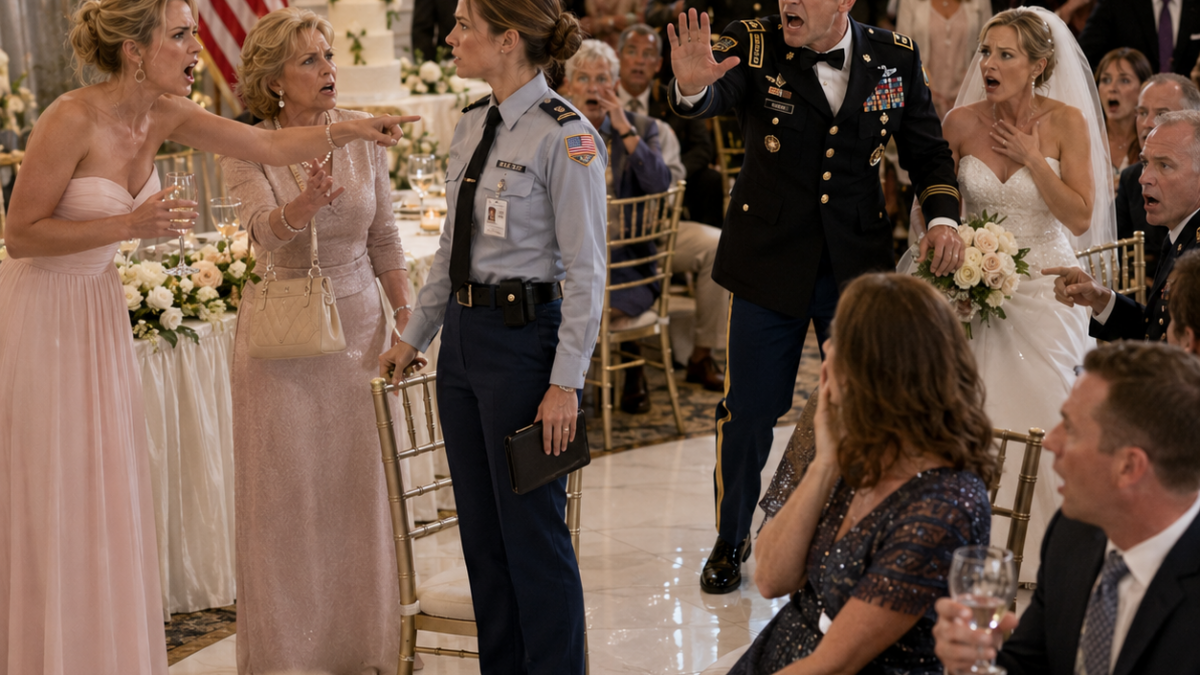
“My Sister’s Just A Gate Guard. Who Would Want Her?” She Mocked. The Room Burst Into Laughter. My Mom Added, “She’s The Shame Of This Family.” The Groom—An Army Veteran—Suddenly Stood Up, Looked At Me, And Shouted, “Stand Down! She Is… She’s The Reason I Am Alive…”
### Part 1
“She might be the family disgrace, but at least she showed up on time today.”
My mother’s voice rolled through the speakers and across a ballroom packed with nearly three hundred guests.
A second earlier, my younger sister, Natalie, had lifted the microphone toward the back of the room and smiled directly at me.
“My sister dragged herself all the way here,” she’d said. “Must’ve been hard getting time off from guarding doors.”
People laughed.
Not everyone. But enough.
Enough that the sound came at me in waves beneath the crystal chandeliers.
I sat alone beside the fire exit, wearing the dark blue uniform my mother had called “flashy garbage” that morning.
My name is Claire Mercer.
I was thirty-six years old, and at that point I had spent fifteen years in the United States Army. I’d slept in places where the walls shook at night. I’d carried wounded soldiers through dust so thick I could taste concrete between my teeth.
At home, though, none of that seemed to count.
To my family, I was still the difficult daughter.
The one who hadn’t married the right kind of man.
The one who didn’t attend enough neighborhood dinners.
The one whose job was too uncomfortable to explain at the country club.
The one they could seat by an emergency exit and laugh at.
What they didn’t know was that the groom had just left the stage.
And he was walking straight toward me.
But to understand why, you have to go back fourteen days.
The invitation arrived at my Pentagon office on a gray Monday afternoon.
The fluorescent light above my desk had been buzzing for twenty minutes. My coffee had gone cold. A thin layer of bitter oil floated across its surface.
The envelope looked expensive.
Cream-colored cotton paper. Gold edging. Thick enough that it resisted when I bent it.
My name was written across the front.
Claire Mercer.
No rank.
No title.
Nothing else.
I slid my finger under the flap and immediately felt the sting of a paper cut.
A bead of blood rose on my fingertip.
I wiped it against a tissue, opened the envelope, and watched a small handwritten note fall onto my desk.
Behave yourself.
I recognized my mother’s handwriting immediately.
Marianne Mercer wrote every letter with the same rounded loops, as if even her threats had to pass a calligraphy inspection.
I stared at those two words longer than I should have.
No “Can’t wait to see you.”
No “We’re glad you’re coming home.”
Just an order.
Behave.
I unfolded the invitation.
Natalie Mercer’s name filled half the card in oversized gold script.
That didn’t surprise me.
What did surprise me was the name beneath hers.
Ethan Hale.
My fingers tightened around the invitation.
For a moment, the office disappeared.
I could smell scorched concrete.
Diesel.
Hot metal.
Blood.
I could hear someone screaming for a medic.
My right thigh gave an involuntary throb where an old scar ran beneath my trousers.
Ethan Hale.
Years earlier, in Syria, I had known him as Captain Hale.
He had been trapped beneath a collapsed steel support after part of a structure came down around his team.
I remembered crawling through powdered concrete until my palms were raw.
I remembered finding him conscious but fading.
I remembered the weight of him when I pulled him clear.
Most of all, I remembered his hand locking around my wrist while he struggled to stay awake.
“Don’t let me die here, ma’am.”
“I won’t.”
And I hadn’t.
Now that man was marrying my sister.
I read the name again.
Ethan Hale.
Natalie had never mentioned what he did in the Army.
In fact, she’d barely mentioned him to me at all.
My office door opened.
Brigadier General Marcus Reed came in carrying a folder. He tossed it onto my desk, then noticed the invitation.
His eyes stopped on the groom’s name.
“Hale?”
I looked up.
“You remember him?”
Marcus gave me a long look.
“Everyone who was there remembers him.”
I leaned back in my chair.
“My sister’s marrying him.”
Marcus pulled out the chair opposite mine.
“Does she know?”
“Know what?”
“Who you are to him.”
I looked at the invitation again.
“I doubt she knows who I am to anyone.”
Marcus didn’t laugh.
He knew enough about my family not to.
After a few seconds, he said, “Are you going?”
My first instinct was no.
Then I looked at the little note beside the invitation.
Behave yourself.
Something cold settled inside me.
“Yes.”
Marcus nodded once.
“Good.”
“I don’t know what they want from me.”
“You know exactly what they want.”
He tapped the invitation with one finger.
“They want you small.”
I said nothing.
He stood.
“Don’t help them do it.”
Then he walked out.
I stayed behind, staring at Ethan’s name.
My family thought they were inviting a woman they could control.
They had no idea they had invited the one person the groom would recognize before anyone else in the room.
And for the first time in years, I wondered what would happen when those two worlds finally collided.
### Part 2
I landed in Virginia late that night with one canvas duffel bag.
Inside were toiletries, two changes of civilian clothes, and my dress blues folded between sheets of tissue paper.
I rented a car and drove toward Alexandria just after sunrise.
Fog clung low over the streets.
When my mother’s house came into view, I slowed.
The red-brick colonial looked exactly as I remembered it.
Perfect lawn.
Perfect shutters.
Perfect white columns.
What nobody looking at it knew was that ten years earlier, the bank had nearly taken it.
My stepfather’s business had collapsed. My mother had called me crying for the first time in my adult life.
“Claire, they’re going to take the house.”
I’d been deployed.
I still remembered standing under a canvas awning with rain hammering the roof while she told me she had nowhere else to go.
So I arranged automatic transfers.
Thirty percent of my monthly pay.
Every month.
For years.
I never asked to be repaid.
At the time, I thought that was what family meant.
The oak door opened before I knocked.
My mother stood there wearing cream silk trousers and a pale blouse.
Her gaze dropped immediately to my boots.
Then my jacket.
Then my duffel.
“I see you came.”
“Good morning to you too.”
Her lips tightened.
“I assume you brought something appropriate for the ceremony.”
“I brought my uniform.”
The change in her face was immediate.
“No.”
I stared at her.
“No?”
“Claire, this isn’t one of your military events.”
“I’m aware.”
“Then wear a normal dress.”
“I’m attending an Army veteran’s wedding. My uniform is appropriate.”
Her hand tightened around the brass doorknob.
“This weekend is about Natalie. Please don’t turn it into some display.”
I almost smiled.
“What display?”
“You know exactly what I mean.”
“No, Marianne. I don’t.”
She hated when I used her first name.
Her eyes sharpened.
“Don’t cause trouble.”
I stepped across the threshold.
“If you’re this worried about me causing trouble, maybe you shouldn’t have invited me.”
She backed away.
The house smelled like lemon polish.
That smell hit me harder than expected.
Every childhood Christmas had smelled like that. Every dinner before guests arrived. Every morning after my mother decided the house didn’t look respectable enough.
Lemon polish and tension.
She led me past two empty bedrooms.
Then another.
Finally she stopped at the smallest guest room at the end of the hall.
“You’ll sleep here.”
I looked back toward the larger rooms we’d passed.
“Those occupied?”
Her pause was half a second too long.
“We’re keeping them available.”
“For whom?”
“People who need them.”
There it was.
I didn’t argue.
The room had beige carpet, a narrow bed, and one lamp with a crooked shade.
My mother remained in the doorway.
“The rehearsal dinner starts at six.”
“Okay.”
“You’ll need to arrange transportation.”
“There aren’t seats in the cars?”
“They’re full.”
I stared at her.
She stared back.
Neither of us pretended anymore.
“Understood.”
At dinner that evening, my place card didn’t even have my full name.
E. Mercer.
I was seated beside the kitchen doors.
Whenever one swung open, cold air struck my neck along with the smell of industrial soap and burned butter.
Natalie arrived twenty minutes late and received applause.
She hugged people she hadn’t seen in years.
When she passed me, the hem of her dress brushed my chair.
She never looked down.
Halfway through dinner, an aunt asked my mother, “What does Claire do now?”
My mother barely looked at me.
“Oh, some kind of security work.”
Natalie laughed into her wine.
“She basically guards buildings, doesn’t she?”
A few people chuckled.
I cut into my steak.
“No,” I said.
Natalie blinked.
It was the first time she’d looked directly at me.
“No?”
“That’s not what I do.”
Her smile became sweeter.
“Then what exactly do you do?”
Before I could answer, a gravelly voice came from farther down the table.
“Wait.”
A silver-haired man pushed his glass aside.
I knew his face vaguely, though I couldn’t place him.
He studied me.
“Mercer.”
My mother went very still.
The man leaned forward.
“Were you in Afghanistan in 2011?”
The entire table quieted.
I set down my fork.
“Yes, sir.”
His expression changed.
Not shock.
Recognition.
“I thought so.”
My mother’s hand struck the table harder than necessary.
Glasses rattled.
“Dessert,” she announced brightly. “We really should get dessert started.”
Nobody moved.
The older man kept watching me.
I finally remembered him.
Colonel Thomas Greer.
Retired.
A man whose name had appeared on operations reports I’d read years ago.
My mother had invited him because he looked impressive on a guest list.
But from the alarm in her eyes, she was beginning to understand something.
People from my world were entering hers.
And unlike her, they knew exactly who I was.
### Part 3
I didn’t sleep at my mother’s house that night.
By nine-thirty, I’d taken my duffel and moved to a motel twelve minutes away.
The clerk barely looked at me when I checked in.
Perfect.
No history.
No judgment.
No lemon polish.
The room smelled faintly of bleach and old air conditioning. The carpet had a dark stain near the bathroom door. Somewhere outside, a truck engine rumbled through the parking lot.
I slept better there than I had in my childhood bedroom.
At six the next morning, I opened the garment bag.
My uniform hung straight against the faded wallpaper.
I dressed slowly.
Trousers.
Shirt.
Jacket.
Ribbons.
Insignia.
The weight across my shoulders was familiar.
So was the reflection in the scratched mirror.
This wasn’t clothing I wore to impress anyone.
It was a record.
Every ribbon meant something.
Every piece of metal represented people, places, decisions, failures, victories.
Things my mother had reduced to “security work” because the truth complicated the story she preferred to tell.
When I arrived at the church, guests were crowding the entrance.
White lilies lined the stone foyer, filling the air with a heavy sweetness.
Conversations softened as I walked inside.
Some guests glanced at my shoulders.
Then glanced again.
My mother’s face appeared near the bridal suite.
She crossed the foyer so quickly she nearly collided with a waiter carrying champagne.
“What are you wearing?”
I looked down at myself.
“Exactly what I told you I would.”
Her fingers closed around my sleeve.
“This is ridiculous.”
“Let go.”
“You are trying to embarrass your sister.”
I didn’t raise my voice.
“Let go of my arm.”
She did.
Slowly.
“You couldn’t wear a simple dress for one day?”
“The Army considers this formal attire.”
“This is not about the Army.”
“No,” I said. “It certainly isn’t.”
She looked around at the watching guests.
Then lowered her voice.
“Find your seat. Stay there. Do not make yourself the center of attention.”
I followed her gaze to the seating chart.
Names had been written across an ivory board in gold calligraphy.
Parents.
Grandparents.
Close friends.
Relatives I hadn’t seen since college.
I searched twice before finding mine.
Someone had added it in black pen.
Claire M. — Table 12.
The ballroom reception tables were already numbered on a smaller floor-plan card.
Table 12 sat at the rear.
Beside the fire exit.
I looked at my mother.
She smiled tightly.
“It will be quieter there.”
I nodded.
“Good.”
For some reason, that answer unsettled her.
The ceremony began twenty minutes later.
I sat near the rear while sunlight came through the stained glass in fractured shades of blue and red.
Then Natalie appeared.
Everyone stood.
She looked beautiful.
I can admit that.
Her dress was simple, elegant, nothing like the loud personality she carried into most rooms.
For one strange second, I saw my baby sister again.
The little girl who used to sleep in my room during thunderstorms.
The girl who once held my hand walking into kindergarten.
Then I remembered the kitchen-table laughter.
The dismissive smile.
The years of silence unless someone needed money.
I faced forward.
Ethan stood at the altar.
He had changed.
His hair was shorter than I remembered. There were lines at the corners of his eyes.
But I noticed the leg immediately.
He still favored it.
Only slightly.
Most people never would have seen it.
I did.
His right side had taken the worst of the collapse.
The priest began.
Ethan listened.
Natalie smiled.
Then, during a pause, Ethan looked toward the rear of the church.
His eyes passed over several rows.
Stopped.
His body stiffened.
Even from a distance, I watched recognition move across his face.
His lips parted.
For three seconds, he wasn’t a groom in a tailored suit.
He was a wounded captain staring through dust.
I gave him the smallest nod.
His throat moved.
Then the priest continued, and Ethan had to look forward again.
My pulse had accelerated.
I hadn’t expected that.
Not after all those years.
Near the end of the ceremony, the priest invited immediate family forward for a blessing.
My mother stood.
My stepfather stood.
Natalie’s closest relatives moved toward the aisle.
I placed one hand against the pew in front of me.
Before I could rise, my mother’s fingers closed around my arm.
She didn’t look back.
“This moment isn’t for you.”
The words were barely audible.
Her grip tightened.
For years, I had been trained to move toward danger.
To react.
To protect.
Instead, I slowly sat back down.
My mother’s fingers released me.
She walked toward the altar without looking back.
Something inside me changed then.
Not dramatically.
Nothing broke.
Nothing exploded.
I simply understood.
There would be no relationship to save after this weekend.
I wasn’t losing my family.
I was finally seeing that I had already lost them years ago.
Across the church, Ethan looked past the priest.
His eyes found me sitting alone.
Then they moved to my mother.
And the expression on his face changed.
### Part 4
The reception began an hour later.
Table 12 was worse than I’d expected.
It sat near the service corridor beside a metal fire door with an illuminated EXIT sign glowing above it.
From my chair, I could see the entire ballroom.
My family could barely see me.
Exactly as intended.
Crystal chandeliers threw hard white light over gold-trimmed tables. A live quartet played near the dance floor. Waiters carried plates of beef and vegetables beneath silver covers.
Everyone looked polished.
Comfortable.
Expensive.
I watched my mother circulate among them as if she were running for office.
She laughed with the photographer.
Touched elbows.
Introduced guests by title.
“This is Judge Hollis.”
“Have you met Dr. Warren?”
“Colonel Greer, you remember my husband.”
Titles mattered enormously to Marianne.
Just not mine.
A waiter passed my table with a wine bottle and continued without stopping.
I reached for a bottle left on an empty chair and poured my own.
The wine was warm and overly sharp.
Across the room, Ethan glanced toward me twice.
Natalie noticed the second time.
She leaned close to him and whispered something.
His expression stayed neutral.
Hers didn’t.
Dinner ended.
Speeches began.
My stepfather talked about Natalie’s childhood.
A bridesmaid told an embarrassing college story.
Everyone laughed at the appropriate moments.
Then Natalie took the microphone.
I knew that smile.
She’d worn it before every cruel thing she’d ever said.
The corners of her mouth lifted first.
Her eyes stayed cold.
She spoke about Ethan.
About love.
About loyalty.
About how lucky she had been to grow up in “the most supportive family anyone could ask for.”
I nearly laughed at that.
Then she turned.
“And speaking of family, I should probably acknowledge the biggest surprise of the weekend.”
Her eyes found me.
“My older sister actually came.”
Some guests turned around.
I felt their attention moving through the room before their eyes reached me.
Natalie grinned.
“Apparently she managed to get away from guarding doors long enough to attend.”
Scattered laughter.
I took a sip of wine.
Natalie continued.
“I’ll admit, I wasn’t sure she’d find the place without someone giving her security instructions.”
More laughter.
A little louder.
Someone near table eight looked uncomfortable.
Natalie enjoyed that even more.
Then my mother walked onto the dance floor.
“Give me that.”
She took the microphone from Natalie.
For one foolish second, I thought she might stop it.
Instead, she finished it.
“She might be the family disgrace,” Marianne said, turning toward my corner, “but at least she showed up on time today.”
The laughter exploded.
Three hundred guests didn’t all laugh.
But when enough people do, it becomes one sound.
A heavy, rolling wall of noise.
I stared at my mother.
She looked delighted.
That hurt more than Natalie’s joke.
My sister was childish.
My mother was deliberate.
She had been waiting for this.
I set down my glass.
Carefully.
The base touched the white linen without making a sound.
Then I pushed my chair back.
The legs scraped across the carpet.
People nearest me stopped laughing.
I stood.
My shoulders settled naturally.
My hands stayed at my sides.
I didn’t glare.
Didn’t speak.
Didn’t storm toward the stage.
That seemed to confuse them.
The laughter began collapsing from the outside inward.
Table eleven went quiet.
Then table ten.
Then nine.
People finally looked at the details they’d ignored when I was seated.
The ribbons.
The insignia.
The stars.
Colonel Greer was staring at my mother with an expression somewhere between disbelief and disgust.
Marianne still held the microphone.
Her smile had become uncertain.
Natalie tilted her head.
“Come on, Claire,” she called. “It’s a joke.”
I said nothing.
“Don’t be dramatic.”
Still nothing.
My mother lifted the microphone again.
“Everyone knows Claire has never had much of a sense of humor.”
That’s when Ethan stepped away from the stage.
Natalie reached for his hand.
He pulled it free.
“Ethan?”
He didn’t answer.
His shoes struck the polished floor.
Once.
Twice.
Again.
The ballroom went silent.
Ethan walked through the center aisle between tables.
People moved their chairs aside.
He didn’t look at my mother.
Didn’t look at Natalie.
His eyes stayed on me.
He stopped two feet away.
For several seconds neither of us spoke.
Then his posture changed.
Feet set.
Shoulders straight.
Chin level.
His right hand came up in a perfect salute.
“Ma’am.”
The word carried through the room.
Behind him, someone gasped.
I returned the salute.
“Captain.”
His jaw tightened.
“Former captain.”
“I remember.”
His hand dropped.
He turned slowly toward the stage.
My mother looked as if someone had unplugged her.
Natalie’s smile was gone.
Ethan’s voice carried farther than hers ever had.
“You’ve all been laughing at the wrong person.”
Nobody moved.
Ethan pointed toward me.
“This woman is Major General Claire Mercer.”
My mother’s lips parted.
Ethan wasn’t finished.
“And if she hadn’t pulled me out from under a collapsed structure in Syria, none of you would be attending my wedding today.”
### Part 5
The microphone slipped from Natalie’s hand.
It hit the floor with a violent burst of feedback.
Several guests flinched.
Natalie didn’t move.
She simply stared at Ethan.
Then at me.
Then back at Ethan.
“What?”
Ethan’s face remained hard.
“You heard me.”
My mother still held her own microphone, though her hand had begun shaking.
“I… I don’t understand.”
Colonel Greer stood from table two.
“I do.”
His chair scraped backward.
He faced me, straightened, and saluted.
Another guest rose near the dance floor.
Then another.
Within seconds, five people were standing.
Some were veterans.
One was still active duty.
Every one of them understood exactly what my family hadn’t bothered to learn.
They saluted.
I returned each one.
The room felt smaller.
Natalie finally found her voice.
“Ethan, why didn’t you tell me?”
His head snapped toward her.
“Tell you what?”
“That you knew Claire.”
“I didn’t know your Claire Mercer was General Mercer.”
Natalie’s face flushed.
“She never said—”
“Apparently nobody asked.”
That landed hard.
My mother lowered the microphone.
“This is being blown completely out of proportion.”
Ethan stared at her.
“You called a major general a family disgrace in front of three hundred people.”
“It was teasing.”
“No,” Colonel Greer said from across the room. “It wasn’t.”
My mother looked around.
She saw it.
The guests weren’t laughing anymore.
Some avoided her eyes.
Others whispered openly.
Her world had changed direction in less than two minutes.
And because reputation mattered more to Marianne than affection ever had, panic arrived quickly.
She hurried toward me.
“Claire.”
I didn’t move.
“Can we speak privately?”
“No.”
Her eyes flashed.
“Please.”
That word was rare enough that I followed her.
Not for her.
For myself.
I wanted to hear what she would say once there was no audience.
She pushed through the fire exit and into the service hallway.
The temperature dropped immediately.
The air smelled like bleach, onions, and wet cardboard.
The door slammed behind us.
My mother’s face changed.
The hostess disappeared.
“What did you do?”
I stared at her.
“Excuse me?”
“You planned this.”
I almost laughed.
“You think I planned Ethan recognizing me?”
“You came in that uniform knowing what would happen.”
“I told you exactly what I was wearing.”
“You wanted to humiliate Natalie.”
“No.”
My voice stayed quiet.
“You humiliated Natalie.”
She blinked.
“You stood there and insulted me until someone you respect explained why you shouldn’t.”
Her jaw tightened.
“You could have told us your rank.”
“I did.”
“No, you didn’t.”
“I told you about every promotion for years.”
Her face went blank.
I remembered the emails.
The Christmas phone calls.
The messages that received thumbs-up emojis hours later.
Lieutenant colonel.
Colonel.
Brigadier general.
Major general.
Every milestone had been reduced to something that interfered with Natalie’s birthday dinner or my mother’s vacation pictures.
“You didn’t listen,” I said.
She shook her head.
“That’s ridiculous.”
“You called my work security consulting.”
“Because nobody understands military titles.”
“You understand ‘judge.’ You understand ‘doctor.’ You understand ‘CEO.'”
She flinched.
I continued.
“You understood enough to hide me.”
“You are twisting everything.”
“No.”
I stepped closer.
“I’m finally refusing to twist it for you.”
Her expression softened abruptly.
It was the transformation she had used my entire childhood.
Anger to injury.
Control to tears.
“Claire, we’re your family.”
There it was.
The emergency key.
Family.
The word that had opened my wallet for ten years.
I looked at her carefully.
“Why was I seated by the kitchen yesterday?”
She looked away.
“Seating was difficult.”
“Why was my name handwritten on the chart?”
No answer.
“Why did you stop me from joining the family blessing?”
Her eyes flicked back.
“That was complicated.”
“Why?”
“Because Natalie asked me to.”
For the first time that night, something genuinely surprised me.
“Natalie asked you?”
Marianne hesitated.
Too late.
I had seen it.
There was more.
“When?”
“Claire—”
“When did she ask you?”
My mother rubbed her hands together.
“Before you arrived.”
“Why?”
She said nothing.
Behind the fire door, faint music had started again.
The band was trying desperately to restart the reception.
I stepped closer.
“What exactly did Natalie tell you about me?”
My mother’s eyes filled with fear.
Not embarrassment this time.
Fear.
And suddenly, the wedding jokes didn’t feel like spontaneous cruelty anymore.
They felt like preparation.
### Part 6
My mother wouldn’t answer.
So I opened the fire door.
Natalie was waiting on the other side.
She had left the dance floor.
Ethan wasn’t with her.
Her veil had been removed, and her face looked younger without the performance smile.
“Claire.”
“What did you tell Mom?”
She glanced past me.
Marianne immediately said, “This isn’t the time.”
I ignored her.
“Natalie?”
My sister crossed her arms.
“I told her you would make this about yourself.”
“Why?”
“Because you always do.”
I stared at her.
“Give me one example.”
“You disappeared for years.”
“I was deployed.”
“You missed my college graduation.”
“I was overseas.”
“You weren’t at Dad’s retirement dinner.”
“I was in Germany.”
“You always have an excuse.”
There was such conviction in her voice that for half a second I wondered if she truly believed it.
Then I remembered something.
“Who paid your college tuition?”
Her face changed.
My mother’s voice sharpened.
“Don’t.”
I looked at Natalie.
“Who?”
“Dad.”
“No.”
She frowned.
“What?”
“Your last two years. Who paid?”
She looked toward our mother.
Marianne said nothing.
I felt the answer before either spoke.
Natalie lowered her voice.
“Mom and Dad.”
I laughed once.
Not because it was funny.
Because suddenly dozens of old conversations rearranged themselves in my head.
Every call asking me for emergency money.
Every transfer.
Every “temporary” family crisis.
I looked at Marianne.
“You used the house money for Natalie’s tuition?”
“We used household funds.”
“My transfers were household funds?”
“You gave that money voluntarily.”
“To stop foreclosure.”
“The house was stabilized.”
“So you redirected it.”
Marianne’s mouth tightened.
“It was all for family.”
Natalie looked between us.
“What is she talking about?”
“Nothing.”
I pulled out my phone.
Not dramatically.
Just enough to open my banking app.
I found the recurring transfer.
Ten years of history.
Thirty percent.
Every month.
I turned the screen toward Natalie.
“This.”
She stared.
Her eyes moved down the transaction list.
“What is that?”
“The money that saved Mom’s house.”
Natalie looked at our mother.
“She paid the mortgage?”
“Part of it,” Marianne said quickly.
“For ten years?”
Silence.
Natalie looked back at me.
Then something hardened in her expression.
Not gratitude.
Resentment.
“So that’s what this is about.”
I almost couldn’t believe it.
“What?”
“You want credit.”
“No.”
“You want everyone to know you saved the family.”
“I wanted to know why the family I saved treats me like an embarrassment.”
She shook her head.
“This is exactly what I mean. Everything becomes some heroic Claire Mercer story.”
I stared at her.
Then it clicked.
She had spent her entire life measuring herself against a version of me our mother had created.
Not the real me.
A villain.
The selfish sister.
The absent daughter.
The cold woman who chose a career over family.
If I succeeded, I was showing off.
If I helped, I was controlling.
If I stayed silent, I was arrogant.
There was no version of me that could win.
“You actually hate me,” I said.
Natalie’s face twitched.
“I don’t hate you.”
“You invited me to your wedding so you could humiliate me.”
“I invited you because Mom insisted.”
Marianne snapped, “Natalie!”
Too late again.
I looked at my mother.
“You insisted?”
Her face collapsed inward.
Not with shame.
With calculation.
And then I understood.
The invitation hadn’t been reconciliation.
It had been optics.
My mother needed the missing daughter present so the family looked complete.
Natalie needed the family failure visible so she could look better by comparison.
I had been invited as decoration.
An object positioned near a fire exit.
Ethan appeared at the far end of the hallway.
He had removed his jacket.
He stopped when he saw the three of us.
“Natalie.”
She turned.
“Ethan, please.”
“We need to talk.”
She hurried toward him.
He looked at me first.
“Are you all right?”
My sister’s face went rigid.
I almost said yes.
Instead, I told the truth.
“I will be.”
Ethan nodded.
Then he led Natalie toward another hallway.
My mother and I were left alone again.
She looked suddenly old.
“Don’t cut us off because of one bad weekend.”
I looked at her.
“One weekend?”
She knew immediately she’d said the wrong thing.
I stepped toward the parking lot door.
“Tomorrow morning I’m stopping the transfers.”
Her head snapped up.
“What?”
“The mortgage transfers.”
“Claire, don’t be ridiculous.”
“They end tomorrow.”
“You can’t do that.”
I put my hand on the push bar.
“Actually, Marianne, that’s the first thing tonight that I absolutely can do.”
Her face drained.
And for the first time, I realized the thing she feared losing wasn’t her daughter.
It was the money.
### Part 7
I drove back to the motel before the cake was cut.
My phone started ringing before I reached the highway.
Mom.
Then Natalie.
Then my stepfather.
Then Mom again.
I turned the device face down on the passenger seat.
Rain had started falling, soft at first, then harder.
Wipers swept across the windshield.
Back and forth.
Back and forth.
The repetition calmed me.
At the motel, I removed my uniform carefully and hung it beside the window.
Then I sat on the edge of the bed in my undershirt, listening to rain strike the air-conditioning unit.
My phone showed twenty-three missed calls.
There was one text from Ethan.
Thank you for coming. I am sorry for what happened.
I stared at it.
Then another arrived.
For what it’s worth, I should have known something was wrong when Natalie refused to talk about you.
I didn’t answer.
His marriage was his problem.
Mine was finally becoming simple.
The next morning, I called the bank.
The representative asked whether I was certain I wanted to cancel the recurring transfer.
“Yes.”
“Effective immediately?”
“Immediately.”
One click.
Ten years ended.
I expected guilt.
Instead, I felt lighter.
Then I blocked my mother’s number.
My stepfather’s.
Natalie’s.
The messages stopped.
For about an hour.
Then relatives began.
Aunt Rebecca:
Your mother is devastated.
A cousin:
Family shouldn’t fight over money.
Another:
Natalie says you destroyed her wedding.
Interesting choice of verb.
I had sat at the back of a room and said almost nothing.
But people who depended on my silence considered truth a form of destruction.
Marcus called around noon.
“How bad?”
“Bad enough.”
“You staying?”
“In Virginia?”
“With them.”
I looked around the motel room.
“No.”
“Good.”
I heard papers moving on his side.
Then he said, “There’s something else.”
“What?”
“Someone sent me a video.”
My stomach tightened.
“From the reception?”
“Several, actually.”
I closed my eyes.
Of course.
Three hundred guests.
Phones everywhere.
“How far has it gone?”
“Far.”
“Wonderful.”
“Claire.”
“What?”
“Watch before you decide it’s a disaster.”
He sent the link.
I opened it.
The video began with my sister’s joke.
Then my mother’s.
Then the laughter.
Then me standing.
Then Ethan walking through the room.
The salute.
His announcement.
The other veterans rising.
I expected humiliation.
Instead, I saw something I hadn’t been able to see while standing inside it.
The room changing.
People weren’t looking at me with pity.
They were looking at my mother.
The comments beneath the video were already multiplying.
Most had nothing to do with my rank.
They were about the cruelty.
About family members who reduced someone’s accomplishments because those accomplishments threatened them.
About veterans who came home to manipulation.
About adult children paying parents’ bills while being treated like failures.
I shut the phone off.
That part hurt.
Because I knew exactly how many people understood.
Over the next week, the story spread far beyond the wedding guests.
I declined interviews.
I declined television requests.
I declined an invitation to publicly “respond” to my mother.
I had no interest in humiliating her for sport.
Distance was enough.
Then, five days after the wedding, an email arrived from a staff attorney who worked with military families.
She had seen the video.
Her message contained no gossip.
Only one question.
Would you be willing to discuss a support initiative for service members experiencing financial exploitation by relatives?
I read it twice.
Then called Marcus.
“What if I used this?”
“For what?”
“Something useful.”
He was quiet.
Then he said, “Now that sounds like you.”
Two weeks after the wedding, I stood behind a podium in a Pentagon conference room.
No dress blues.
Just a charcoal suit.
Reporters filled the seats.
Camera shutters clicked.
I placed both hands on the podium.
“We train service members to survive hostile environments,” I said. “We teach them how to identify physical threats, financial scams, operational risks.”
The room became still.
“But exploitation doesn’t always come from strangers.”
I thought of my mother’s lemon-polished house.
My sister laughing behind a microphone.
A decade of automatic payments.
“Sometimes the person draining you uses the word family as permission.”
I announced the Sentinel Initiative that afternoon.
Legal referrals.
Financial counseling.
Family-boundary resources.
Mental health support.
Not revenge.
Infrastructure.
When I finished, reporters started shouting questions.
One asked whether the program had been inspired by “a recent family incident.”
I paused.
“Pain is only useful if you stop handing it back and start building something with it.”
That quote made the evening news.
My mother sent me an email that night.
Only one line mattered.
How could you do this to us?
I deleted it.
She still believed everything was about what had been done to her.
That was the moment I stopped waiting for her to understand.
### Part 8
Three months passed.
Then six.
The world did what it always does.
It moved on.
The wedding video stopped appearing everywhere.
People found new scandals to discuss.
My life became quieter.
The Sentinel Initiative didn’t.
Within the first few months, requests came from service members across the country.
A sergeant whose parents had opened accounts in his name.
A sailor whose relatives treated every deployment paycheck like community property.
An officer supporting siblings who insulted her whenever she tried to set limits.
Different details.
Same sentence.
But they’re family.
I came to hate those words when used as a weapon.
Family can ask.
Family can need.
Family can make mistakes.
Family does not get unlimited access to your dignity.
My mother tried to reach me through other people.
She sent birthday flowers to my office.
I donated them to the hospital lobby downstairs.
My stepfather mailed a handwritten letter saying the house payments had become difficult.
I forwarded him the contact information for a financial counselor.
Nothing more.
Natalie tried twice.
The first time she emailed:
You have no idea what your little stunt did to my marriage.
I deleted it.
The second came nearly a year after the wedding.
It was different.
Ethan and I separated.
I stared at that sentence for a while.
Then continued.
I know you probably don’t care, but I finally understand some of what happened. Mom told me my whole life that you thought you were better than us. She said you sent money because you liked controlling everyone. She said you skipped things because we weren’t important enough.
My hands rested on the keyboard.
There was more.
I believed her because it was easier than admitting I was jealous of you.
For the first time, I felt something close to sadness for my sister.
Not enough to rebuild anything.
But sadness.
She ended with:
I’m sorry. I don’t expect forgiveness. I just needed to say it.
I didn’t answer immediately.
That night I sat beside my apartment window while rain streaked the glass.
The river below reflected white and red lights from passing traffic.
Years ago, I would have rushed to rescue her.
I would have said it was okay.
I would have taken half the blame to make reconciliation easier.
That instinct was still somewhere inside me.
But instincts can be retrained.
The next morning, I wrote back.
I read your message.
I accept that you regret what you did.
I hope you build a better life from what you learned.
But I don’t want a relationship with you.
Please respect that.
Claire.
I sent it.
No anger.
No lecture.
No reopening the door.
She replied two hours later.
I understand.
And that was the last conversation we ever had.
Ethan contacted me once after the separation.
We met for coffee near Arlington.
Nothing romantic.
Nothing dramatic.
He walked with the same slight hitch in his right leg.
When he sat across from me, he looked embarrassed.
“I should’ve known.”
“You couldn’t have.”
“I married into that family.”
“So did my stepfather.”
He laughed quietly.
Then grew serious.
“I want you to know I didn’t leave because of the wedding.”
“I didn’t ask.”
“I know.”
He stirred his coffee.
“But the wedding showed me something I’d been ignoring.”
I nodded.
That I understood.
Before leaving, he stood and offered his hand.
“I never properly thanked you.”
“For Syria?”
“For Syria. And for reminding me that surviving something doesn’t mean you have to keep living inside it.”
I shook his hand.
“Take care of yourself, Ethan.”
“You too, General.”
Then he walked away.
That was all.
No romance.
No convenient ending where the groom suddenly discovered he’d married the wrong sister and chose me instead.
Life isn’t a cheap movie.
Sometimes the right ending is simply everyone walking in the direction they should have chosen years earlier.
By the second anniversary of the wedding, the house in Alexandria had been sold.
I heard about it through a cousin.
My mother and stepfather moved into something smaller.
Natalie moved to another state and started over.
I felt no triumph.
Consequences aren’t trophies.
They’re just consequences.
One autumn evening, I returned home after a fourteen-hour day.
My apartment smelled like coffee and the rain coming through a cracked window.
I took off my shoes.
Set down my keys.
Then I noticed an envelope on the kitchen counter.
Inside was a note from a young lieutenant who had used the Sentinel Initiative after relatives pressured him into paying debts he couldn’t afford.
Thank you for helping me understand that saying no didn’t make me a bad son.
I read that line three times.
Then I sat down.
For years, I’d thought my greatest failure was that I couldn’t make my family proud of me.
I had sent money.
Missed sleep.
Accepted insults.
Made myself smaller.
I thought love was something you earned by becoming useful enough that people eventually treated you kindly.
I had been wrong.
Love that requires your humiliation isn’t love.
Loyalty that only flows in one direction isn’t loyalty.
And blood isn’t a lifetime contract granting someone permission to disrespect you.
I walked to the window.
Washington glowed beyond the river.
Cars moved along the streets below, their headlights sliding through the darkness.
My reflection looked back at me.
No uniform.
No medals.
No stars.
Just Claire.
For once, that was enough.
I never forgave my mother.
Not in the way people like to package forgiveness into a neat little ending.
I stopped hating her.
That was different.
Hatred requires attention.
Eventually, I simply stopped giving her any.
I didn’t need revenge.
I didn’t need her apology.
I didn’t need Natalie to explain herself again.
And I certainly didn’t need a seat at their table.
They had spent years trying to convince me that being excluded was punishment.
What they never understood was that one day, I would finally recognize exclusion for what it really was.
An open door.
So I walked through it.
And I never went back.
THE END!
Disclaimer: Our stories are inspired by real-life events but are carefully rewritten for entertainment. Any resemblance to actual people or situations is purely coincidental.








