Rescue Chief Told Me To Stop Giving Orders—Then His Team Realized I Was The Missing Commander.
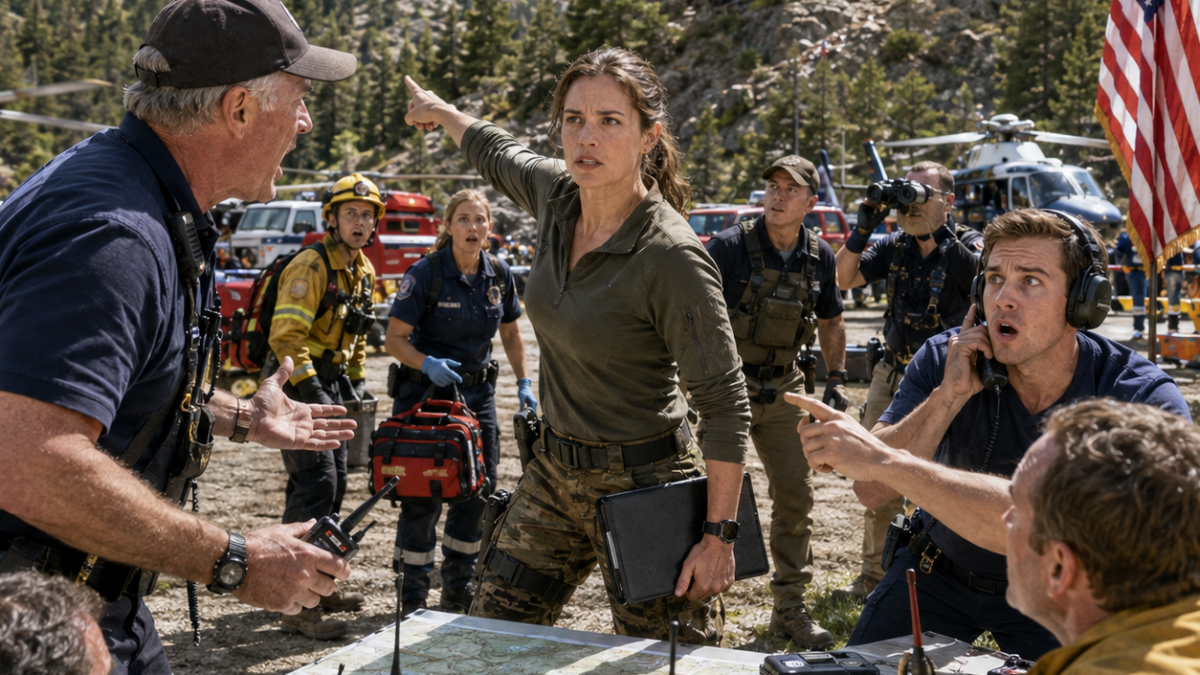
“You’re Not In Charge Here,” The Rescue Chief Shouted As I Pointed Toward The Ridge. Then His Radio Crackled, And A Voice Said, “Chief, We Found Her. That’s The Commander.”
### Part 1
The first thing Chief Grant Mercer did was grab my wrist.
Not hard enough to hurt me. Hard enough to make a point.
Wind hammered the north face of Mercer Peak at nearly forty miles an hour, with gusts strong enough to slap sleet sideways across our goggles. Visibility had collapsed to thirty feet in places. Headlamps floated through the gray like weak stars, appearing and disappearing between curtains of ice.
I stood beside a folding map table weighted down with carabiners and two radio batteries, one gloved finger pressed against a ridge line no one on his team seemed interested in searching.
Mercer pushed my hand away from the map.
“You’re not in charge here.”
His voice carried farther than it needed to.
Six rescuers turned.
One of them froze halfway through tightening a harness.
Another stopped writing on a clipboard.
Mercer leaned closer, rain ticking against the red shell of his county jacket.
“I don’t know who let a civilian contractor past the command line, but this is an active rescue operation. You need to stop giving orders and get off this mountain.”
I looked at him.
Then I looked past him.
The north ridge disappeared into white.
Fourteen hours.
Two missing backcountry skiers.
Temperature dropping.
Wind shifting west.
A drainage channel below the ridge that would pull an exhausted person toward a narrow stand of fir trees before the slope flattened.
The same drainage I had mapped years earlier.
The same unstable traverse Mercer had just ordered his team across.
My stomach tightened.
“You send them that way,” I said, “you’re going to lose more than the skiers.”
Mercer’s jaw moved.
Not much.
Just enough.
“What did you say?”
“The traverse above Ravine Three is unstable.”
“We assessed it.”
“No. You looked at it.”
His face hardened.
There is a particular kind of confidence men like Grant Mercer wear when they believe authority and expertise are the same thing. His posture straightened. His shoulders squared. Around us, nobody moved.
“The route stays,” he said.
A memory flashed so fast I smelled it.
Wet nylon.
Blood from my split lip.
Frozen pine.
A radio crushed under my body while snow filled the collar of my jacket.
I shoved it back down.
“Who signed off on the route?”
“I did.”
“Then you need to change it.”
He laughed once.
Not because anything was funny.
“You’re done.”
He turned toward a rescue technician standing near the communications case.
“Escort her back to staging.”
The technician looked uncomfortable.
She was young, maybe twenty-five, and I recognized the hesitation in her eyes. Not recognition of me. Recognition of the terrain.
“Chief,” she said, “she did mention the wind loading before the last update.”
Mercer didn’t even look at her.
“And I heard it.”
“Sir—”
“Route stays.”
The radio on the table crackled.
“Command, Ridge Two. Approaching traverse.”
My entire body went cold.
Mercer reached for the microphone.
I got there first.
“Ridge Two, hold position.”
Every face turned toward me.
Mercer stared as if I had pulled a gun.
“What the hell are you doing?”
The radio hissed.
Then a man’s voice came through.
“Unknown caller, identify.”
I hadn’t heard that voice directly in three years.
Age had roughened it.
Fatigue had lowered it.
But some sounds bypass memory and go straight into bone.
Daniel Cho.
My former second-in-command.
The kid I had taught to read avalanche fractures by watching the shadow line beneath fresh snow.
The nineteen-year-old volunteer who once followed me down a flooded canyon because I told him the water would rise before the forecast said it would.
I closed my eyes for half a second.
Mercer grabbed for the microphone.
I stepped away from him.
“Ridge Two,” I said. “Back off the traverse twenty yards. Get behind the rock shelf and wait.”
Silence.
Mercer snapped, “Ignore that order.”
Another pause.
Then Daniel spoke.
Not to Mercer.
To me.
“Say that again.”
My throat tightened.
“Back off the traverse twenty yards. Rock shelf on your left. Stay under it until I reroute you.”
There are moments when a crowded place becomes silent without actually getting quieter.
The wind was still screaming.
Radios still hissed.
A generator still rattled near the command trailer.
But every human being around me seemed to stop breathing.
Daniel inhaled sharply over the radio.
“Who is this?”
I looked at the mountain.
For three years I had imagined this moment.
I had imagined anger.
Vindication.
Maybe even satisfaction.
What I felt instead was exhaustion.
“This is Nora Bennett.”
Nothing.
Then static.
Then a sound like somebody dropping equipment.
Mercer stared at me.
His face had emptied.
Daniel’s next words came low and unsteady.
“Chief…”
Mercer grabbed the radio.
“Daniel, continue your route.”
But Daniel wasn’t talking to him.
“Chief,” he said again.
This time everyone heard the break in his voice.
“That’s her.”
Mercer’s fingers loosened around the radio.
Daniel swallowed hard.
“That’s Commander Bennett.”
Someone behind me whispered, “What?”
I didn’t turn around.
On the side of the command trailer, half-covered by sleet, was a bronze memorial plaque.
I knew exactly what it said.
Nora Bennett.
Incident Commander.
Lost in service.
Three years earlier, they had carved my name into metal because it was easier than admitting they had stopped looking.
Mercer followed my gaze.
And for the first time since I walked onto the mountain, he looked afraid.
Not of me.
Of what my being alive meant.
Then the ridge radio erupted.
“Command! Movement!”
Everyone snapped toward the speaker.
Daniel’s voice came through again.
“Slide activity on the traverse!”
A deep rumble rolled through the storm.
The map table trembled beneath my hand.
Thirty seconds later, the route Grant Mercer had insisted was safe disappeared under thousands of pounds of moving snow.
If Daniel had obeyed him instead of me, his entire team would have been standing on it.
Mercer watched the white wall settle into the ravine.
Then he slowly turned back toward me.
And I knew this was no longer just a rescue.
Three years of buried history had just broken open with the mountain.
### Part 2
Nobody asked me to leave after the slide.
That was the first change.
The second was subtler.
People stopped looking at Grant Mercer before they moved.
They started looking at me.
I hated how familiar it felt.
Authority is a strange thing. You can remove the title, the office, the uniform patch and the key card, but if people once trusted you with their lives, some piece of that trust remains stored in muscle memory.
I pointed to the map.
“Ridge Two stays sheltered. Send Team Four up the western spur.”
Mercer stood opposite me.
“This is still my operation.”
I met his eyes.
“Then operate.”
His cheeks darkened.
“The western spur adds forty minutes.”
“Thirty-two if they cut below the second granite shelf.”
“You haven’t been on this mountain in three years.”
That landed exactly where he meant it to.
A few people glanced down.
He continued.
“Terrain changes.”
“So do maps.”
I pulled the waterproof topographic sheet toward me.
“But water still runs downhill, prevailing wind still loads the same bowls, and your missing skiers still had fourteen hours to make bad decisions before we arrived.”
I traced the drainage.
“If they got disoriented in the storm, they’ll avoid the exposed saddle. Most recreational skiers do. They’ll drop toward tree cover.”
One of the team leaders, a gray-haired woman named Rachel Myers, leaned over the table.
“Drainage Seven?”
“Exactly.”
Mercer frowned.
“We already cleared that.”
“You cleared the upper section.”
“We had eyes on it.”
“From above.”
I tapped the map.
“The lower drainage bends east. You can’t see it from the ridge.”
Rachel looked at Mercer.
“She’s right.”
That irritated him more than my being alive.
I recognized that too.
Grant Mercer had been ambitious long before he inherited my command chair.
He had joined the unit two years after I became incident commander. Strong climber. Good endurance. Good public speaker. The county board loved him because he could explain ugly emergencies in clean sentences that made donors feel useful.
But he hated uncertainty.
Mountains are mostly uncertainty.
That was always our difference.
I treated maps like arguments.
Grant treated them like instructions.
“Team Four,” Rachel said into the radio. “Reroute toward Drainage Seven.”
Mercer cut her a look.
She didn’t apologize.
While she transmitted coordinates, I stepped away from the table.
My hands had begun to shake.
Not visibly.
Not yet.
I walked behind the command trailer and pressed my palms against the cold metal siding.
Three years disappeared.
I was lying at the bottom of Blackstone Ravine.
My ankle bent wrong.
My radio silent.
Snow packed around my waist.
I remembered shouting until my throat tore.
Then darkness.
Then waking to a stranger pulling frozen gloves off my hands inside a cabin that smelled like wood smoke and wet wool.
Eleven days.
That was how long I had existed outside the official world.
Eleven days before a trapper named Amos Wade managed to get me to a road.
By then, Kesseler County had already called off the search.
That fact was not supposed to matter.
People assumed survival created gratitude.
Sometimes survival creates questions.
Why had the search ended so quickly?
Why had the last known hazard report I transmitted disappeared from the final incident summary?
Why did the county’s official map show Blackstone Traverse as an “unexpected instability event” when I had personally flagged the route months earlier?
And why, four months after my memorial, was Grant Mercer standing at a donor gala describing my death as proof of what happened when commanders became “too personally invested to make cautious decisions”?
I heard those words on a recording almost a year later.
I watched the video alone.
Three times.
Then I threw up.
Not because he called me reckless.
Because people applauded.
Footsteps crunched behind me.
I turned.
Daniel stood ten feet away.
He had changed.
Of course he had.
The nineteen-year-old I remembered had been all elbows and restless energy. The man in front of me had a short beard, deeper lines beside his mouth and a scar across one eyebrow.
For a second neither of us spoke.
His eyes filled.
He looked away.
Then back.
“Tell me I’m not hallucinating.”
“I’m here.”
He laughed once.
A broken sound.
Then he crossed the distance and stopped just short of touching me.
“You were alive.”
“I was.”
“For three years.”
“Yes.”
His face hardened.
That hurt more than Mercer’s anger.
“You let me think you were dead.”
“I didn’t know how to come back.”
“That’s not an answer.”
“I know.”
“I searched for you.”
The wind cut between us.
“I know that now.”
“Every anniversary.”
My throat closed.
Daniel shook his head.
“I filed six extension requests.”
“I heard.”
“Mercer denied four himself.”
That made me look up.
“What?”
Daniel’s mouth tightened.
“He said the probability model didn’t justify resources.”
Cold spread through me that had nothing to do with sleet.
The denial paperwork I had found only showed three county rejections.
Not six.
Before I could ask more, Rachel shouted from the command table.
“We’ve got something!”
Daniel and I ran back.
A radio transmission crackled through static.
“Team Four to command. Found ski tracks entering lower drainage. Two sets.”
My prediction had been right.
Mercer’s face went gray.
Rachel grinned.
“They’re in Seven.”
I should have felt relief.
Instead I looked at Grant Mercer.
“Daniel said he filed six search extensions.”
Mercer’s eyes met mine.
A fraction too slowly.
“Not now.”
“How many did you deny?”
“This is an active rescue.”
“How many?”
His jaw locked.
And right then I understood something I had not understood during two and a half years of gathering records.
Grant hadn’t only benefited from my disappearance after the mountain took me.
He had made sure nobody went looking too hard afterward.
### Part 3
We found the first skier’s glove at 6:17 that evening.
Blue insulated shell.
Half-buried beside a fir root.
Team Four radioed it in while ice rattled against the command tent roof.
The temperature had fallen another six degrees.
Rachel marked the location.
Daniel calculated distance from the track intersection.
I stared at the contour lines.
“The drainage forks.”
Mercer stood behind me.
“I know.”
“Which side did you send them?”
“East.”
“Pull them back.”
His hand landed flat on the table.
“No.”
I looked at him.
“The eastern fork cliffs out.”
“We have thermal.”
“Thermal is unreliable through wet canopy.”
“We have a stronger track.”
“Because water funnels debris east.”
His mouth tightened.
It was happening again.
Same mountain.
Same argument.
Same man placing confidence ahead of uncertainty.
Only this time, I wasn’t willing to disappear quietly.
“Rachel,” I said, “get Team Four to stop.”
Mercer slammed the radio down.
“You do not get to walk back in after three years and take command because one route failed.”
The tent went still.
I lowered my voice.
“I’m not asking for command.”
“Could’ve fooled me.”
“I’m asking you not to send people toward a cliff in freezing rain.”
“You think you’re the only person who knows this terrain?”
“No.”
“Because from where I’m standing, you vanished, stayed gone, and now you’re acting like everyone who kept this team alive without you is incompetent.”
That one hit.
Because there was truth inside it.
I had stayed gone.
Not because I didn’t care.
Because every time I imagined walking through the station doors, I could feel the ravine beneath my feet.
For nearly a year after my recovery, I couldn’t stand on loose gravel without my pulse exploding.
I slept with my boots beside the bed.
I hated enclosed bathrooms because steam felt like whiteout.
Once, at a grocery store, someone dropped a case of bottled water behind me and I woke up sitting against a freezer with a stranger asking if I needed an ambulance.
I had not been ready to command anyone.
But Grant didn’t know that.
Nobody here did.
“I stayed gone because I was injured.”
Mercer scoffed.
“For three years?”
“Not every injury shows on an X-ray.”
His expression shifted.
Only slightly.
Daniel stepped between us.
“Enough.”
Mercer looked at him.
“Excuse me?”
“You heard me.”
Daniel’s shoulders were rigid.
“The skiers are still out there.”
For one second I saw the nineteen-year-old again.
Not because he looked young.
Because he was scared and refusing to show it.
I tapped the western fork.
“Search this side first.”
Rachel studied the map.
“Why?”
“Wind exposure.”
She waited.
I explained.
“Two people moving together in this weather will look for a break from crosswind. West fork is deeper, more tree cover, less open slope. East looks easier on a topo, but once you’re inside it, you can’t see the cliff until you’re committed.”
Daniel nodded.
“I remember that section.”
Mercer gave him a sharp look.
“From when?”
Daniel looked at me.
“Nora taught it.”
Silence again.
Rachel lifted the radio.
“Team Four, hold. Redirect west fork.”
Mercer did not stop her.
That mattered.
Thirty-one minutes later, the radio came alive.
“Command, visual! One subject!”
Everyone moved at once.
“Condition?” Rachel asked.
“Conscious. Severe cold exposure. Says partner is farther down.”
I closed my eyes.
Alive.
One.
Not two.
The rescued skier, a twenty-eight-year-old man named Owen Blake, was wrapped in an emergency bivy and carried to an intermediate warming point. Over the radio, he kept repeating the same thing.
“Maya fell.”
Rachel asked, “How far?”
“I don’t know.”
“Into the drainage?”
“No. We got separated near rocks.”
“What rocks?”
He couldn’t answer.
Confusion from hypothermia.
I looked again at the map.
Something bothered me.
If they had followed the western drainage, where could one skier fall without entering the creek bed?
Daniel saw my face.
“What?”
I pulled an older paper map from my own pack.
The corners were worn soft.
My handwriting filled the margins.
Mercer stared at it.
“You still carry that?”
“Yes.”
I traced a faint dashed line omitted from the county’s current version.
“Old survey cut.”
Rachel leaned closer.
“I’ve never seen that.”
“Because the county stopped maintaining it nine years ago.”
Daniel’s finger followed the line.
“It crosses below the basalt shelf.”
“And there’s a vertical drop on the other side.”
Mercer shook his head.
“No skier would take an unmarked cut in a storm.”
“They might if they saw old blazes.”
“There aren’t any.”
I looked at him.
“There used to be.”
His face changed.
Just enough.
I remembered the trail maintenance memo buried in my files.
The one telling crews to “deprioritize marker removal and reroute expense pending post-gala funding review.”
Old route markers had not only been left near Blackstone.
They had been left here too.
I reached into my inner jacket and pulled out the small encrypted drive I had carried for two years.
Grant’s eyes followed it.
“What is that?”
“The reason I came back with evidence instead of a speech.”
I set it beside the map.
“Original weather logs. My GPS transmission history. Maintenance directives. Archived route warnings.”
His face lost color.
Rachel stared at him.
“Grant?”
He said nothing.
I looked toward the dark ridge.
“If Maya saw one of those old markers, she could’ve followed it straight toward the basalt drop.”
Daniel grabbed his pack.
“I’m going.”
“So am I.”
Mercer stepped forward.
“No.”
Daniel turned on him.
“Chief—”
“I said no. Conditions are deteriorating.”
I stared at Grant.
Three years earlier, he had used caution as the moral lesson of my disappearance.
Now caution gave him the perfect excuse to stop us before we found where his neglected trail markings led.
I picked up my helmet.
“I’m going anyway.”
Mercer’s voice hardened.
“If you leave this command area, I’ll have you removed from mutual aid.”
“Then remove me when I get back.”
I walked into the sleet.
Daniel followed.
Behind us, Rachel hesitated only two seconds.
Then she grabbed a rope bag and came too.
### Part 4
The mountain sounded different at night.
In daylight, storms feel visible.
At night, they become sound and pressure.
Ice clicked against my helmet.
Wind moved through the firs with a deep wooden groan.
Our headlamps illuminated no more than twenty feet ahead, and every branch flashed white before vanishing behind us.
Daniel walked ten feet to my left.
Rachel stayed behind with the rope bag.
Nobody wasted breath talking.
I knew what they were both thinking.
Was I still as good as they remembered?
I was asking myself the same question.
The first old trail blaze appeared after twenty-three minutes.
Faded orange paint on the side of a pine.
Rachel stopped.
“You were right.”
I touched the mark.
The paint was nearly gone, but not enough.
In a whiteout, color becomes direction.
“She followed these.”
Daniel looked uphill.
“Why weren’t they removed?”
I said nothing.
He knew.
We continued.
At the basalt shelf, the ground narrowed.
I felt the old fear arrive.
It always began in my left foot.
A phantom pressure around the ankle I shattered in Blackstone Ravine.
Then my breathing shortened.
Then sound became too sharp.
For half a second, my headlamp beam became the white tunnel I remembered before the fall.
“Nora.”
Daniel’s voice.
I stopped.
“I’m fine.”
“You’re not.”
“I said I’m fine.”
He stepped closer.
“You used to tell us never to lie about capacity in the field.”
I almost laughed.
Of course he remembered that.
“Give me ten seconds.”
Rachel pretended to adjust her pack.
A kindness.
I planted both feet.
Inhaled.
Counted.
The mountain returned to the present.
“Okay.”
Daniel didn’t smile.
But something in his posture loosened.
We moved on.
Five minutes later, Rachel found the ski.
It lay upside down against a rock, binding broken.
A few yards beyond it, the terrain disappeared.
Daniel crawled forward and aimed his light over the edge.
“Drop.”
“How far?”
“Maybe thirty feet to a ledge. More below.”
Then we heard it.
A voice.
Weak.
“Help!”
Rachel was already unpacking rope.
Daniel shouted down.
“Maya! Search and rescue! Stay still!”
A faint answer came back.
“I’m stuck.”
“Are you injured?”
“My leg hurts.”
“Can you move your hands?”
“Yes.”
“Good. Keep talking.”
I anchored.
Rachel rigged lowering hardware.
Daniel clipped in.
Old instincts aligned so naturally it almost hurt.
No discussion.
No debate.
Years disappeared.
Three people who understood the same system began moving like parts of a machine.
Then a fourth headlamp appeared above us.
Grant Mercer.
Two technicians followed.
He stopped when he saw the ski.
His face tightened.
“You located her?”
“Thirty feet down,” Rachel said.
Grant looked at the old blaze on the tree.
Then at me.
I watched him understand.
Not that Maya had made a bad decision.
That the county had left a misleading marker exactly where my documents said they had.
Grant swallowed.
“Let my team take over.”
“No,” Daniel said.
“That’s an order.”
Daniel clipped his descender.
“No.”
I looked at him.
“Daniel.”
He met my eyes.
“I’m not letting him stop this one too.”
The words landed harder than I expected.
Grant stiffened.
“What does that mean?”
Daniel laughed without humor.
“You know what it means.”
“Not now.”
“No. Now.”
Rachel looked between them.
Daniel pointed toward me.
“I submitted six search extensions after Nora disappeared.”
Grant’s face went blank.
“You submitted unauthorized requests.”
“I submitted requests because her beacon telemetry never showed terminal loss.”
Rachel turned sharply.
“What?”
I looked at Daniel.
“What telemetry?”
He stared at me.
“You don’t know?”
“No.”
For a moment even the storm seemed distant.
Daniel slowly said, “Your emergency beacon pinged twice after the official search ended.”
My pulse stopped.
“That’s impossible.”
“I saw it.”
“When?”
“First ping, thirty-six hours after they pulled the teams.”
My mouth went dry.
“Second?”
“Four days later.”
I turned to Grant.
He looked older in the headlamp glare.
Daniel continued.
“I sent both to command.”
Rachel whispered, “Grant…”
He looked toward the cliff instead of us.
“I was told they were unreliable.”
“By who?” I asked.
He didn’t answer.
I stepped closer.
“Who told you?”
Grant finally looked at me.
“The county emergency director.”
“Name.”
“Martin Hale.”
I knew Martin Hale.
Everybody did.
He had chaired the budget committee that approved Grant’s promotion.
Daniel shook his head.
“You didn’t just receive that answer, Grant. You signed it.”
Grant’s voice rose.
“The signals were outside probability radius.”
“So you stopped looking?”
“The storm had already put two rescuers in danger!”
“I volunteered to go alone.”
“And I stopped you because I wasn’t going to lose another person.”
Daniel’s face twisted.
“You threatened my position.”
“Because you were obsessed.”
“She was alive!”
The words echoed off the rock face.
Below us, Maya cried out.
Everything stopped.
I looked over the edge.
This argument had waited three years.
She could not.
“Daniel. Rope.”
He breathed hard.
Then nodded.
We lowered him.
Minutes later his voice rose from the ledge.
“Contact! She’s conscious.”
Relief moved through us.
Rachel began setting the haul system.
Grant stepped in to help.
I nearly told him not to.
Then I stopped myself.
Whatever he had done, he still knew ropes.
We needed hands more than judgment.
Twenty minutes later, Maya came over the edge wrapped in a rescue blanket, crying from pain and cold but alive.
Daniel climbed up after her.
He unclipped.
Then he reached into an outer pocket.
“I brought something.”
He held out his phone.
No signal.
But a saved document glowed on the screen.
A scanned county form.
I saw Grant’s signature first.
Then the date.
Four days after my disappearance.
The heading read:
EXTENDED SEARCH REQUEST — DENIED.
Below it was a handwritten note.
Further beacon anomalies not actionable. Public memorial preparations may proceed.
I stared at those words.
For three years, I had believed my story had been rewritten after everyone thought I was dead.
Standing in the sleet beside the skier we had just saved, I realized the truth was worse.
They had begun closing my case while evidence still suggested I was alive.
### Part 5
The rescue ended at 2:43 in the morning.
Both skiers survived.
Owen was transported first.
Maya followed with a splinted leg, wrapped in enough insulation to make her look twice her size.
When the ambulance doors shut, nobody cheered.
Rescue teams sometimes do after a difficult save.
Not that night.
Too much had changed.
At the command trailer, Grant removed his helmet and set it on the table.
His hair was flattened with rain.
Without the red shell and the posture, he looked less like a chief and more like a tired man approaching sixty who had not slept in two days.
Rachel stood across from him.
Daniel stayed beside me.
Nobody else came inside.
Grant looked at the drive on the map table.
“What exactly is on that?”
“Everything I could recover.”
“Define everything.”
“The original weather archive. My GPS telemetry. Maintenance orders. Hazard reports. Trail reroute requests. The version of my incident timeline filed before it was revised.”
His eyes lifted.
“You have the first draft?”
“Yes.”
“How?”
“Contractor archive.”
He exhaled slowly.
“That was supposed to be destroyed after migration.”
“Apparently somebody missed a folder.”
Daniel almost smiled.
Grant didn’t.
I inserted the drive into my tablet.
Folders filled the screen.
Dates.
Emails.
Reports.
Photographs.
For two and a half years, I had collected them quietly.
Not because I had a master plan.
That is the part people always misunderstand afterward.
They imagine revenge creates discipline.
Mostly grief does.
Grief will make you save a receipt nobody else cares about.
It will make you request archived weather data at midnight because one number feels wrong.
It will make you remember exactly which words somebody used when they rewrote the worst day of your life.
I opened the original incident report.
Rachel read over my shoulder.
“Known instability reported at 17:42.”
“That’s my call.”
I opened the revised report.
The sentence had become:
Localized instability developed unexpectedly during deteriorating conditions.
Rachel stared.
“They removed the warning.”
“Yes.”
Grant rubbed his face.
“I didn’t write that sentence.”
“No,” I said. “You signed the document containing it.”
“I had been in command for eleven days.”
“You knew the mountain.”
“I was taking over a team that had just lost its commander.”
“Apparently not completely.”
His eyes closed.
Daniel made a disgusted sound.
Grant snapped, “You think this was simple?”
Daniel stepped forward.
“I think you signed away a living person.”
“I signed the information I was given.”
“You denied the search.”
“I denied putting more rescuers into unstable terrain based on two questionable pings.”
“One was near a cabin.”
Grant froze.
So did I.
Daniel looked at me.
“The second ping was seven miles southeast of your fall location.”
My skin prickled.
“Amos’s cabin was southeast.”
“How far?”
“Maybe six, seven miles depending on route.”
Daniel stared at Grant.
“You knew that.”
Grant’s face changed.
“No.”
“You had the topographic overlay.”
“I never saw an occupied structure.”
“It wasn’t registered as occupied.”
“Then how was I supposed to know?”
“You could have sent a vehicle to the access road.”
Grant slammed his palm down.
“The access road was snowed in!”
“Then request air!”
“Air refused the weather!”
“Request it when the weather cleared!”
“It was too late!”
“For who?” I asked.
Both men stopped.
I kept my voice quiet.
“For me, or for the memorial schedule?”
Grant looked at me.
Behind his anger was something else.
Shame.
Not enough to excuse anything.
But real.
He sank into a folding chair.
“The board was already moving forward.”
“With declaring me dead?”
“Presumed lost.”
“Same thing for a plaque.”
Rachel said, “Why rush the memorial?”
Grant looked at the floor.
Nobody spoke.
I suddenly remembered the gala recording.
The donors.
The new rescue vehicle unveiled four months after my disappearance.
Grant speaking beside it.
The timing had always bothered me.
“What funding was pending?” I asked.
He looked up sharply.
Daniel frowned.
“What?”
I turned the tablet toward Grant.
“The maintenance directive says rerouting Blackstone would have forced a budget review before the gala. The memorial happened before the gala. Your promotion was announced before the gala.”
Grant said nothing.
Rachel’s face hardened.
“Nora…”
I understood.
Not everything.
Enough.
The county had been applying for a regional emergency-services grant.
Leadership instability could delay review.
An acting commander, an unresolved missing-person case involving command decisions, a known uncorrected hazard—
All of it would raise questions.
A clean tragedy was easier.
A heroic memorial.
A new chief.
A lesson about safety.
A successful gala.
I whispered, “They needed closure.”
Grant’s silence confirmed it.
Daniel said, “You let them use her death to stabilize the department.”
Grant stood.
“No. I let them tell me stabilizing the department was the same thing as honoring her.”
I stared at him.
He looked directly at me.
“And I believed them.”
That hurt in a new way.
Because monsters are easy.
Grant wasn’t one.
He was something more common and therefore more dangerous.
A man who kept choosing the convenient explanation until the consequences belonged to somebody else.
I removed the drive.
“The county board sees this.”
His shoulders dropped.
“Yes.”
“No private review.”
“I understand.”
“No closed disciplinary panel.”
He nodded.
“Public hearing.”
Rachel inhaled.
Grant looked at me for several seconds.
Then he said, “You should know something before you do that.”
Daniel muttered, “Here we go.”
Grant ignored him.
“The timeline changes didn’t start with me.”
I already knew that.
What I didn’t expect was his next sentence.
“The original order to end your search came before I was acting commander.”
I frowned.
“Who signed it?”
Grant looked toward the station lights below the mountain.
“Your deputy emergency director.”
My stomach turned.
“I didn’t have a deputy emergency director.”
“Not rescue deputy.”
He paused.
“County administration.”
Then he said the name.
“Laura Bennett.”
The room seemed to tilt.
Daniel looked at me.
Rachel whispered, “Bennett?”
Yes.
Bennett.
My last name.
Laura Bennett wasn’t only the county official who had signed the order ending my search.
She was my older sister.
### Part 6
I had not spoken to my sister in nineteen months.
Not because of the mountain.
At least, I had never thought it was because of the mountain.
Laura had always been the organized one.
She remembered birthdays.
Filed taxes early.
Kept receipts in labeled envelopes.
Where I climbed cliffs and slept beside rescue radios, she built a career in county administration because she believed every crisis became manageable once someone made a spreadsheet.
When I disappeared, Laura became the public face of my family.
My parents had died years earlier.
There was no husband.
No children.
Just Laura.
She stood at my memorial beside Grant Mercer and thanked the county for “doing everything humanly possible.”
I had watched that speech online after I recovered.
It was one of the reasons I stayed away.
She looked shattered.
I couldn’t imagine arriving at her door and forcing her to experience my death twice.
Later, once I had stabilized, guilt became embarrassment.
Embarrassment became distance.
Then I learned she had moved out of county.
I told myself there would be time.
There is always time until there isn’t.
At 8:30 the next morning, I sat in a diner booth with Daniel.
Coffee steamed between us.
Neither of us had changed clothes.
The place smelled like bacon grease and lemon cleaner.
Daniel pushed his phone across the table.
On the screen was the search termination form.
Laura Bennett.
Deputy Director, Emergency Coordination.
Signed 10:14 a.m., two days after my fall.
“Why didn’t you tell me last night you had this?”
“I didn’t know until Grant said her name.”
“You had the form.”
“I had the denial page. I never got the full termination packet.”
“Where did this come from?”
“Grant sent it twenty minutes ago.”
That surprised me.
Daniel saw it.
“He said you deserved to see it before the hearing.”
I scrolled.
The language was clinical.
Survivability probability low.
Weather risk unacceptable.
Search objectives exhausted.
No actionable beacon signal.
I stopped.
“No actionable beacon signal.”
Daniel nodded.
“The first ping occurred later that day.”
“So this document was accurate when she signed it.”
“At 10:14, yes.”
“What happened after the ping?”
He pulled up another file.
An amendment.
Unsigned.
Recommended extension pending technical review.
Then a note added in the margin:
Family has accepted presumed loss. Further extension may create unnecessary distress and operational exposure.
I read it twice.
“Family.”
Daniel said nothing.
“I was the family.”
“Laura was listed as next of kin.”
My coffee suddenly tasted metallic.
“Who wrote the note?”
“No name.”
I stared through the diner window.
Snowplows scraped gray slush along the curb.
My sister had spent most of our childhood warning me not to do stupid things.
At twelve, she made me wear a helmet on a bicycle when no other kid did.
At seventeen, she waited outside a climbing gym for three hours because I had forgotten my phone.
When I became commander, she joked that the county had finally found a way to pay me for frightening her.
Could she have accepted my death too quickly?
Yes.
People break.
Could she have helped suppress evidence?
I didn’t know.
That uncertainty hurt more than certainty.
My phone vibrated.
Unknown number.
I answered.
“Nora?”
My sister.
I said nothing.
Her breathing caught.
“Nora.”
“Laura.”
Then she started crying.
Not loudly.
That made it worse.
“Oh my God.”
I closed my eyes.
Daniel looked away.
Laura tried to speak three times before words came.
“Grant called me.”
“Of course he did.”
“He told me you were alive.”
“I’ve been alive for three years.”
“I know.”
“No. You didn’t.”
Silence.
Then she said, “I need to explain.”
“Did you sign the search termination?”
Her crying stopped.
“Yes.”
“Did you receive the beacon ping?”
A pause.
Too long.
“Laura.”
“Yes.”
My fingers tightened around the phone.
“Both?”
“Yes.”
Daniel watched my face.
“Did you stop the extension?”
“I—”
“Yes or no.”
Her voice broke.
“Yes.”
The diner noise blurred.
A fork clinked against a plate somewhere behind me.
Someone laughed near the register.
Normal life continuing while mine rearranged itself.
“Why?”
“The first ping was weak.”
“The second was near a cabin.”
“We didn’t know there was a cabin.”
“You knew there was a road.”
“The road was inaccessible.”
“Then you wait for weather.”
“They told me survival probability was almost zero.”
“Who?”
“Martin Hale.”
Of course.
The county emergency director.
The same man who chaired the grant process.
She rushed on.
“He said extending the search could put four teams at risk. He said you would never want that.”
My throat burned.
“And you believed him?”
“I had already spent two days believing you were dead.”
“Daniel didn’t.”
“I wasn’t Daniel!”
Her voice rose.
Then softened.
“I was your sister.”
I said nothing.
She whispered, “And I was terrified.”
There was the answer.
Not the whole answer.
But the human one.
She had been scared.
Grant had been ambitious.
Martin Hale had been managing political risk.
Different motives.
Same outcome.
I was erased.
Laura said, “Nora, please don’t go into that hearing thinking I wanted them to stop.”
“Did you sign it?”
“Yes.”
“Then what you wanted after the signature didn’t matter.”
She inhaled sharply.
“Can I see you?”
“No.”
“Nora—”
“No.”
“I thought you were dead.”
“And when the evidence changed, you chose the version that was easier to live with.”
Silence.
I ended the call.
Daniel didn’t say anything for a long time.
Finally he asked, “You okay?”
“No.”
It was the first completely honest answer I had given anyone in years.
Then his phone buzzed.
He read the message.
His expression changed.
“What?”
He looked up.
“The board moved the hearing.”
“To when?”
“Tomorrow morning.”
“Why?”
He turned the screen toward me.
Emergency session.
The notice named Grant Mercer.
It named county emergency director Martin Hale.
It named Laura Bennett.
Then one final line caught my attention.
Archive discrepancy review to include destruction of historical incident materials.
I stared at it.
Somebody had been trying to destroy the records.
And suddenly the hearing was no longer just about what happened three years ago.
It was about who had realized I was coming back before I ever stepped onto the mountain.
### Part 7
The county board room was full by 8:45.
Rescue volunteers stood along the back wall.
Reporters filled two rows.
A local television camera pointed toward the witness table.
My bronze memorial plaque had been removed from the command building that morning.
Nobody told me where they put it.
I didn’t ask.
Grant sat at the left end of the table in a dark suit that fit badly across his shoulders.
Laura sat two seats away.
When I entered, she stood automatically.
I did not go to her.
Martin Hale did not stand.
He was sixty-three, silver-haired, immaculate, with the polished calm of a man who had spent thirty years learning that tone could substitute for truth if paperwork was complicated enough.
The board chair opened with procedure.
I barely heard it.
A projector showed my original incident file on the wall.
Then the revised one.
Line by line, the differences appeared.
Hazard known became hazard unforeseen.
Route concern transmitted became no confirmed concern received.
Search extension recommended became operational objectives exhausted.
Martin adjusted his glasses.
“Documentation evolves during incident reconciliation.”
I almost admired the sentence.
It said nothing while sounding responsible.
The board chair asked, “Were these changes authorized?”
“Yes.”
“By whom?”
“Multiple departments.”
“Names?”
Martin paused.
Grant looked at him.
Laura stared at the table.
Finally Martin said, “I approved final reconciliation.”
The room shifted.
Not dramatic.
Just chairs moving.
Pens stopping.
The sound of people realizing something had changed.
Then came the beacon records.
Daniel testified first.
He explained the two signals.
He produced his copies of the requests.
The board attorney asked why he had kept them.
Daniel looked directly at me.
“Because Commander Bennett taught us that if a fact matters, write it down twice.”
I had forgotten saying that.
My eyes burned.
The attorney asked Grant about the denials.
He did not dodge.
“I denied them.”
“Why?”
“At the time I believed operational risk outweighed signal reliability.”
“Do you still believe that was correct?”
Grant took a long breath.
“No.”
Martin turned toward him.
Grant kept going.
“I also allowed administrative pressure to influence decisions that should have remained operational.”
The room tightened.
The board chair asked, “What pressure?”
Grant looked at Martin.
“The county was pursuing a regional grant.”
Martin’s expression barely changed.
Grant said, “An unresolved command fatality involving a known hazard would have triggered review.”
Martin finally interrupted.
“That is speculation.”
Grant shook his head.
“No. You told me.”
The first real crack appeared in Martin’s face.
Laura covered her mouth.
Grant continued.
“You told me the team needed stability. You told me donors needed confidence. You told me Nora’s memorial could become a symbol of safer leadership.”
I felt nothing.
That surprised me.
I had imagined hearing the truth would create some explosion inside my chest.
Instead it felt like finding the final piece of a puzzle after staring at the box for years.
Of course.
Not murder.
Not conspiracy in a dark room.
Something uglier because it was ordinary.
Career pressure.
Funding.
Optics.
People making one convenient decision at a time.
Then my sister testified.
She cried.
I did not.
She admitted signing the search termination.
She admitted receiving the later pings.
She admitted Martin advised her that reopening the search would “extend family trauma without operational justification.”
The attorney asked, “Did you agree?”
Laura looked at me.
“Yes.”
That was all I needed.
Not because I hated her.
Because love did not change what she chose.
When my turn came, I did not tell them about the cabin first.
I told them about the rescue two nights earlier.
About Owen and Maya.
About the old trail blaze.
About the traverse Grant wanted to use.
I projected the maintenance directive.
Budget reroute deferred.
Marker removal deferred.
Funding discussion postponed.
Then I showed the weather logs.
Then my GPS data.
Then my original hazard transmission.
No speech.
No dramatic accusation.
Just the sequence.
Martin Hale interrupted twice.
Both times the board chair stopped him.
Finally the attorney asked me, “Commander Bennett, what outcome are you requesting?”
I looked at the people who had once attended my funeral.
“I’m not requesting my old job.”
Grant glanced at me.
Daniel did too.
“I am requesting an independent safety review. Preservation of all incident archives. Outside oversight of hazard reporting. And a policy that no administrative official can terminate an active search without documented operational concurrence.”
The attorney nodded.
“And personally?”
The question surprised me.
“What do you want personally?”
I thought about it.
Then I said, “I want the record corrected.”
That was all.
The board recessed for forty minutes.
When they returned, Martin Hale was placed on administrative leave pending investigation.
Laura’s former decisions were referred for ethics review, though she no longer worked for the county.
Grant Mercer was removed from incident command immediately.
He did not protest.
Then the board chair looked toward me.
“Ms. Bennett, pending certification review, we would like to offer you interim command.”
The room murmured.
I shook my head.
“No.”
Daniel looked stunned.
The chair blinked.
“No?”
“I came here to fix the truth. Not inherit the wreckage before you’ve fixed the system.”
Silence.
Then I looked at Rachel.
“Appoint Myers interim. She challenged bad information while I was still considered a stranger.”
Rachel’s eyes widened.
The chair whispered with the board.
Five minutes later, they approved it.
Outside the courthouse, Laura waited for me.
Her face was swollen from crying.
“Nora.”
I stopped.
She stepped closer.
“I’m sorry.”
I believed her.
That did not mean I owed her forgiveness.
“I know.”
“Can we start again?”
“No.”
Her face folded.
I continued before she could speak.
“I don’t hate you. But when evidence told you I might be alive, you let someone convince you that accepting my death was kinder than questioning them.”
“I was afraid.”
“I know.”
“I loved you.”
“I know that too.”
She reached for my hand.
I stepped back.
Love can be real and still fail you.
That was one of the hardest things I had learned.
“Take care of yourself, Laura.”
Then I walked away.
Daniel caught up beside the courthouse steps.
“So what now?”
I looked toward the mountains.
For the first time in three years, I did not feel pulled backward by them.
“I go back to work.”
He smiled.
“Which county?”
I glanced at him.
“Whichever one has the best coffee.”
He laughed.
Then my phone rang.
Rachel.
I answered.
Her first words were, “You’re going to want to hear this.”
I stopped walking.
“What?”
“We found the archive deletion log.”
My stomach tightened.
“Who accessed it?”
A pause.
Rachel said, “Grant did.”
I looked back at the courthouse doors.
The hearing was over.
Apparently the truth wasn’t.
### Part 8
Grant Mercer was waiting for me at the rescue station when I arrived.
No uniform.
No command jacket.
Just jeans, boots and a gray sweater.
He stood beneath the empty rectangle where my memorial plaque used to hang.
I walked past him into the office.
Rachel and Daniel were inside.
A laptop displayed the archive audit.
Grant followed.
Rachel pointed to the screen.
“Credentials show your account deleted forty-two files nine months ago.”
Grant nodded.
“I know.”
Daniel stared at him.
“You admitted it?”
“Because I did it.”
I felt anger return.
Clean.
Sharp.
“Why?”
Grant looked at me.
“Because Martin ordered an archive purge.”
“That doesn’t help you.”
“I didn’t say it did.”
“What did you delete?”
“Duplicates.”
Rachel scoffed.
“Forty-two duplicates?”
“Mostly scanned copies, old drafts, outdated maps.”
I stepped closer.
“My original report?”
“No.”
“Beacon logs?”
“No.”
“Maintenance directives?”
“No.”
“Then why are we here?”
Grant reached into his pocket.
Daniel immediately tensed.
Grant pulled out a small storage card.
He placed it on the desk.
“Because before I deleted anything, I copied the full archive.”
Nobody spoke.
Rachel stared.
“You stole county records?”
“I preserved them.”
“Why?”
Grant laughed quietly.
Because apparently even he understood the irony.
“Because I stopped trusting Martin.”
I looked at the card.
“When?”
“About a year after your memorial.”
That surprised me.
Grant leaned against the desk.
“He kept asking me to revise incident summaries before board reviews. Small things. Phrasing. Liability language. I told myself it was normal.”
I said, “Until?”
“Until a volunteer was injured on a river rescue and the preliminary report blamed field judgment.”
Rachel frowned.
“I remember that.”
“The rope had failed inspection.”
Her face changed.
Grant nodded.
“Maintenance issue. Martin wanted the report softened until after budget renewal.”
Daniel swore.
Grant continued.
“That’s when I went back and looked at your file.”
My voice dropped.
“And you knew.”
“Not everything.”
“You knew enough.”
“Yes.”
There it was.
No excuse.
No carefully phrased apology.
Just yes.
My chest felt strangely light.
“You could’ve corrected it.”
“I should have.”
“You could’ve contacted Daniel.”
“I should have.”
“You could’ve found Laura.”
“I should have.”
“Why didn’t you?”
Grant looked toward the empty plaque mount.
“Because every year I waited made admitting it harder.”
I believed that too.
Cowardice often grows interest.
“The archive card contains the material Martin tried to purge,” he said. “Including internal emails.”
Rachel inserted it into an offline computer.
Folders opened.
One email chain was enough.
Martin to grant committee.
Avoid reopening Bennett incident until funding award finalized.
Another.
Martin to Grant.
Public narrative should emphasize weather unpredictability and command overreach rather than infrastructure deficiencies.
Another.
Martin to Laura.
Search resumption is unlikely to alter outcome and may prolong emotional harm.
I sat down.
Three years.
All that pain translated into office language.
No villain twirling a mustache.
Just people using words like narrative and exposure while I lay in a cabin unable to walk.
Daniel placed both hands on the desk.
“Send it to the investigator.”
Rachel nodded.
“I will.”
Grant looked at me.
“I’m not asking you to forgive me.”
“Good.”
“I know.”
“I don’t care whether you thought you were protecting the team.”
He flinched.
“I know.”
“You protected your position.”
“Yes.”
“And when you grabbed my wrist on the mountain, you still thought your title mattered more than the terrain.”
His eyes dropped.
“Yes.”
I stood.
“Then we’re done.”
He nodded once.
Before he left, he stopped at the door.
“For what it’s worth, I never thought you were reckless.”
I almost laughed.
“That wasn’t worth much when you let everyone else think it.”
He absorbed that.
Then he walked out.
The investigation lasted four months.
Martin Hale resigned before disciplinary proceedings concluded, but the county referred evidence to state authorities for review of records manipulation and misuse of administrative authority.
Laura received an ethics finding related to conflict of interest and improper administrative participation in a family member’s active search.
She wrote me twice.
I did not answer.
Not because I wanted revenge.
Because apologies do not create obligations.
She had a life to rebuild.
So did I.
Grant lost his command certification for a period and left county rescue work.
Months later I heard he was teaching climbing safety at a private gym two states away.
I felt nothing when Daniel told me.
That was how I knew I was finished with him.
As for me, I stayed with the neighboring wilderness unit until Kesseler County completed its independent review.
They rewrote hazard policy.
Separated operational command from county public-relations authority.
Created mandatory archive retention.
And removed every outdated marker on the north face.
Six months after the hearing, Rachel called.
“We’re done.”
“With what?”
“Everything you asked for.”
“That’s optimistic.”
She laughed.
“Most of it.”
Then she said, “Come home.”
I looked out the window of the ambulance bay.
Rain streaked the glass.
My first instinct was no.
Then I thought about Daniel.
About Rachel.
About every volunteer who had searched for me until someone higher up told them to stop.
A county is not its administrators.
A rescue team is not its worst chief.
And a mountain belongs to nobody.
“I’ll consider it.”
“You always say that when you already decided yes.”
“I taught you too much.”
“Apparently.”
Two weeks later, I walked back into the Kesseler command building.
No ceremony.
My choice.
No cameras.
No donors.
The board had offered the permanent commander position after Rachel declined it.
This time I accepted.
Daniel was waiting beside the map wall.
Older.
More careful.
Still incapable of hiding emotion when he saw me wearing the commander patch.
He cleared his throat.
“Looks weird.”
“What’s weird?”
“You being alive.”
I threw a marker at him.
He ducked.
Rachel laughed from the radio desk.
For the first time, the building felt less like a mausoleum.
My old memorial plaque had been moved into an archive room.
I asked them not to destroy it.
Not because I wanted the honor.
Because I wanted new recruits to see it.
Underneath, we added a smaller plate.
It said:
Records are not truth unless people have the courage to correct them.
Eight months later, Daniel and I stood on a ridge above Blackstone Ravine.
Morning sun hit the snow so brightly I had to narrow my eyes.
No storm.
No sirens.
Just wind moving lightly across the cornice.
Daniel handed me coffee.
“Do you ever think about going down there?”
I knew what he meant.
The ravine.
The exact place where I had disappeared.
“Sometimes.”
“Want to?”
“No.”
He nodded.
No argument.
That was why I trusted him.
Some places don’t need to be conquered twice.
We stood there in silence.
Eventually Daniel said, “You know what bothers me?”
“Only one thing?”
He ignored that.
“Everyone tells the story like you came back and exposed them.”
“That’s basically what happened.”
“No.”
He shook his head.
“You came back for the skiers.”
I looked across the ridge.
He was right.
I had carried that drive for two years.
I had documents.
Proof.
Names.
I could have walked into a board meeting at any time.
But I didn’t return because I finally became brave enough for revenge.
I returned because two strangers were missing on my mountain and the rescue route was wrong.
That mattered.
The rest came after.
Grant once told donors my disappearance proved the danger of commanders who became too personally invested.
He misunderstood me.
You should be personally invested when people trust you with their lives.
You should care enough to challenge the map.
Care enough to question the report.
Care enough to say no when the easier story doesn’t match the evidence.
You just can’t let caring become ego.
The mountain taught me that too.
It doesn’t care about rank.
It doesn’t care which jacket you wear.
It doesn’t care whose name is on the command trailer.
It only responds to gravity, weather, terrain and whatever choices you make before those things catch up with you.
My sister eventually stopped writing.
I heard through someone else that she had moved west and started working outside government.
I wished her well.
From a distance.
Forgiveness wasn’t necessary for that.
Neither was reconciliation.
Grant never contacted me again after the station.
That was fine.
Some people belong in the chapter where you learned something expensive.
They don’t belong in the ending.
My ending was simpler.
I came back.
Not as the woman who vanished.
Not as the name on a plaque.
Not even as the commander everyone remembered.
I came back as someone who finally understood that surviving does not obligate you to return unchanged.
You are allowed to come back sharper.
Quieter.
Less willing to explain yourself.
You are allowed to stop begging people to believe what the evidence already proves.
And if somebody has written you out of your own story because your absence made their life easier, remember this:
Keep the records.
Remember what actually happened.
And when the moment comes, don’t waste energy screaming at people committed to misunderstanding you.
Put the truth on the table.
Then let them figure out what to do with the silence.
That morning on Blackstone Ridge, Daniel finally started walking back toward the station.
After a few steps, he turned.
“Commander?”
“Yeah?”
He grinned.
“You coming?”
Three years earlier, men with radios had searched this mountain for me and eventually decided there was nothing left to find.
I looked once at the ravine.
Then I turned my back on it.
“Right behind you.”
THE END!
Disclaimer: Our stories are inspired by real-life events but are carefully rewritten for entertainment. Any resemblance to actual people or situations is purely coincidental.








