My Husband Left a Note Beside Our Newborn—So I Mailed It to His Father
My Husband Left a Note Beside Our Newborn—So I Mailed It to His Father
Eighteen hours after I gave birth, my husband disappeared with our only infant car seat and left behind a six-line note blaming a woman he called “Mom.” Seven years later, he returned—not because he missed his son, but because our child had become heir to a fortune he believed should have been his. By then, I had done the one thing Caleb never expected: I had gone directly to his ruthless billionaire father. But when Caleb uncovered proof that I had researched the Callaway fortune before I became pregnant, the truth threatened to destroy everything I had built—and forced an old man to decide which of us was really using his grandson.
Part 1: My husband abandoned our newborn, forcing me toward his powerful father
“I can’t stay, Natalie. Mom needs complete quiet, and a newborn isn’t exactly quiet. I’ll call when things settle down.”
That was the note my husband left beside my hospital bed while I was still bleeding through a pad the size of a folded towel.
Cheap spiral-notebook paper. No flowers. No apology. No full signature. Just a crooked C at the bottom, as though abandoning your wife eighteen hours after she gave birth became less shameful if you used an initial.
Our son, Noah, slept against my chest.
His mouth had Caleb’s soft curve. His dark hair stood up in damp feathers. Every few seconds, his tiny fingers opened and closed against my gown, trusting a world that had done nothing yet to deserve him.
My mother stood by the window, reading the note for the third time.
My father stayed near the door, his hands hanging uselessly at his sides. He had spent thirty years repairing electrical systems in office buildings, but there was no breaker to reset for what Caleb had done.
The nurse said Caleb had gone outside to make a call.
He never came back.
Worse, he had taken our only infant car seat in his truck. My father had to drive through a thunderstorm to buy another before the hospital would release us.
“Call the police,” my mother whispered. “Call somebody. He left you here with his child.”
I looked at Noah instead.
Beyond the glass, rain smeared Charlotte into gray ribbons.
I should have been shocked.
Part of me was.
But beneath the pain, exhaustion, and humiliation was something colder.
Recognition.
Caleb Callaway had been leaving people long before he left me.
I had simply believed I would be the exception.
“We’re not chasing him,” I said.
Dad turned. “That man has responsibilities.”
“Caleb doesn’t carry responsibilities, Dad. He carries excuses until someone else gets tired enough to carry the consequences.”
My parents knew Caleb was reckless. They knew about the debts, the disappearing jobs, the friends who appeared whenever he had money.
They did not know everything.
Caleb was the only son of Victor Callaway, founder of Callaway Industrial Holdings, a privately owned manufacturing and logistics empire operating across six states.
Victor had tried to turn Caleb into an heir.
Expensive schools. Summer jobs at company plants. A seat near the boardroom.
Caleb treated every door like an exit.
Two drunk-driving arrests. A forged expense report. A warehouse party ending with a forklift through a loading-bay door.
Eventually, Victor removed him from the company and stopped returning his calls.
I knew much of that before I married Caleb.
That is the part people later used to decide whether I was a victim or a villain.
The truth was less comfortable.
Caleb did not completely deceive me.
I helped deceive myself.
I saw his charm. His wounded-boy stories. The tenderness that appeared whenever he feared losing me.
I thought steadiness could be taught by example.
I thought marriage might give him a home he would not run from.
Then I became pregnant and believed one final dangerous thing.
Maybe fatherhood would make him grow up.
Maybe Noah would reconnect him with Victor.
Maybe the Callaway name could become a reason to build something instead of destroy it.
The note beside my bed answered every maybe.
Three days later, Caleb called.
By then Noah and I were in my childhood bedroom at my parents’ small brick ranch in Matthews.
“Mom’s migraines are bad,” Caleb said. “The crying would send her over the edge.”
His biological mother had been dead fourteen years.
The “Mom” in his note was Mary Ann, a wealthy widow who let Caleb live in her guesthouse in exchange for errands and attention.
Caleb called older women “Mom” when they paid his bills.
“You took the car seat,” I said.
“I thought you had another.”
“You installed it yourself. You knew we didn’t.”
Silence.
Then came the familiar edge in his voice.
“I can’t do this if you’re going to attack me.”
“When can I expect the rent money?”
“I’m sorting things out.”
“The hospital balance?”
“We can talk when you calm down.”
“Your son’s formula?”
He hung up.
That was the last voluntary call Caleb made for almost seven years.
I stared at the phone for a long time.
Then I looked at Noah.
I stopped being a woman waiting for her husband to return.
I became a mother willing to knock on a dragon’s door.
“I’m contacting Victor Callaway,” I told my parents.
Mom stared at me.
“He’ll think you’re after money.”
“I am.”
The room went silent.
“I’m after cardiology appointments. Rent. Food. Good schools. Choices Noah won’t have to beg for. If Victor wants to call all that money, he can.”
But I did not call him that day.
Desperation gets dismissed.
Preparation gets invited into rooms.
And for the next three months, while Noah slept twenty minutes at a time, I studied Victor Callaway like my son’s future depended on it.
Because it did.
Then I mailed Victor one sentence that would change all of our lives:
Mr. Callaway, you have a grandson.
Part 2: A DNA test opens the door to Victor Callaway’s fortress
I researched everything I could find about Victor.
Newspaper profiles. Court filings. Foundation reports. Old interviews.
He funded neonatal units but refused to put his name on them. He had survived a hostile takeover by buying the debt of the company trying to acquire him.
Most importantly, I learned what he valued.
Proof.
Control.
Continuity.
Results.
He had no acknowledged grandchildren.
So I bought heavy cream stationery and wrote by hand.
“Mr. Callaway, you have a grandson. His name is Noah James Callaway. His father knew of his birth and left the hospital eighteen hours afterward. I am not requesting sympathy. I am notifying you of a fact that may matter to you.”
I enclosed Noah’s birth certificate, a photograph of him sleeping, and a photocopy of Caleb’s note.
I kept the original.
Nineteen days passed.
On the twentieth morning, Thomas Bell, Victor’s attorney, called.
“Mr. Callaway would like to meet you tomorrow at four.”
Victor’s car collected Noah and me the next afternoon.
His Myers Park home was gray stone behind enormous old oaks. Nothing about it screamed wealth.
That made it worse.
Loud wealth wants to be seen.
Old power assumes it already has been.
Victor waited in a dark library near the fireplace.
Silver hair. Charcoal suit. Caleb’s eyes with the fear removed and iron put in its place.
He did not shake my hand.
“So,” he said, looking at Noah, “you are the woman who trapped my son.”
I had rehearsed twelve openings.
I used none.
“No, sir. I’m the woman he stranded in a hospital.”
One eyebrow moved.
“Do you want money?”
“I want stability for Noah.”
“A decorative word for money.”
“Money is a practical word for cardiology appointments, rent, food, and school.”
His attention moved to the carrier.
Noah opened his eyes, stared at Victor like a tiny judge, and sneezed.
Victor’s jaw loosened.
“Caleb says the child may not be his.”
“That same Caleb said his dead mother needed quiet. His handwriting is available if you’d like to compare.”
Thomas Bell coughed into his fist.
Victor almost smiled.
Almost.
“There will be a DNA test.”
“I expected one.”
“My attorney selects the laboratory.”
“As long as there’s an admissible chain of custody.”
Victor looked at me differently.
“Who told you to say that?”
“The internet and fear.”
Forty-eight hours after the test, Thomas called.
Probability of paternity: 99.999%.
Victor never apologized.
Instead, he sent me forty-seven pages of legal documents.
An irrevocable trust for Noah’s health, education, housing, and support. Caleb could never control it or borrow against it. A trust company and I would serve as co-trustees. Victor would pay for approved accounting and finance courses so I could understand every report I signed.
Annual audits.
Receipts.
Oversight.
Privacy.
Nothing removed Caleb’s legal duty to support his child.
Thomas pointed at that clause.
“Mr. Callaway is not purchasing a child.”
He looked directly at me.
“He is protecting one.”
I signed.
The first time Victor held Noah, he sat rigidly in a leather chair.
“Support his neck,” I said.
“I have held a child before.”
“Caleb survived. That is not necessarily a recommendation.”
Victor stared at me.
Then a sound escaped him.
Not quite laughter.
But close.
Noah grabbed his silk tie and pulled.
Victor let him keep it.
That was the beginning.
I just didn’t realize that while Victor was slowly learning how to become Noah’s grandfather, Caleb was learning something too.
He was learning exactly how much his abandoned son might someday be worth.
Part 3: Seven absent years end when Caleb returns demanding his “rights”
Our meetings with Victor became monthly.
At first they felt like audits.
I brought pediatric records, grocery totals, photographs, trust receipts.
Victor once asked why a baby needed three diaper creams.
I explained rashes.
He never asked again.
When Noah turned one, Victor gave him Caleb’s old silver rattle.
At two, a wooden train made by apprentices at the oldest Callaway plant.
At three, an atlas.
Noah liked the box better.
Victor looked personally betrayed.
Affection came to that man disguised as infrastructure.
He never said, “I missed you.”
He said, “The driver will collect you Thursday.”
He never said, “I’m proud.”
He said, “His vocabulary is ahead of schedule.”
When a winter storm knocked out our power for nine hours, he did not say he had worried about us.
The trust bought a generator.
I learned his language.
I took night classes at UNC Charlotte. Accounting first. Then finance.
Numbers comforted me.
People could charm you and disappear.
Cash flow eventually told the truth.
One afternoon Victor left a company report on the library table.
“That division’s margin is collapsing,” he said.
I studied it.
“Shipping costs rose twelve percent, but the contracts allow price adjustments only once a year.”
“And?”
“You’re treating a contract problem like an operations problem. Renegotiate the adjustment clause before you cut employees.”
He watched me for a long moment.
“If you intend to guard Callaway interests, learn the language of wolves.”
So I did.
By Noah’s fifth birthday I had finished my degree and taken a financial analyst job at a maternal-health nonprofit.
I refused Victor’s offer to work for him.
“Pride is expensive,” he said.
“So is dependence.”
He gave me the smallest nod.
From Victor, that was applause.
Caleb existed mostly as returned envelopes and unpaid child-support orders.
Once he sent Noah a birthday card with the wrong age written inside.
I saved it.
Then, when Noah was seven, Caleb walked back into our lives.
We were eating Sunday lunch at Victor’s house after Noah’s first chess tournament when the security alarm chimed.
A voice came from the hall.
“Dad. I came to meet my family.”
My fork stopped halfway to my mouth.
Caleb entered wearing expensive sneakers and the bright, brittle smile he used whenever he had rehearsed a new version of himself.
He opened his arms.
“There’s my boy.”
Noah immediately moved behind my chair.
“Do not come closer,” I said.
“Nat, don’t make this weird. I’ve had time to work on myself.”
Victor appeared behind him, leaning on his ebony cane.
“You have thirty seconds to leave my house.”
Caleb laughed.
“I’m your son.”
“That is biology. Not permission.”
Then Caleb looked at Noah.
“Come on, buddy. Give your dad a chance.”
Noah gripped my dress.
I stood.
“You don’t get to arrive seven years late and call his fear a chance.”
Caleb’s smile vanished.
“You used my kid as a golden ticket.”
That sentence struck harder than I wanted it to.
Because one sharp edge of it touched something true.
I had contacted Victor strategically.
I had understood what Noah’s bloodline might mean.
But Caleb was using one fragment of truth to bury seven years of abandonment.
“You left a note,” I said. “I built everything after it.”
Security escorted him out.
As he disappeared down the hall, he shouted one last promise.
“I have rights. I’ll see you in court.”
Six months later, sitting across from him at mediation, I realized custody had never been the thing he truly wanted.
He wanted access to Noah’s trust.
And when the court denied him that, Caleb went searching for something much more dangerous.
Leverage.
Part 4: Caleb uncovers my darkest secret and tries selling it
Caleb received supervised visitation.
He missed one meeting.
Arrived forty minutes late to another.
At the third, he brought Noah a remote-control truck and spent most of the hour asking what Grandpa Victor had promised him.
The psychologist ended the visit early.
At mediation, my attorney laid seven years on the table.
Thirty-two months of unpaid child support.
Returned letters.
Failed drug screens.
The hospital note.
Caleb stared at its photocopy.
“That was private.”
“It stopped being private when it became your parenting plan.”
Eventually, he signed an order giving me sole custody. Future visits remained supervised unless he completed treatment, maintained stable housing, paid current support, and followed therapeutic recommendations.
Victor separately offered to pay directly for accredited rehabilitation.
Caleb signed with tears of rage in his eyes.
I thought we had won.
Eight months later, Victor summoned me to his library alone.
A stack of printed pages waited on his desk.
I recognized the search history immediately.
Victor Callaway net worth.
Inheritance rights of grandchildren in North Carolina.
Can an estranged son inherit?
Irrevocable trust for minor beneficiary.
Some searches were dated two months before Caleb and I stopped using birth control.
Victor’s voice was quiet.
“Tell me these are fabricated.”
I could have lied.
Instead, I said, “They’re real.”
“You researched my estate before Noah was conceived?”
“Yes.”
His fingers tightened around his cane.
“My grandson was a strategy.”
“Part of my decision was strategic.”
His face changed.
“You studied inheritance law before he had a heartbeat.”
“I studied survival because Caleb was already draining our account.”
“You used my name.”
“I used the only door your son hadn’t already sold.”
He turned toward the window.
“Did you ever love Caleb?”
“Yes.”
“Do you now?”
“No.”
“Do you love Noah? Or what he secured?”
That nearly broke me.
I put both hands on Victor’s desk.
“Your grandson has been my child since his first heartbeat. I loved Caleb. I wanted a baby. I hoped becoming a father would change him. And yes, I knew that if he failed, you might protect our child.”
Victor’s eyes hardened.
“I calculated. I hoped. I was naive and ambitious at the same time. Then your son left me bleeding beside a newborn. Everything after that happened in daylight. I brought you receipts. I earned my degree. I worked. I never stole one dollar.”
The clock marked the quarter hour.
Then Victor said, “Caleb brought me these pages yesterday.”
I swallowed.
“He asked me for five million dollars in exchange for keeping them private.”
I stared at him.
“He tried to blackmail you?”
“He called it a settlement.”
Victor opened another drawer.
“I changed my estate plan six months ago. Noah will receive a protected generation-skipping trust.”
“Before you saw those searches?”
“Yes.”
“And now?”
“Now I strengthen it.”
I could barely speak.
“Why?”
Victor tapped the pages.
“My son found evidence and tried to sell it within twenty-four hours. You found opportunity and spent seven years turning it into discipline.”
Then he gave me the sentence I would remember for the rest of my life.
“Caleb tried to dig your grave, Natalie.”
Victor’s gaze went cold.
“He forgot to ask where the dirt would land.”
Two weeks later, it landed at Noah’s school.
Part 5: Caleb’s public ambush exposes exactly who he has become
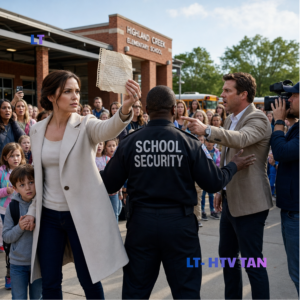
Caleb arrived at dismissal with a freelance videographer and a woman calling herself an investigative family reporter.
He shouted the moment Noah and I came through the doors.
“I just want to see my son!”
Noah froze.
I moved him behind me.
The school resource officer intercepted Caleb at the visitor line. Parents raised phones.
The reporter shouted questions about whether the Callaway family had bribed a court to separate a father from his child.
Caleb pointed at me.
“She planned everything! She got pregnant to steal my father’s money!”
The old me might have panicked.
Instead, I held Noah’s hand and looked directly at Caleb.
“And you abandoned him at the hospital the day he was born. If you want to tell the story, start with your note.”
The courtyard fell silent.
Caleb’s face twisted.
“You kept that?”
That question did more damage than any speech I could have made.
The clip spread online that evening.
People found Caleb’s arrest history.
His public child-support docket.
His failed custody conditions.
Victor issued one sentence through the company.
“The Callaway family will continue protecting the safety and privacy of a minor child. Financial pressure will not alter that obligation.”
He did not use Caleb’s name.
The omission was surgical.
My attorney obtained a no-contact order.
Caleb lost his treatment allowance after violating the agreement. He attempted to sell an interview titled The Woman Who Stole My Dynasty.
No serious outlet bought it.
Yet watching his life collapse did not feel as satisfying as I once imagined.
Part of me still remembered the man who once drove two hours at midnight because I mentioned missing my grandmother’s peach pie.
His tenderness had not always been fake.
It had simply never been strong enough to survive inconvenience.
Noah began therapy with Dr. Patel.
One evening, at eight years old, he finally asked me the question I feared.
“Did you have me so Grandpa would give us money?”
I knelt in front of him.
“I had you because I wanted you. I also hoped being your father might make Caleb responsible. And I knew Grandpa might protect you if Caleb didn’t.”
“So I was a plan?”
“No.”
I took his hands.
“You were never a plan. I had plans because you were coming.”
Later, Noah asked Victor if he had been used.
Victor answered in his usual unsentimental way.
“People will try to use your name, money, and sometimes your feelings. Your mother used my attention to protect you. I used her intelligence to make sure you grew up with judgment.”
Noah was quiet.
“What did my dad leave me?”
Victor’s answer came immediately.
“A warning.”
Then his voice softened.
“Warnings are valuable if you listen early.”
Years passed.
And just when Caleb finally began doing the one thing none of us expected—changing without asking for money—Victor’s body began failing him.
For the first time, the most powerful man I knew could not control what happened next.
Part 6: Victor’s final lesson transforms inheritance into responsibility, not revenge
Victor developed congestive heart failure and kidney disease.
He hated help.
He fired two home-health aides for moving papers on his desk.
He refused a walker until he fell in the library and cracked a rib.
When I suggested a stair lift, he glared at me.
“You’re trying to turn my house into a hospital.”
“Hospitals have trained staff. Right now you have pride and a bruised lung.”
“You enjoy ordering me around.”
“I trained for years.”
He approved the stair lift.
Noah adapted better than either of us.
He moved their chessboard to a lower table without mentioning why.
He slowed his steps in the garden.
He read maps aloud when Victor’s eyes tired.
Victor still never said, “I love you.”
He postponed bankers to hear Noah explain Jupiter’s moons.
He kept every handmade birthday card in the same safe as original stock certificates.
In Victor’s language, that was love without disguise.
Meanwhile, Caleb entered court-approved rehabilitation after an arrest for prescription fraud.
For once, the request came through a public defender instead of a threat.
Victor paid the treatment center directly.
“Why?” I asked.
“Because he is my son.”
“You once said biology wasn’t permission.”
“It isn’t.”
His shaking hand paused over the document.
“Sometimes it is responsibility.”
Caleb completed ninety days, relapsed, then returned.
Eventually he sent Noah a letter through Dr. Patel.
“I’m learning that being sorry is not the same as being safe. I don’t expect you to answer.”
Noah did not answer.
I respected that.
Boundaries are not revenge, even when the person outside them is finally sincere.
Victor declined quickly during his last winter.
At 3:12 one February morning, his nurse called.
I drove through freezing rain to Myers Park.
Victor lay beneath a white blanket, oxygen hissing beside him.
“Noah?” he whispered.
“At my parents’ house. He saw you yesterday.”
“Good.”
I sat beside him.
For once, there were no documents between us.
“Don’t let the boy become weak.”
“Kind isn’t weak.”
“I know.”
His eyes closed.
“I learned late.”
I took his hand.
“He knows you love him.”
“Didn’t say it.”
“You gave him an atlas when he was three. It was practically a sonnet.”
The corner of Victor’s mouth moved.
After a while, his eyes opened again.
“Natalie.”
“I’m here.”
“You were the best deal I never planned.”
His fingers tightened once.
Then relaxed.
Victor Callaway died before dawn.
His estate gave Noah a protected minority stake in Callaway holdings, diversified assets, and eventually the Myers Park house.
I could protect the trust until Noah turned twenty-five.
I could not distribute one dollar to myself.
Caleb received no fortune.
Victor left him something else.
One paid position in the records department of the company’s oldest plant, available after twelve consecutive months of sobriety.
The accompanying letter contained one sentence:
“If you want a Callaway legacy, report Monday at 7:00 and learn where the invoices are kept.”
Caleb did not report the first year.
Or the second.
In the third year, after twelve sober months, he arrived at 6:42 on a Monday morning.
And for the first time in his life, Caleb Callaway stayed.
But staying at a job was one thing.
Facing the son he had abandoned was another.
Part 7: Noah finally confronts his father with the note that began everything
Caleb worked in records for six months before asking through Dr. Patel if Noah would read another letter.
Noah was thirteen.
He read it.
Put it in a drawer.
Returned to his homework.
“Do you want to answer?”
“Not yet.”
“That’s okay.”
He looked at me.
“Do you think he’s different?”
I considered my answer.
“I think he is doing different things. Time will tell whether he becomes different.”
Noah nodded.
Victor would have approved.
I eventually became director of strategy for the Callaway Foundation.
We expanded neonatal clinics, technical scholarships, addiction treatment for parents, and temporary housing for women discharged from hospitals with newborns and nowhere safe to go.
Every program had measurable outcomes.
Good intentions are not results.
Victor had taught me that.
Our first residence opened three miles from the hospital where Noah had been born.
Twelve private rooms.
Legal aid.
Childcare support.
Locked document storage.
We called it Harbor House.
There was no Callaway name above the entrance.
Years later, while moving Victor’s private papers into archival storage, I found the first letter I had mailed him.
Noah’s sleeping photograph was still folded inside.
On the envelope, Victor had written three words in blue ink.
Verify. Then decide.
Beside it, I placed Caleb’s hospital note.
Then Noah’s silver rattle.
Three objects.
Calculation.
Abandonment.
Legacy.
Noah was seventeen now, taller than Caleb had been when I married him.
He entered the library carrying scholarship applications.
“What’s that?”
I pointed to the cheap notebook paper.
“The note your father left at the hospital.”
He read it without touching it.
When he finished, he looked at me.
“He blamed a dead woman?”
“A living woman he called Mom. But the truth was simpler.”
“What truth?”
“He was scared.”
Noah studied the crooked C.
“Can I have it?”
“Why?”
“I want to show it to him when I’m ready.”
“You don’t owe him a confrontation.”
“I know.”
Then Noah said something that made me hear both Victor and myself inside him.
“This isn’t the first page of my life. It’s the last page of his excuse.”
By then, Caleb had been sober four years.
He still worked at the Gastonia plant. He rented a one-bedroom apartment. He paid current child support and a small amount toward what he owed from years before.
He had stopped asking for recognition.
Two weeks later, Noah met him inside Dr. Patel’s office.
I waited in the lobby.
This was not my scene to control.
Forty-three minutes later, Noah came out.
His eyes were red.
His shoulders were steady.
Through the closing door, I saw Caleb still sitting inside.
The hospital note lay on the table between them.
“Are you okay?” I asked.
“Not yet.”
Noah breathed slowly.
“But I think I will be.”
We walked outside without discussing forgiveness.
Because forgiveness is not a door that opens once.
Sometimes it is simply the decision to stop standing in the doorway.
Caleb never became the father I imagined when I married him.
He became something smaller, harder, and perhaps more honest.
A man who finally understood that regret did not entitle him to a place in his son’s life.
Whether Noah eventually gave him one would be Noah’s decision.
No money.
No cameras.
No inherited guilt.
People still tell my story in whatever version makes them comfortable.
Some say I trapped a reckless rich man and outplayed his family.
Some say I rescued my son.
Both versions flatten the truth.
I was a frightened woman who made a calculated choice, then spent years becoming worthy of the protection I had sought.
Victor was a ruthless man who did not know how to love gently, but learned to love reliably.
Caleb was a coward who arrived too late and discovered that blood opens fewer doors than character.
And Noah was never the prize at the end of our fight.
He was the reason the fight had to end differently.
The greatest victory was never the money.
It was Harbor House.
It was Noah growing up knowing his worth did not come from the Callaway name.
It was Victor learning that kindness and strength could occupy the same room.
It was Caleb finally reporting to work at 6:42 in the morning because nobody was going to rescue him anymore.
And it was that cheap hospital note.
Caleb had left it beside my bed because he believed leaving ended his responsibility.
Instead, it became the first piece of evidence in a life built around something stronger than revenge.
Safety.
Truth.
Choice.
He walked away from his responsibility that morning.
And in doing so, he unknowingly awakened mine.
THE END.
All the characters and events in this story are fictional and created for the purpose of storytelling and entertainment.
If this story brought you a moment of reflection, comfort, or curiosity, then it has truly fulfilled its purpose.
Thank you sincerely for reading. Your feedback and support are always appreciated and inspire me to keep sharing more stories with you.








