Stepmother Pulled My Chair Away — “You Don’t Belong Here.” She Didn’t Know I Was a Major.
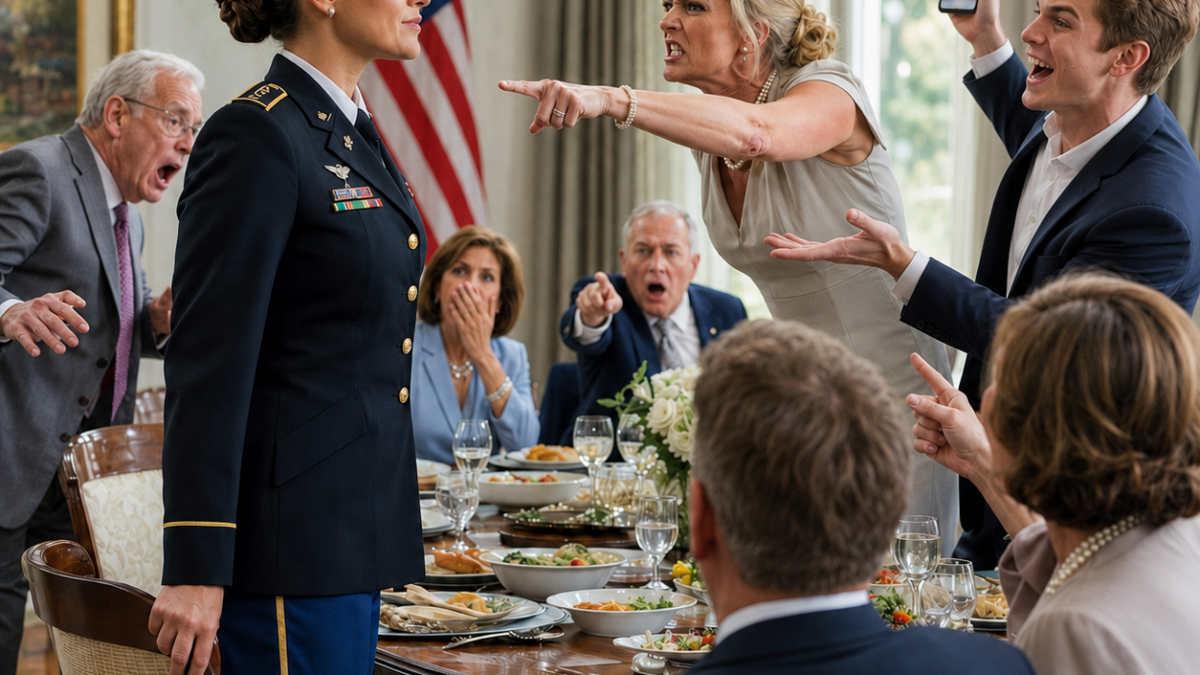
“I Was About To Sit At The Dinner Table When My Stepmother Pushed My Chair Away. ‘A Military Woman Doesn’t Belong In This Family.'” The Room Went Silent. My Stepbrother Started Recording. I Slowly Stood Up And Smiled. “You Just Made The Biggest Mistake Of Your Life.”
### Part 1
The legs of the dining chair screamed against the hardwood just as I started to sit down.
For half a second, I thought somebody had bumped it.
Then I looked up and saw Vanessa Cole holding the back of the chair with one perfectly manicured hand.
My stepmother was smiling.
Not warmly. Not nervously.
It was the little closed-mouth smile she had worn for years whenever she managed to hurt me without leaving anything obvious enough for my father to confront.
“You don’t belong here,” she said.
The smell of roast beef, rosemary, and the vanilla candle burning on the sideboard suddenly seemed too strong.
My father’s fork stopped halfway to his mouth.
Across the table, my stepbrother Mason gave a short laugh.
Vanessa glanced at my dress uniform as if it were something dirty I had tracked into her house.
“A woman who disappears for months at a time and comes home dressed like this doesn’t get to pretend she’s some devoted daughter,” she continued. “Sit somewhere else.”
Nobody moved.
I had been home from an eight-month deployment for less than forty-eight hours.
There was still desert dust trapped in the seams of one pair of boots upstairs at the hotel. I still woke at three in the morning hearing sounds that weren’t there. Two nights earlier, I had stood in an airport bathroom with cold water running over my wrists because I couldn’t stop thinking about people whose families had been waiting for them too.
And somehow this room felt harder to breathe in.
Mason pulled his phone from his pocket.
“Oh, this is good,” he said.
He turned the camera toward me.
“Come on, Claire. Give us the tough-soldier face.”
I looked at him.
Then at Vanessa.
Then at my father.
Dad stared at his plate.
That hurt more than the chair.
Vanessa’s smile widened.
She thought silence meant she had won.
She had always mistaken restraint for weakness.
I straightened.
The brass on my uniform caught the chandelier light. Vanessa didn’t understand what most of the insignia meant. She had never bothered to learn. To her, my military career was simply the strange thing I had chosen instead of becoming the version of me she could control.
Mason kept filming.
“Say something,” he teased.
I did.
“You just made the biggest mistake of your life.”
The smile disappeared from his face for a moment.
Vanessa actually laughed.
“What are you going to do?”
I reached into my jacket pocket.
Her eyes flicked toward my hand.
I pulled out my phone.
No shouting.
No threats.
No scene.
I opened one conversation and typed a single word.
Tomorrow.
Then I hit send.
The message went to two people.
Vanessa didn’t know either of them.
Not really.
She knew one by name, but she had made the dangerous assumption that he worked for her interests.
The other person had been waiting nearly three months for me to give permission to move.
Mason lowered his phone slightly.
“Who were you texting?”
I placed my phone beside my plate.
“No one you need to worry about tonight.”
Vanessa rolled her eyes and shoved the chair farther away.
“Always so dramatic.”
I walked to the breakfast nook, pulled out another chair myself, and carried it to the table.
Nobody offered to help.
That was fine.
I had stopped waiting for this family to make room for me a long time ago.
I sat down.
Vanessa stared.
“You’re actually staying?”
“Dad asked me to dinner.”
My father finally looked up.
There was something in his expression I couldn’t read.
Fear, maybe.
Or shame.
“Claire…”
“It’s okay,” I said.
But it wasn’t.
And he knew it.
We finished dinner with forks scraping plates and Mason periodically checking the video he had recorded.
At one point he snorted.
“This is definitely going online.”
“Post the whole thing,” I said.
He looked delighted.
Vanessa didn’t.
Her eyes narrowed.
She knew me well enough to understand one thing.
I rarely asked people to preserve evidence unless I intended to use it.
Still, her confidence returned quickly.
After dessert, she followed me into the hallway.
“You know what your problem has always been?”
I reached for my coat.
“You think because you went away and got some fancy title, you’re better than us.”
I turned.
“You don’t even know my title.”
Something flickered across her face.
Then she shrugged.
“Does it matter?”
“No.”
I slipped my coat over my uniform.
“Not to what happens tomorrow.”
As I stepped outside, cold November air hit my face.
Behind me, through the front window, I saw Vanessa say something to Mason.
He stopped smiling.
My phone vibrated.
The reply was only four words.
Everything is ready, Major.
I stared at the screen.
Six months of patience had just come to an end.
And Vanessa still thought our biggest problem was a chair.
### Part 2
My mother, Laura Bennett, died when I was twelve.
People often describe losing a parent as if grief arrives like a storm.
For me, it was more like water entering a house through the foundation.
Slowly.
Quietly.
By the time you realize how much damage has been done, everything smells damp and nothing sits quite level anymore.
Mom had been sick for almost two years.
Toward the end, our house smelled constantly of laundry detergent, soup, and the lavender lotion she kept beside her bed.
My father, Daniel, did everything he could.
But after she died, he became a man who could fix a leaking faucet at midnight and still forget to eat dinner.
For two years, we lived around each other.
Then Vanessa appeared.
She was elegant in a way our house had never been.
She wore perfume that lingered after she left a room. She replaced our mismatched coffee mugs with a matching white set and kept fresh flowers on the kitchen island.
At first, I wanted to like her.
I wanted Dad to laugh again.
Vanessa brought a son with her.
Mason was fifteen, three years older than me, and had mastered the kind of confidence that came from never wondering whether a room wanted him there.
The first few months were fine.
Then little things changed.
My mother’s framed picture disappeared from the hallway.
Vanessa said she had moved it “somewhere more private.”
It ended up in a drawer.
At Christmas, the family card showed Dad, Vanessa, and Mason standing beneath the pine tree.
I was at the edge of the photograph.
The next year, I wasn’t in it.
Vanessa apologized.
“The printer must have used the wrong version.”
When Dad suggested retaking the picture, I told him not to worry about it.
That became my habit.
Don’t worry about it.
When Vanessa decided Mason needed my larger bedroom because he was preparing for college, I moved into the smaller room.
Don’t worry about it.
When money my mother had put aside for my education somehow became unavailable, Vanessa explained that family finances were complicated.
Don’t worry about it.
When Mason received a nearly new car and I took the bus, Vanessa said boys had different transportation needs.
Don’t worry about it.
At seventeen, I caught her going through a box of my mother’s belongings.
She was holding Mom’s old silver bracelet.
“What are you doing?”
Vanessa turned without looking embarrassed.
“Cleaning.”
“That’s my mother’s.”
“And it’s been collecting dust for years.”
I took the bracelet from her hand.
Her expression hardened.
“You have to stop worshipping the dead, Claire.”
I remember the refrigerator humming behind us.
I remember a clock ticking.
I remember thinking that if I screamed, my father might come downstairs and finally see everything.
Instead, I whispered, “Don’t touch her things again.”
Vanessa smiled.
“Or what?”
I didn’t have an answer.
Not then.
At eighteen, I left.
The morning I departed for basic training, Dad hugged me beside his truck.
He cried.
Vanessa stayed on the porch in a robe with her coffee.
Mason was asleep.
Dad whispered, “You can always come home.”
I looked past him at the house where another woman had slowly erased every visible sign that I had once belonged.
“I know.”
But I didn’t believe it.
The military gave me something that house never had.
Rules that applied to everybody.
Clear expectations.
Consequences.
If I failed, the failure belonged to me.
If I succeeded, nobody could quietly move the achievement into someone else’s room and call it a misunderstanding.
The years were hard.
Sometimes brutally hard.
But they were mine.
I became an officer.
Then a captain.
Then, after twelve years of work, mistakes, deployments, sleepless nights, evaluations, and responsibility for people whose families trusted me to bring them home, I became Major Claire Bennett.
Dad knew.
He was proud.
Vanessa barely acknowledged it.
When Dad mentioned my promotion during a holiday call, I heard her in the background.
“That’s nice.”
Nothing more.
I told myself I didn’t care.
Then, six months before that dinner, my father called me at 1:17 in the morning.
His voice sounded weak.
“Claire?”
I sat up immediately.
“What happened?”
He was quiet for so long I could hear him breathing.
Then he said something that made me turn on the bedside lamp.
“I need you to look at something for me.”
“What?”
“Some papers.”
There was fear in his voice.
My father had survived losing my mother.
He had survived raising me while grieving.
I had almost never heard him sound afraid.
“Dad, what papers?”
He lowered his voice.
“I don’t know what I signed.”
And in that moment, every childhood instinct I had trained myself to ignore came roaring back.
### Part 3
Dad had undergone a medical procedure several weeks before that phone call.
Nothing catastrophic, but enough to leave him exhausted and temporarily dependent on Vanessa for transportation, appointments, and paperwork.
“She handled everything,” he told me.
I stood barefoot in my apartment kitchen, listening to the refrigerator compressor click on.
“What does everything mean?”
“Bills. Insurance. Banking.”
My stomach tightened.
Dad had always handled his own money.
“What changed?”
“I got a notice.”
Paper rustled near his phone.
“It says something about an account I don’t recognize.”
“Send me a picture.”
“I already did.”
I opened the message.
The page itself was ordinary.
A financial statement.
What bothered me was one transfer.
Not enormous.
Just unusual.
“Have you moved money recently?”
“No.”
“Did Vanessa?”
A pause.
“She has access.”
“How much access?”
Another pause.
That was the moment I knew.
“Dad.”
“I signed some things after the procedure.”
“What things?”
“I don’t remember.”
The next morning, I called an attorney recommended by someone I trusted.
Her name was Rebecca Sloan.
She spoke calmly, asked precise questions, and refused to jump to conclusions.
That made me trust her.
“You need documents before accusations,” she said.
“I agree.”
“Can your father request records himself?”
“Yes.”
“Good. Do that first.”
So we did.
What emerged was not a dramatic theft.
That would have been easier.
It was a pattern.
A few thousand here.
Another amount there.
New account permissions.
Changed contact preferences.
Automatic statements switched to electronic delivery.
Nothing screamed crime on its own.
Together, they whispered something worse.
Someone had been counting on Dad not looking.
I wanted to confront Vanessa immediately.
Rebecca stopped me.
“Right now you have suspicious activity.”
“Then what do I need?”
“A complete picture.”
I hated waiting.
But the Army had taught me that moving too early could destroy the advantage of knowing more than the other side believed you knew.
So I waited.
Dad quietly gave us access to what he legally could.
I reviewed years of statements during nights when I should have been sleeping.
A financial adviser named Neil Harper appeared again and again in the records.
Vanessa had mentioned him before.
“He handles our future,” she had once told Dad proudly during a video call.
I contacted him carefully.
At first, Neil was defensive.
Then I asked about one authorization.
He went silent.
“That isn’t what I was told,” he said.
“What were you told?”
“That Daniel had requested those changes.”
“He didn’t.”
Silence.
“I’ll need to review my notes.”
Three days later, Neil called back.
His voice had changed.
He had found emails.
Instructions.
Dates.
Requests made in Dad’s name that had not come directly from Dad.
That was when Rebecca stopped calling the situation “concerning.”
She started calling it “actionable.”
Still, I told them both the same thing.
“No confrontation yet.”
Why?
Because Dad was ashamed.
He kept blaming himself.
“I should have paid attention.”
“You were recovering.”
“I still signed things.”
“You trusted your wife.”
That sentence always made him quiet.
It was why I had intended to resolve everything discreetly.
Freeze what needed freezing.
Undo whatever could be undone.
Remove Vanessa’s authority.
Protect Dad from becoming gossip among neighbors, friends, relatives.
For all my anger toward her, I didn’t want my father’s humiliation to become public entertainment.
Ironically, Vanessa would be the one to change that.
Two weeks before I came home, Dad called again.
“Sunday dinner,” he said.
I was packing equipment in a room lit by fluorescent panels that made everyone look exhausted.
“I don’t know.”
“Please.”
Something in his voice stopped me.
“Is she pressuring you?”
“No.”
“Is Mason involved?”
“I don’t think so.”
“You don’t think so?”
“Claire, please. One dinner.”
I rubbed my forehead.
“Okay.”
His exhale sounded like relief.
Then, almost too quietly, he said, “There’s something else I need to tell you when you’re here.”
“What?”
“Not on the phone.”
I went still.
“Dad, if this is about the accounts—”
“It isn’t.”
That answer bothered me more.
“What is it about?”
He hesitated.
“Your mother.”
My hand froze over my duffel bag.
Mom had been dead for twenty years.
“What about her?”
“Come home first.”
Then he ended the call.
For the next two weeks, I wondered what my father had kept from me for two decades.
I thought that would be the biggest secret waiting in that house.
I was wrong.
### Part 4
The morning after the dinner-table humiliation, I woke at 5:42 without an alarm.
For several seconds, I didn’t know where I was.
The hotel ceiling was too white.
The heater clicked near the window.
Then I remembered Vanessa’s hand on the chair.
Mason’s phone.
My father staring down.
I checked my own phone.
Thirty-seven notifications.
Mason had posted the video.
The caption was exactly the kind of thing he thought was clever.
Family hero gets reminded where she belongs.
He had cut the clip badly.
He kept Vanessa pulling the chair.
Kept her saying, “You don’t belong here.”
Kept himself laughing.
Kept me standing up and saying, “You just made the biggest mistake of your life.”
What he removed was almost everything that might have made him look reasonable.
I sat on the edge of the bed and watched it twice.
Then I noticed something.
Someone in the comments had identified my rank.
Another person corrected Mason after he referred to me as “some soldier.”
“That insignia belongs to a Major.”
Then another comment appeared.
Then twenty.
Then hundreds.
Military spouses.
Veterans.
People with no military connection at all.
Most weren’t discussing me.
They were discussing Vanessa.
“Who pulls a chair away from somebody at a family dinner?”
“Her dad just sat there?”
“The guy filming thinks he looks good here?”
Mason started responding defensively.
By seven, he had turned off comments.
By eight, copies were circulating elsewhere.
By nine, the original disappeared.
Too late.
I wasn’t celebrating.
Public humiliation wasn’t the objective.
I knew too well how quickly strangers could turn a few seconds of video into a story that belonged to everyone except the people living it.
My objective was Dad.
Rebecca texted at 6:10.
Freeze request initiated. Adviser ready. Bring Daniel in personally.
Neil sent another message.
I have the full transaction log.
I showered, put on civilian clothes, then changed my mind.
My dress uniform hung from the closet door.
Vanessa had looked at it with contempt.
She had called it costume-like without understanding what any part of it represented.
I put it back on.
Not for revenge.
For myself.
At 9:25, I arrived at Dad’s house.
A delivery truck idled two houses away.
Somebody was running a leaf blower down the street.
Everything outside looked offensively normal.
Dad opened the door before I knocked.
His face seemed older than it had the night before.
“Come in.”
“Where’s Vanessa?”
“Upstairs.”
“Mason?”
“Left early.”
Dad glanced at my uniform.
Then his eyes filled.
“I’m sorry about last night.”
“We’ll talk about that later.”
I set a thick gray folder on the kitchen table.
His hand hovered above it.
“What is this?”
“The answer to the question you asked me six months ago.”
He sat down.
The kitchen clock ticked.
Page by page, I showed him the transfers.
Then the changed account permissions.
Then the documents authorizing Vanessa to make broader financial decisions.
He stared at his signature.
“I signed this?”
“That appears to be your signature.”
“I don’t remember it.”
“I know.”
His face changed when he reached the next page.
A transfer had gone into an account connected solely to Vanessa.
Another had covered an expense Dad knew nothing about.
Then there was the total.
Not ruinous.
But big enough to destroy trust.
He pressed both hands flat against the table.
“How long?”
“At least fourteen months that we can document.”
His voice cracked.
“She told me everything was fine.”
“I know.”
“She said I was confused after the procedure.”
My jaw tightened.
“She told you that?”
He nodded.
Then I realized Vanessa hadn’t merely relied on his exhaustion.
She had been teaching him to distrust his own memory.
Footsteps sounded overhead.
Dad closed the folder.
“No.”
I looked at him.
His expression had changed.
The frightened man who called me six months earlier was still there.
But something else was rising through him.
“I’m doing this,” he said.
“Dad—”
“No. I let you face her alone last night.”
His eyes met mine.
“I’m not doing that again.”
Vanessa entered the kitchen wearing a pale sweater and holding a mug.
She stopped when she saw us.
Then she saw the folder.
The mug went very still in her hand.
“What’s going on?”
Dad pushed out the chair opposite him.
“Sit down.”
Vanessa’s gaze moved from him to me.
Then back to the folder.
And for the first time in all the years I had known her, I saw genuine fear enter her eyes.
### Part 5
Vanessa didn’t sit.
She set her coffee on the counter instead.
“What is this supposed to be?”
Dad opened the folder.
“Did you move money from my retirement accounts?”
Her expression barely changed.
“We move money all the time.”
“I don’t.”
“You asked me to handle things.”
“I asked you to pay bills.”
She glanced at me.
There it was.
The pivot.
Whenever Vanessa lost control of a conversation, she found someone else to blame.
“She put this in your head.”
Dad looked down at the records.
“These are statements.”
“Statements can be misunderstood.”
“Then help me understand.”
Vanessa crossed her arms.
“You were recovering. There were expenses.”
“What expenses?”
“Household things.”
“Which ones?”
She hesitated.
Less than a second.
But I saw it.
Dad saw it too.
Vanessa’s attention snapped toward me.
“You’ve been spying on us.”
“No.”
“You had no right.”
“He asked me.”
Her face turned toward Dad.
“You went behind my back?”
He looked almost stunned by the question.
“My accounts are in my name.”
“We’re married.”
“That doesn’t answer me.”
For years, Dad had lowered his voice when Vanessa raised hers.
That morning, he didn’t.
It changed the whole room.
She felt it too.
Her anger sharpened.
“I took care of you when she was gone.”
I kept my mouth shut.
“This daughter you’re suddenly so proud of wasn’t here,” Vanessa continued. “I drove you. I handled the appointments. I dealt with everything while Major Important was playing hero.”
Dad flinched.
I didn’t.
Rebecca had warned me that people under pressure often revealed motives accidentally because they became more interested in being understood than being careful.
Vanessa did exactly that.
“I deserved some security,” she said.
Dad stared at her.
“Security?”
She realized what she had said.
“I mean our security.”
“No, you didn’t.”
“Daniel—”
“Why is there an account I can’t access?”
Vanessa’s mouth closed.
The silence gave him his answer.
Dad turned another page.
“What is this?”
She looked.
A copy of the authorization that had expanded her financial control.
Her jaw tightened.
“You signed it.”
“I was barely awake.”
“You knew what you were signing.”
“I didn’t.”
“You always do this,” she snapped. “You forget something and then act like I deceived you.”
The sentence hit the room harder than shouting.
Dad’s face went blank.
I understood then how often she must have said it.
How many times she had taken a man already frightened by illness and convinced him that his own memory was the unreliable thing.
I leaned forward.
“Neil Harper has preserved his correspondence.”
That finally broke her composure.
“Neil?”
She said his name too fast.
“Yes.”
“He can’t discuss our finances with you.”
“He’s discussing Dad’s finances with Dad’s legal counsel.”
Her face lost color.
“What legal counsel?”
The doorbell rang.
Vanessa jumped.
I didn’t.
Dad looked at me.
“Is that—”
“Yes.”
Rebecca entered carrying a leather portfolio.
She greeted Dad first.
Not me.
That mattered.
This was his decision now.
“Mr. Bennett,” she said, “I have the documentation we discussed.”
Vanessa looked from Rebecca to me.
“You planned this.”
I shook my head.
“I prepared for it.”
“You waited until after last night to humiliate me.”
“No.”
I glanced toward the empty dining room.
“You humiliated yourself last night.”
Her eyes flashed.
“This is because of a chair?”
“No.”
I let that word hang.
“The chair is why I stopped protecting your privacy.”
For once, Vanessa had nothing to say.
Rebecca explained the immediate steps.
The disputed accounts would be frozen pending review.
Dad would revoke Vanessa’s financial authority.
Any transfers requiring explanation would be traced.
Nothing Rebecca said was theatrical.
That seemed to frighten Vanessa more.
There was no screaming lawyer.
No threat of handcuffs.
Just procedures moving forward whether she liked them or not.
Then Dad asked the question I hadn’t expected.
“What about the house?”
Vanessa turned sharply.
“Our house?”
Dad looked at Rebecca.
“You said there was something strange in the property paperwork.”
I stared at him.
Rebecca paused.
There was something in her expression I didn’t like.
“Yes.”
Vanessa’s breathing changed.
Dad noticed.
I noticed.
And suddenly I realized the bank accounts might not have been the largest thing Vanessa had tried to take.
### Part 6
Rebecca removed three pages from her portfolio.
“I was going to discuss this with you privately,” she told Dad.
“No,” he said. “Do it here.”
Vanessa grabbed the back of a kitchen chair.
For a strange second, I thought about the night before.
Another chair.
Another hand.
A completely different balance of power.
Rebecca placed the documents on the table.
“The deed itself has not changed.”
Dad exhaled.
“But there was an attempted change to how the property would be handled upon your death.”
The room went silent.
Vanessa’s fingers tightened.
“What kind of change?” Dad asked.
“A proposed trust revision.”
He frowned.
“I don’t have a trust revision.”
“You do not have a completed one.”
Rebecca tapped the page.
“But someone had preliminary documents prepared.”
Dad read the first paragraph.
His face drained.
I leaned closer.
The plan would have placed the house under a structure heavily favoring Vanessa and, eventually, Mason.
My name was absent.
That alone wouldn’t have shocked me.
What shocked me was the timing.
The draft had been created less than two weeks after Dad’s procedure.
“Who requested this?” I asked.
Rebecca looked toward Vanessa.
“The request originated through an email address used by Mrs. Cole.”
Dad closed his eyes.
Vanessa exploded.
“I was protecting myself!”
No one spoke.
“You all expect me to apologize for thinking about my future?” she demanded. “What happens if Daniel dies? Claire has her career. She has government benefits. She disappears for years. Mason and I are the ones who are actually here.”
“Mason is thirty-five,” I said.
“He’s my son.”
“And I’m his daughter,” I said, nodding toward Dad.
Vanessa laughed bitterly.
“Biologically.”
Dad’s chair shifted.
“Stop.”
She ignored him.
“This is exactly what she has always wanted. She comes marching back in here with medals on her chest and suddenly I’m the villain.”
“You were moving my money,” Dad said.
“I was managing it.”
“You were preparing documents involving my house.”
“For our future.”
“Without telling me.”
“You would have agreed.”
“Then why didn’t you ask?”
That ended it.
Vanessa stared at him.
Dad removed his wedding ring.
No dramatic motion.
No speech.
He simply pulled it off and set it beside the folder.
The tiny metallic click against the wood was the loudest sound in the room.
Vanessa’s face collapsed.
“Daniel.”
“I defended you for years.”
“You needed me.”
“I trusted you.”
“I took care of you!”
“And you used that trust.”
She looked at me.
Hatred replaced panic.
“This is what you wanted.”
I shook my head.
“No.”
“You’ve hated me since you were fourteen.”
“I stopped needing you when I was eighteen.”
That hurt her more.
I could see it.
Hatred still grants someone importance.
Indifference takes it away.
She stepped closer.
“You think that uniform makes you powerful?”
I looked at her.
“No. Responsibility does.”
Her eyes dropped to the insignia on my shoulder.
Maybe for the first time, she actually saw it.
“Mason called you a captain online,” she muttered.
“I’m not a captain.”
Dad looked at her.
“She’s a Major.”
Vanessa blinked.
I almost laughed.
Not because rank mattered inside a family.
It didn’t.
But she had spent years mocking a life she had never bothered to understand, and now even the title in her own insult had been wrong.
The door opened behind us.
Mason rushed inside.
His hair was uncombed, his face red.
“What did you do?”
Vanessa turned.
“Mason—”
He shoved his phone toward me.
“My company called me.”
I didn’t take it.
“So?”
“They saw the video.”
“That you posted.”
“They’re saying I made the company look bad.”
“That sounds like a conversation between you and your employer.”
“You ruined my life.”
I stared at him.
“You recorded yourself laughing while your mother pulled a chair away from me.”
“You could’ve stopped me from posting it!”
I actually had to process that.
“You want me to be responsible for not preventing you from embarrassing yourself?”
His face twisted.
Dad spoke quietly.
“Mason, go.”
“This is my home too.”
“No.”
Dad stood.
“Apparently I should have corrected that misunderstanding years ago.”
Mason looked at his mother.
She said nothing.
For the first time, neither of them controlled the room.
But as Mason stormed upstairs, Rebecca leaned toward me.
“There’s another issue.”
I looked at her.
“What?”
“The adviser found one more transfer.”
My stomach tightened.
“How much?”
“It isn’t the amount that worries me.”
She slid a page across the table.
I read the destination.
Then I read it again.
The money had been connected to an account carrying the name of someone who had been dead for twenty years.
My mother.
### Part 7
My first thought was fraud.
My second was worse.
“What is this?”
Dad reached for the statement.
When he saw the name Laura Bennett, he stopped breathing for a moment.
Vanessa went pale.
That told me she knew something.
“Explain it,” I said.
Rebecca lifted a hand slightly.
“We’re still verifying.”
Dad looked at Vanessa.
“You know what this is.”
“No.”
“You looked at it before Claire even finished speaking.”
Vanessa backed toward the counter.
“It’s old paperwork.”
“What paperwork?”
She wouldn’t answer.
Dad turned to me.
“Remember what I said on the phone?”
About Mom.
I nodded.
He walked into his study.
When he returned, he was carrying a small metal lockbox.
I recognized it immediately.
It had belonged to my mother.
I hadn’t seen it since high school.
“You had that?”
Dad looked ashamed.
“It was in storage.”
“Why?”
“Vanessa said most of Laura’s things were packed away.”
Vanessa’s lips tightened.
Dad opened the box.
Inside were documents, photographs, a few pieces of jewelry, and envelopes tied with a faded ribbon.
My mother’s handwriting appeared on the top envelope.
For Claire.
My chest tightened so quickly it hurt.
I looked at Dad.
“You’ve had this the whole time?”
His eyes filled.
“I didn’t know the letters were inside.”
Vanessa spoke.
“Oh, please.”
I turned slowly.
She must have realized the mistake immediately.
“You knew.”
“I knew there were papers.”
“You knew there were letters.”
“No.”
Dad reached deeper into the box.
Beneath the envelopes was paperwork connected to a small investment account Mom had created before she died.
It wasn’t a fortune.
But it had been intended for me.
College.
A first home.
Whatever future she wouldn’t live to see.
Dad stared at the figures.
“This was the money.”
The room seemed to tilt.
When I was sixteen, Vanessa had told me there wasn’t enough left in the education account.
When I was seventeen, she told me family expenses had changed.
At eighteen, I joined the Army believing my mother’s savings were essentially gone.
They hadn’t been.
Not all of them.
The account had been moved years earlier into a broader family investment structure.
Dad had apparently agreed to it during a chaotic period after marrying Vanessa.
He remembered almost nothing about the details.
But recent activity suggested Vanessa had begun shifting part of what remained through another account that still carried Mom’s name in its historical registration.
“That money was supposed to be Claire’s,” Dad whispered.
Vanessa’s composure shattered.
“Mason needed help.”
I felt nothing at first.
Sometimes shock arrives as emptiness.
“Help with what?”
“College. His car. Later, some debt.”
Dad stared at her.
“You used Laura’s money for Mason?”
“We were a family!”
“No,” I said.
Everyone looked at me.
“We were people living in the same house.”
Vanessa’s eyes filled with angry tears.
“You had opportunities.”
“I made opportunities.”
“You had the military.”
“I joined at eighteen because you told me the money my dead mother saved for me was gone.”
She opened her mouth.
Nothing came out.
I finally understood something that had bothered me for years.
Vanessa hadn’t merely preferred Mason.
She had converted my silence into resources for him.
The bedroom.
The car.
The money.
Even my mother’s place in the house.
Every time I said, “Don’t worry about it,” Vanessa had taken me literally.
Dad sat heavily.
“I failed you.”
“This isn’t about you right now.”
“It should have been twenty years ago.”
I looked at the unopened letters.
My mother had written to me.
Vanessa had known the box existed.
Maybe she had read them.
Maybe she hadn’t.
For once, I didn’t want to know immediately.
There are truths you chase.
There are others you need to approach slowly because they can still cut even after decades.
Rebecca broke the silence.
“We can pursue recovery of misused funds.”
Dad nodded.
“Yes.”
Vanessa stared at him.
“You said you didn’t want this public.”
“I didn’t.”
He looked toward the dining room.
“You made it public.”
She began crying.
Real tears this time.
Years earlier, they might have moved me.
Now I simply watched.
She had mistaken my patience for permission.
My father’s grief for weakness.
My mother’s absence for opportunity.
And when she finally realized the family was no longer going to absorb the consequences for her, she reached for the last weapon she had.
“You’ll regret choosing her over me.”
Dad looked exhausted.
“I should have chosen my daughter years ago.”
Vanessa flinched.
Then Dad said the words that ended their marriage.
“I want you out of this house.”
### Part 8
Vanessa left six days later.
Not dramatically.
There was no screaming scene on the lawn.
No police car.
No crowd of neighbors.
Just cardboard boxes, packing tape, the heavy thud of drawers closing, and Mason carrying expensive luggage to his SUV while refusing to look at me.
Dad chose not to pursue every possible criminal consequence.
At first, I disagreed.
Rebecca had made it clear that some of Vanessa’s actions could lead to far more serious proceedings if Dad wanted to push.
But it was his case.
His marriage.
His decision.
He demanded restitution, legal separation, the reversal of every authority she held, and a formal accounting of funds she had moved.
Most of what could be traced was returned or resolved through the settlement.
The property documents died before they became anything more than drafts.
The financial permissions were revoked immediately.
Vanessa walked away with far less control than she had expected.
And far less dignity than she could have kept if she had simply left quietly when Dad first confronted her.
Mason’s online problem became his own.
The video spread beyond his control.
He deleted it, then posted a long explanation claiming people had misunderstood “family humor.”
That made things worse.
His employer didn’t fire him because I asked them to.
I never contacted them.
They had their own standards, and apparently broadcasting yourself mocking someone at a family dinner while she was publicly humiliated didn’t fit those standards.
He lost the position a few weeks later.
Mason blamed me anyway.
He sent one final message.
Hope destroying our family was worth it.
I read it once.
Then I blocked him.
I didn’t answer because some accusations don’t deserve defense.
Dad and I spent the following weeks doing something we should have done years earlier.
Talking.
Actually talking.
Not holiday calls.
Not weather.
Not “work is busy.”
Not “everything’s fine.”
One evening, we sat on the back porch with coffee.
The maple tree near the fence had lost almost every leaf.
Dad rubbed both hands around his mug.
“I saw things.”
I waited.
“When you were younger.”
“What things?”
“Her moving your belongings. Mason getting more. You going quiet.”
He swallowed.
“I told myself blending families was difficult.”
I stared across the yard.
“You told yourself whatever let you avoid choosing.”
He winced.
“Yes.”
I appreciated that he didn’t defend himself.
“I was afraid,” he continued. “After losing your mother, I thought if I admitted my second marriage was wrong, then I had failed again.”
“You were the adult.”
“I know.”
“I was fourteen.”
“I know.”
“You let me think keeping quiet was the price of keeping you happy.”
His eyes filled.
“I know.”
I had imagined that apology many times when I was younger.
In those fantasies, hearing it fixed something.
Reality was different.
It mattered.
But it didn’t return birthdays.
It didn’t give me back my bedroom.
It didn’t restore the years when I stopped calling home because every conversation made me feel like a guest asking permission to exist.
“I forgive you,” I said.
Dad looked at me.
“But forgiveness doesn’t make those years disappear.”
“I understand.”
“And if you ever ask me to sit at a table with Vanessa or Mason again, the answer is no.”
He nodded.
“I won’t.”
That was the difference between forgiving my father and reopening a relationship with Vanessa.
Dad had finally accepted responsibility.
Vanessa never did.
She sent me two emails over the next several months.
The first blamed me.
The second was softer.
She said she had been “under enormous pressure” and hoped that “with time, family could heal.”
I deleted both.
Mason tried once through a relative.
I declined.
There are people who apologize because they understand your pain.
And there are people who apologize because consequences have become uncomfortable.
I had no interest in confusing the two.
The most important thing Dad gave me during those weeks wasn’t money.
It was the metal lockbox.
I took it back to my apartment.
For three nights, I couldn’t open the letters.
Then on Sunday morning, I made coffee, sat beside the window, and untied the faded ribbon.
My mother had written one letter for every birthday she feared she would miss.
Thirteen.
Sixteen.
Eighteen.
Twenty-one.
The final envelope had no age on it.
Only my name.
Inside, she had written about courage.
Not military courage.
Not medals.
Not being fearless.
She wrote that she hoped I would become the kind of woman who knew the difference between being kind and making herself small.
I read that sentence four times.
Then I cried harder than I had cried in years.
Months later, I returned to duty.
My life didn’t suddenly become perfect.
Real endings rarely work that way.
I still woke some nights with memories from deployment.
Dad and I were rebuilding something slowly, with boundaries instead of pretending.
I was promoted again years later, but strangely, the rank mattered less to me than it once had.
Because Vanessa had taught me something without meaning to.
Titles don’t create your place in the world.
Other people don’t either.
A chair certainly doesn’t.
I remember that dinner sometimes.
The scrape of wood against hardwood.
Mason laughing.
Dad looking down.
Vanessa saying, “You don’t belong here.”
For years, younger Claire would have desperately wanted someone at that table to stand up and contradict her.
Now I know better.
I didn’t need Vanessa to tell me I belonged.
I didn’t need Mason to respect me.
I didn’t even need my father to rewrite the past.
I needed to stop offering people unlimited access to me simply because we shared history.
The last time I saw Vanessa was outside Rebecca’s office after the settlement.
She looked smaller somehow.
Not physically.
Just stripped of the certainty that everyone else would keep absorbing the cost of her choices.
She stopped beside me.
“Are you happy now?”
I looked at her.
“No.”
That seemed to surprise her.
“Then what was all this for?”
I thought about my mother’s letters.
My father’s shaking hands.
The missing money.
The years of silence.
The chair sliding away.
“For peace.”
She scoffed.
“You destroyed a family for peace?”
“No.”
I opened the door.
“I stopped pretending something broken was whole.”
Then I walked outside.
The afternoon was bright and cold.
Traffic moved beyond the parking lot.
Somewhere nearby, someone was cutting grass despite the season, and the smell drifted strangely through the air.
I stood there for a moment, breathing.
No victory speech.
No revenge.
No sudden need for Vanessa to understand.
That was the part I never expected.
By the end, I didn’t need her regret.
I didn’t need Mason’s apology.
I didn’t need a seat at their table.
I had spent half my life building one of my own.
And if there is one thing I learned from the night my stepmother pulled my chair away, it is this:
When somebody works that hard to convince you that you don’t belong, don’t waste your life begging them to make room.
Stand up.
Look carefully at what they’re trying to hide beneath the table.
Then take your dignity, your truth, and your future somewhere they can never reach again.
THE END!
Disclaimer: Our stories are inspired by real-life events but are carefully rewritten for entertainment. Any resemblance to actual people or situations is purely coincidental.








