My Brother Laughed as He Handed Me the Only Economy Ticket — Then the Captain Called Me “General.”
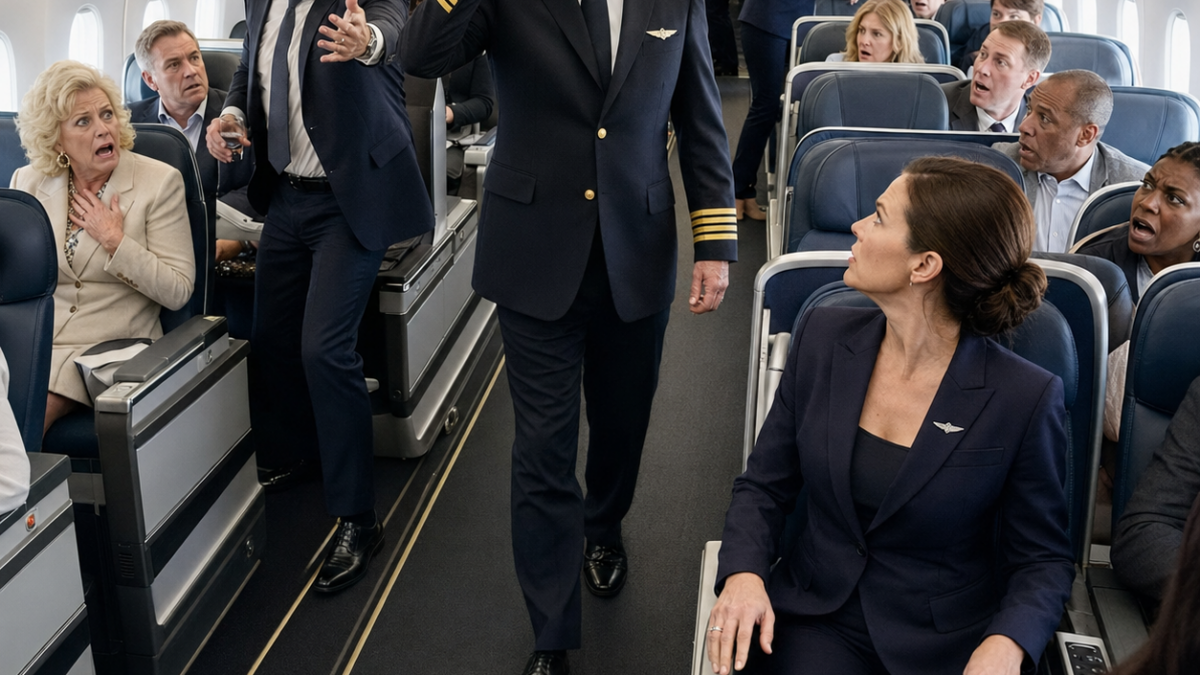
My Brother Handed Out First-Class Tickets To Everyone In The Airport Lounge, Then Dropped An Economy Seat Into My Hand And Laughed, “You’re Used To The Back Anyway.” I Stayed Quiet… Until The Captain Walked Past First Class, Past Business, Straight To Row 34F, Saluted Me, And Said, “General, Ma’am.”
### Part 1
My brother Grant handed first-class boarding passes to everyone in our family as if he were distributing awards. My mother got one. Our cousin Emily got one. The family attorney, Martin Shaw, got one. Even Grant’s investment adviser, Preston Vale, received a seat near the front. Then Grant dropped the last envelope into my hand. “Sorry, Claire. Booking problem.”
Inside was seat 34F, beside the rear galley. He leaned back with his champagne and grinned. “You’re used to the back anyway.” Everyone heard him. Nobody laughed loudly, but nobody defended me either. My mother only touched my sleeve and murmured, “It’s a few hours. Please don’t make this uncomfortable.”
That sentence had followed me through most of my adult life. Grant could insult me, dismiss me, or rewrite history, and somehow I was responsible for keeping the room peaceful. I looked at the leather folder beside his glass. That folder mattered more than the ticket.
We were supposedly flying from Seattle to Charleston to celebrate Mom’s retirement. In reality, we were going to the annual shareholder meeting of Mercer Aeronautics, the company my late father had built from a rented workshop into a major supplier of aircraft pressure sensors, emergency communication modules, and backup electrical components. Dad had left equal voting shares to Grant and me. Mom and a family trust held smaller portions. Grant had run the company for six years while my military career kept me away from daily operations. He used that distance well. To relatives, he described me as someone who “handled government logistics.”
He never mentioned that I had worked beside Dad before he did. At seventeen, I labeled circuit boards after school. At nineteen, I stood in a freezing hangar testing emergency transmitters while Grant was still changing college majors. Later, I earned degrees in aerospace systems engineering and strategic logistics and joined the Air Force. Over twenty-one years, I coordinated emergency air corridors after hurricanes, supervised evacuations, and helped build procedures for aircraft facing simultaneous electrical and communication failures.
Three months before this trip, I had been promoted to major general. Grant knew. Mom knew.
Neither had told the rest of the family. Grant pushed the leather folder toward me. “Routine voting authorizations. Sign before we land and we can avoid an argument in Charleston.” The first page said temporary voting proxy.
It was not temporary. The language transferred control of my shares to Grant for five years. The next document approved the sale of our emergency systems division to a private investment group represented by Preston for less than half its estimated value. A hidden clause authorized a twelve-million-dollar consulting payment to Preston’s firm. I closed the folder.
“Not signing?” Grant asked. “Not in an airport lounge.” His smile tightened. “You never trusted me.”
“Trust doesn’t require a rushed signature.” What he didn’t know was that I had already seen internal messages discussing layoffs, outsourcing, and a batch of communication modules that had failed quality inspections. Engineers had recommended immediate customer notification. Grant had waited eleven days.
He wanted the sale signed before anyone connected those defects to him. I could have confronted him right there. Instead, I boarded quietly. I walked past my family in first class and took 34F.
An older teacher named Nora helped me lift my bag. A college student named Jamal moved his backpack so I had more room. Their small kindness felt more genuine than anything I had received in the lounge. Ten minutes later, the cockpit door opened. The captain walked through first class.
Then business. Then all the way to row 34. He stopped beside me, straightened, and saluted.
“General Mercer, ma’am. I didn’t realize you were aboard.” The cabin went silent. I looked toward first class.
Grant had turned around in his seat. His smile was gone. And for the first time that morning, he looked afraid.
### Part 2
The captain was Aaron Cole, a former Air Force transport pilot I had known years earlier. During a communications blackout over the Pacific, his damaged aircraft had been guided toward an emergency landing by a command center I supervised. I returned his salute. “Captain Cole. Good to see you.” His eyes dropped briefly to seat 34F, then moved toward first class.
“Traveling officially?” “Family business.” He understood from my expression not to ask more.
“We’re honored to have you aboard.” “I’m fine right here.” When he returned to the cockpit, half the cabin was still looking at me.
My phone vibrated before takeoff. Grant: Enjoy your little performance. A salute doesn’t give you business judgment. I saved the message.
For the next hour, I read every page in his folder. The proxy did more than transfer my voting rights. It released Grant from liability for decisions made during the previous eighteen months. It allowed him to appoint two directors without shareholder approval. It guaranteed Preston’s firm an enormous payment if the division sale closed. And Martin Shaw’s signature appeared on every draft.
Martin had spent years claiming he represented the corporation, the family trust, and all of us neutrally. Now I knew better. I looked toward first class. Grant was speaking quietly with Preston. Martin appeared asleep. My cousin Emily sat with her laptop open, glancing back at me every few minutes.
A flight attendant named Rachel Kent stopped beside my row. “General Mercer, Captain Cole asked if you’d visit the cockpit after landing. He said you’ve worked together.” “I’d be glad to.”
Her eyes flicked toward the documents in my lap. “Business trip?” “Family trip.”
She smiled. “Sometimes those require more strategy.” Twenty minutes later, Emily walked toward the rear lavatory, then stopped beside me. “Can we talk?”
I gestured to the empty jump seat across the aisle. She sat and lowered her voice. “Grant says the sale will save the company.” “The company posted its strongest operating revenue in nine years.”
“He said the numbers are misleading.” “Did you verify that?” Her face reddened.
Emily was competent, but Grant had promoted her into interim finance director and made sure she understood how easily he could take the title back. “I found transfers,” she whispered. “Consulting fees through two vendors. The invoices say supply-chain analysis, but there are no reports.” “How much?”
“Almost four million over fourteen months.” “To Preston?” “I can’t prove it. One vendor belongs to a holding company.”
“Were the payments board approved?” “Grant said they were.” “They weren’t.”
She stared at me. “How do you know?” “Because I’m still on the board.” “He said your seat became inactive while you were deployed.”
“My assignment limited public participation. It never removed my authority.” Emily pressed her hands together. “I copied the records.”
“Where?” “Encrypted drive. In my bag.” “Keep it with you. And don’t give it to Martin.”
Her eyes widened. “Martin?” “His signature is on the proxy.” Before she could answer, the cabin lights flickered.
The overhead vents died for a second, then restarted. Most passengers barely noticed. I did.
The moving map froze. The lights shifted to reduced power. A soft chime sounded from the galley. Rachel picked up the interphone. Her expression changed.
Captain Cole announced a minor electrical anomaly and asked everyone to remain seated. Five minutes later, Rachel returned to my row. “General Mercer, the captain would like to speak with you through the secure interphone.”
Grant stood immediately. “Why does the captain need her?” Rachel faced him. “Return to your seat, sir.”
“I’m her brother.” “That does not change the seat-belt sign.” Grant glared at me.
“Claire, don’t turn this into one of your command performances.” I didn’t move. “I haven’t left my seat,” I said. “You have.”
Rachel handed me the interphone. Captain Cole’s voice was calm but tight. “General, we have a partial electrical distribution failure. Backup power is stable, but our long-range communication unit keeps cycling offline.”
Then he gave me the manufacturer batch code. My fingers went cold. I knew that code.
It belonged to the exact series Grant had delayed reporting.
### Part 3
For one second, every sound around me seemed distant—the engines, the air vents, the nervous rustle of passengers shifting in their seats. “Captain,” I said, “isolate that module according to your approved checklist. Do not keep resetting it.” There was a pause.
“Our maintenance center has been asking us to cycle it.” “Don’t go beyond your checklist to preserve the destination. If you still have intermittent contact with air traffic control, request the nearest suitable diversion.” “We do.”
“Then divert.” He lowered his voice. “You believe this batch has a known issue?” “I believe the manufacturer issued, or should have issued, an immediate technical notice.”
“Should have?” “I’ll explain after the aircraft is secure.” I returned the interphone to Rachel.
Across the cabin, Grant was watching me. He came down the aisle despite the seat-belt sign. “What did Cole tell you?”
“Sit down.” “Was it one of ours?” Several passengers turned.
I held his gaze. “Why would that frighten you?” He realized his mistake too late. The aircraft began a gentle left bank.
Captain Cole announced a precautionary diversion to Boise. Grant leaned closer. “You cannot discuss confidential company information with the crew.” “A safety defect isn’t private family information.”
“It wasn’t a defect. It was a documentation issue.” I said nothing for a moment. Then, quietly, “So you knew.”
His jaw tightened. “Not here.” “You brought the documents here. You brought Preston. You changed my seat so you could pressure everyone without me. You chose this place.”
For once, Grant returned to first class without another word. The diversion ruined his entire plan. He had intended to keep me isolated in economy while he persuaded Mom and the others that the sale was urgent. After landing in Charleston, he could present my refusal as bitterness and use my signature—or my silence—as proof that the transaction had my approval.
Now we were heading toward an airport where airline investigators and government safety officials might meet us before he could control the story. Rachel asked me to remain near the rear interphone if needed. I did not enter the cockpit. I did not ask to. Captain Cole and his first officer were responsible for flying the aircraft. My role was limited to what I actually knew.
Through a secure channel, I contacted my command center and requested the latest contractor safety record for the batch. My deputy called back within minutes. Another operator had reported overheating during a ground test forty-eight hours earlier. Our company’s own engineering report recommended immediate removal of every unit in the series.
But the official classification said “limited maintenance concern.” “Who authorized the lower classification?” I asked. There was a pause.
“Grant Mercer, chief executive officer.” I looked toward first class. My father had built the company around one rule: no deadline, contract, or reputation was worth more than the person trusting our equipment.
Grant had replaced that rule with a closing date. Captain Cole came back on the interphone. “We isolated the module. Temperature is stabilizing. Boise accepted us.”
“Good.” “One more thing. Airline operations contacted your company before our data link degraded. Your brother is listed as the executive contact.” My grip tightened.
“What did he tell them?” “That no known safety notice applied and normal reset procedures could continue.” I closed my eyes for half a second.
“Preserve that message.” Grant came back the moment I hung up. “You called your office?”
“The captain requested technical coordination.” “You had no right.” “The batch was already in a government safety database.”
“That listing was preliminary.” “You reduced an immediate-removal warning to a paperwork problem.” His eyes shifted toward the passengers listening nearby.
“Be careful, Claire.” “Is that a threat?” “It’s advice. Regulators arrive, contracts freeze, employees panic, the sale collapses. Hundreds could lose their jobs because you couldn’t wait two days.”
I stood for the first time. “They’re at risk because you waited eleven.” Then my mother reached our row.
And before Grant could stop her, I opened the engineering report on my tablet and placed it in her hands.
### Part 4
My mother read the report slowly. Thermal damage. Repeated cycling.
Immediate removal recommended. Below the warning was Grant’s authorization changing the classification. Mom looked up.
“Tell me this isn’t your signature.” Grant said nothing. That silence changed her face more than any confession could have.
Emily stood several rows away, clutching her bag. “There are payments too,” she said. “Almost four million through vendors tied to Preston. Grant told me they were board approved. They weren’t.” Preston rose from first class. “That is defamatory.”
Rachel blocked the aisle with one arm. “Everyone remains seated.” Martin finally spoke. “Claire, any documents you obtained may be protected by attorney-client privilege.” “You represent the corporation and the family trust,” I said. “Which client authorized a proxy releasing Grant from undisclosed liability?”
He removed his glasses. “We can resolve this privately.” “That opportunity ended when one of our components disrupted a commercial flight.”
Grant stared at me. “You think this makes you a hero.” “No.”
“If the company falls, everyone will blame you.” “That’s why you needed my signature, isn’t it?” He didn’t answer.
I finally understood the full shape of the plan. Grant didn’t only want my voting rights. He wanted my rank.
If a major general responsible for aviation resilience signed the sale documents, Preston’s investors could claim I had reviewed the company’s safety exposure and supported the transaction. My signature would become their shield when the defective batch surfaced. “You were going to use my name to legitimize the deal.”
“You owe this family something.” “I gave this family silence for years. You mistook it for permission.” As we began descending toward Boise, I used the secure line one final time. I requested preservation of manufacturer records, suspension of executive deletion privileges, and formal notice to civilian authorities that safety records might be altered.
Grant watched me put the device away. “What did you do?” “I made sure the truth lands with us.”
Twelve minutes from the airport, the isolated module sent another fault signal. The aircraft remained controllable, but a temperature reading in the equipment bay started rising. Rachel began preparing us for a precautionary emergency landing. Nora, the teacher beside me, gripped my wrist.
“Are we going to be okay?” “The pilots have a stable aircraft and a runway ahead. Listen to the crew.” From first class, Grant kept looking back at me as if expecting me to stand up and perform some dramatic rescue.
That was how he understood authority. He believed power only mattered when people could see it. Captain Cole called again.
“Maintenance wants us to try disconnecting a secondary relay through a cabin access breaker.” “Is that in the approved flight checklist?” “No. It’s a maintenance action.”
“Then don’t improvise unless you reach the emergency threshold.” “Operations is pressuring us.” “Document that you declined an unapproved intervention. The aircraft is flying. Don’t turn a contained fault into an uncontrolled one.”
Two minutes later, the temperature stopped rising. The runway came into view. Emergency vehicles lined the taxiways.
Rachel gave the final commands. We braced. The landing was firm, loud, and completely controlled. Tires struck pavement. Reverse thrust roared. My seat shook beneath me.
Then we stopped. For several seconds, nobody moved. Then applause broke through the cabin.
Grant unbuckled before the sign turned off. “I need to speak with the captain. I’m the manufacturer’s chief executive.” Rachel pointed toward his seat.
“That is exactly why you need to remain where you are.” After firefighters cleared the equipment bay, two airport officers boarded. One asked Grant to identify himself.
The other held out an evidence-preservation order. “We’ll need your phone and laptop.” Grant’s face drained of color.
“You can’t seize corporate property without counsel.” Martin stood. “I am counsel.”
The officer looked at him. “For Mr. Mercer personally, Mercer Aeronautics, or the family trust?” Martin hesitated.
My mother stared at him. “Who are you representing?” And for the first time, no one in my family knew which lie to protect.
### Part 5
We were moved into a conference room inside the Boise terminal while investigators separated witnesses. I gave a factual statement. I explained that the defective batch had been recommended for removal, that Grant had lowered the classification, and that Captain Cole had requested limited technical consultation because of my aviation specialty.
I made one point repeatedly. “I did not fly the aircraft. The crew did.” Grant gave investigators a very different story.
He said the engineering report was preliminary. He accused me of exploiting the malfunction to seize the company. He denied knowing the affected module was installed on our flight. Then the airline produced his message. “No known safety notice applies to this unit. Continue normal reset procedure.”
He had sent it after the crew reported the failure. He had not checked the batch number. He had not contacted engineering. He had simply denied the risk.
Emily turned over the payment records. Preston’s recovered messages were worse. One promised Grant a three-million-dollar annual advisory position after the division sale.
Another read: “Obtain Claire’s proxy before Charleston. The general’s approval neutralizes government contract concerns.” My mother read that line twice. “You were using her rank.”
Grant looked exhausted, but not ashamed. “I was protecting what Dad built.” “You were selling it,” I said.
“I was making it survive.” “By hiding a safety problem and moving production to a contractor you hadn’t audited?” He looked away.
Mom asked me, “Can the company survive this?” “I can help protect the employees and customers. That starts with removing the people who endangered both.” Grant laughed.
“You can’t remove me. I own too much.” “The bylaws allow emergency suspension of an executive who conceals a material safety risk.” His expression changed.
During descent, my deputy had notified the independent directors, insurer, and compliance office. By the time we landed, Grant no longer controlled his own position. The emergency board meeting began by secure video from the conference room. Martin tried to delay it.
The chair refused. Emily presented the financial records. The engineering chief confirmed that his team had demanded immediate customer notification eleven days earlier. Then he revealed something I had not known.
Grant had threatened to fire anyone who contacted regulators before the shareholder vote. The quality director produced an email from Martin ordering defect communications through Grant’s office. The board chair answered, “Privilege does not erase a safety obligation.”
Preston’s agreement showed his payment depended on obtaining unified family shareholder approval. The vote came quickly. Grant was suspended as chief executive pending investigation.
His access to company accounts, facilities, and systems was revoked. Martin was removed as corporate counsel. Preston’s transaction was terminated.
Grant sat beneath the fluorescent lights while his title disappeared one vote at a time. Then the chair asked me to accept temporary executive authority. I declined.
Grant stared at me. The company needed a civilian turnaround leader, not another Mercer family ruler. I recommended the chief operating officer as interim president, an independent safety committee, and Emily remaining in finance if the audit cleared her. The board agreed.
After the call, Grant leaned toward me. “You destroyed me and don’t even want the company.” “I stopped you from destroying it.”
“We could have handled this privately.” “You mean quietly.” “We’re family.”
“You remembered that after losing power.” Mom asked to speak with us alone. Her voice shook.
“Your father left equal shares because he believed you would balance each other. After he died, Grant asked me to stop involving you. I agreed because I was afraid conflict would break the family.” “Silence broke it,” I said. “I know.”
Grant stood. “So everything is my fault?” Mom looked at him.
“The defect is yours. The hidden payments are yours. Changing Claire’s ticket was yours. My silence is mine.” That was the first time I had ever heard her separate responsibility instead of spreading it across the room until nobody owned anything. Grant looked at me.
“What do you want?” “Cooperate. Return what you took. Stop blaming employees.” “And after that?”
“Live with the consequences.” I left him in that conference room. For once, I did not stay to make his discomfort easier.
### Part 6
The investigation lasted nine months. Mercer Aeronautics recalled the affected modules, paid for replacements, accepted independent safety oversight, and redesigned the faulty relay system. Several contracts were suspended, but most returned after the company disclosed everything and proved the problem had been corrected. The sale never happened.
The emergency systems division stayed open. No four hundred workers lost their jobs. Emily cooperated fully with auditors, returned a bonus Grant had approved improperly, and was later promoted to chief financial officer by a unanimous board vote.
Martin lost the company and estate accounts after a professional review found he had blurred the line between representing the corporation and protecting Grant. Preston’s firm repaid consulting fees through a settlement and was barred from future business with us. Grant faced the heaviest consequences.
Investigators found that he knowingly delayed a safety notification and made a misleading statement during an active aircraft malfunction. He eventually pleaded guilty to filing false compliance information and obstructing a regulatory process. He avoided prison under the agreement, but received home confinement, financial penalties, supervised probation, and a permanent ban on serving as an officer of a government-contracted aviation company. He also lost much of his stock.
He had pledged it against personal loans tied to Preston’s deal. When the sale collapsed, the lender enforced the agreement. An independent employee trust purchased the shares, reducing family control and protecting the company from another private power struggle. Mom sold the large house where every holiday had revolved around Grant’s moods. Our relationship did not magically heal.
She learned to apologize without asking me to erase consequences. I learned that accepting an apology did not require restoring access. Grant wrote to me three times.
The first letter blamed Preston, Martin, the market, and our father. I didn’t answer. The second complained about reporters.
I didn’t answer. The third was different. He admitted he had changed my ticket deliberately. He wanted everyone to watch me walk toward economy while he stayed in first class because my career made his achievements feel smaller.
He admitted the proxy was designed to borrow my credibility without giving me influence. At the end, he wrote, “I spent years trying to prove I was ahead of you. I never asked where either of us was going.” I answered with one sentence.
“Accountability is the first honest direction you have chosen.” We did not become close again. Some relationships do not need a dramatic reunion. Sometimes peace is distance, boundaries, and the end of forced pretending.
Captain Cole and his first officer received commendations for disciplined emergency decision-making. Rachel and the cabin crew were recognized for maintaining order. Whenever reporters claimed I had “saved the plane,” Captain Cole corrected them. “General Mercer respected the crew’s authority, identified a manufacturer risk, and connected us with the right resources. The pilots flew the aircraft.”
That mattered more than the viral salute in row 34. Nearly a year later, I returned to Seattle for the opening of Mercer Aeronautics’ new safety center. Inside the entrance was a sentence from one of Dad’s notebooks:
“No deadline, contract, or reputation is more valuable than the person trusting our work.” A young engineer approached me after the ceremony. “General Mercer, were you angry when your brother gave you that economy seat?”
“Yes.” “Why didn’t you argue?” “Because he expected me to. His plan worked better if I looked emotional and unreasonable.”
“So silence was your strategy?” “Temporarily. Silence helps when it gives you time to observe. It becomes dangerous when it protects wrongdoing.” That was what row 34F taught me.
Strength is not endless patience. Dignity is not accepting disrespect forever. Forgiveness is not returning power to someone who abused it.
Grant thought first class proved he belonged at the front, and my economy seat proved I belonged behind him. He was wrong about both of us. The salute did not give me value.
The emergency did not create my authority. And losing everything did not make Grant a victim. For the first time in his life, he was simply responsible for what he had done.
I could live with that. And more importantly, I could finally live without needing him to understand me.
THE END!
Disclaimer: Our stories are inspired by real-life events but are carefully rewritten for entertainment. Any resemblance to actual people or situations is purely coincidental.








